


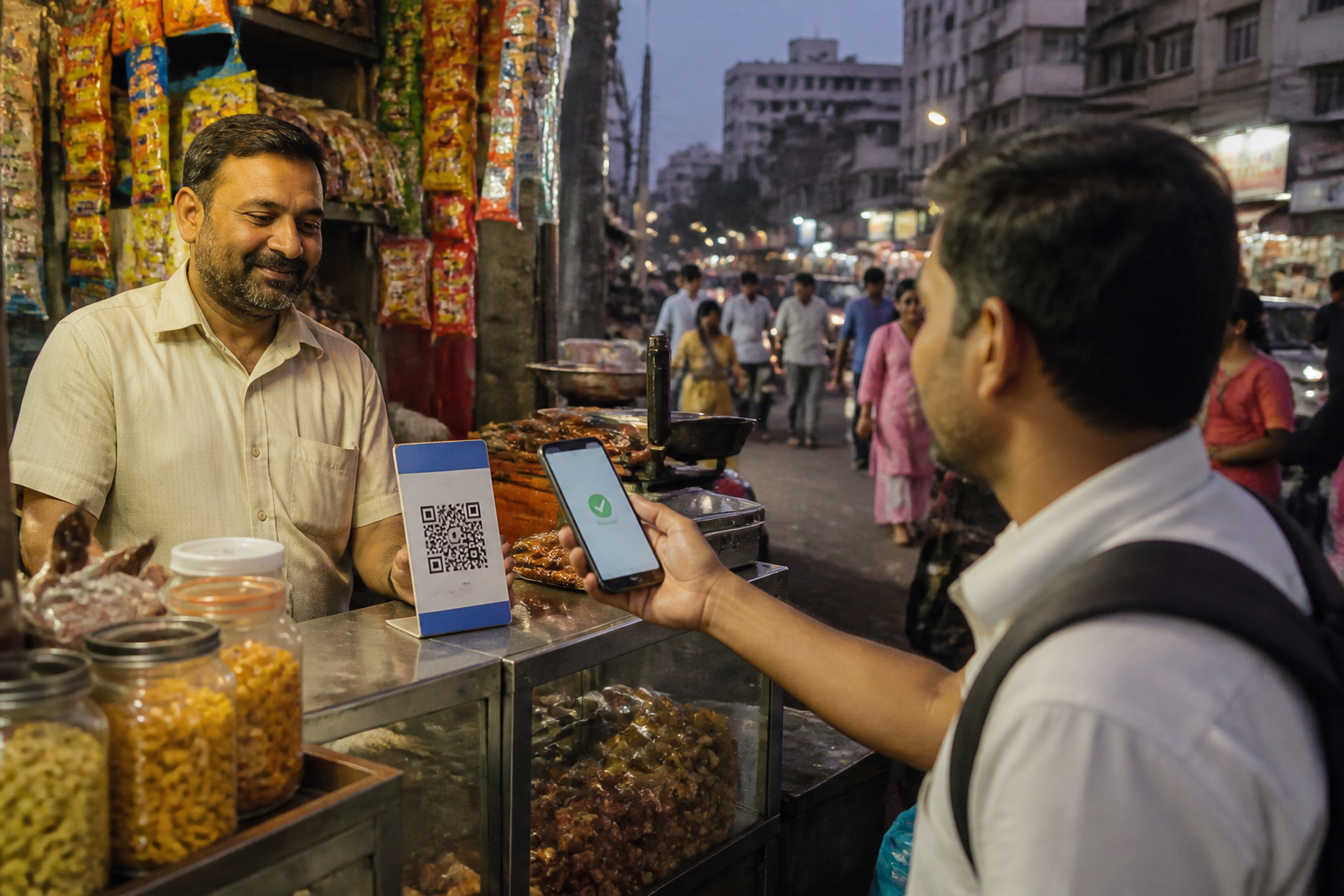
The proposed UPI MDR framework is more than a new fee schedule for merchants. From 15 October 2026, a 0.4% Merchant Discount Rate will apply to eligible person-to-merchant UPI transactions above Rs 2,000, while consumers will continue to pay nothing for using UPI. The change, described in an NPCI FAQ reported by Times of India, attempts to move the payments system towards a more commercially sustainable model without weakening its mass-market appeal.
That distinction matters because UPI now sits inside the everyday operating system of Indian cities. It is used at retail counters, fuel stations, utility offices, educational institutions, transport-linked services and by small vendors who may not have access to formal card-payment infrastructure. The policy therefore raises two connected questions: how can India fund the infrastructure behind a rapidly expanding digital network, and how can it prevent new charges from undermining the small merchants and low-value transactions that made UPI ubiquitous?
The immediate answer in the NPCI framework is to place the cost on eligible merchants rather than consumers. Person-to-person payments will remain free, and consumers will not be charged for scanning a QR code or making a UPI payment. UPI applications will also not be permitted to add a platform fee. The stated objective is to preserve the customer-facing simplicity of UPI while creating a revenue stream within the payments ecosystem.
For ordinary P2M transactions above Rs 2,000, the proposed MDR is 0.4%. A Rs 3,000 payment would therefore generate an MDR of Rs 12, while a Rs 50,000 payment would generate Rs 200, according to the examples in the FAQ. For transactions of Rs 75,000 and above, the charge would be capped at Rs 300. A Rs 1,00,000 payment would thus attract Rs 300 rather than the Rs 400 produced by applying 0.4% without a cap.
The threshold is designed to shield the bulk of routine digital payments. NPCI says transactions up to Rs 2,000 account for more than 95% of UPI P2M transaction volume and will remain outside the charge. The policy also says that merchants cannot pass the MDR on to customers, meaning consumers should continue to pay the listed price. Whether that restriction is consistently observed in the market will depend on implementation and monitoring, but the formal framework places the obligation on the merchant.
The framework is not uniform across all merchants. The FAQ describes a separate P2PM category for small vendors receiving up to Rs 1 lakh per month through UPI QR codes. These merchants will continue to receive zero-MDR treatment, and a payment above Rs 2,000 would not by itself create a charge if the merchant remains within the exempted account classification. The framework says merchants whose inward UPI credits exceed Rs 1 lakh per month for three consecutive months may be moved into the P2M category.
This classification is important for India’s informal and semi-formal retail economy. A street vendor, neighbourhood shopkeeper or small service provider may accept digital payments through a personal or simplified account rather than through a fully acquired commercial merchant account. The stated purpose of P2PM is to prevent processing charges from becoming a barrier to digital acceptance among such businesses. The FAQ also says GST registration will not be required to qualify for zero-MDR protection, with eligibility based instead on collection thresholds and bank-account categorisation.
For cities, the practical question is not simply whether a fee is large or small. It is whether the payment infrastructure remains dependable across thousands of fragmented transactions and small businesses. A QR code at a roadside stall, a payment terminal at a fuel station and a digital bill collection interface at a utility office all depend on banks, payment aggregators, telecommunications networks, servers, fraud monitoring and customer support. The proposed MDR is presented as a way to fund those layers rather than as a consumer charge.
NPCI says revenue from MDR will be distributed within the UPI ecosystem to support infrastructure resilience, innovation, cybersecurity and customer service. The FAQ says the current cost of maintaining UPI operations, including server bandwidth, fraud prevention and bank technical support, is estimated by industry at around Rs 20,000 crore annually. That figure is described in the supplied material as an industry estimate, not as an independently verified official cost statement.
The scale of the system explains why funding has become a policy concern. According to the NPCI figures cited in the report, UPI processed 2,451 crore transactions worth Rs 29.9 lakh crore in August 2026 alone. At that volume, even a short disruption can affect households, merchants and public-facing services. The policy argument is that a system handling this scale cannot rely indefinitely on annual government incentives designed as early-stage support.
The proposed model also tries to avoid imposing the standard percentage charge on sectors where large payments are common but margins or public interest considerations may be different. Railways, telecom services, insurance, fuel and certain utility payments are described as eligible for a flat MDR of Rs 5 for transactions above Rs 2,000. Electricity, municipal water and piped natural gas payments are included in the utility category in the FAQ. Payments below Rs 2,000 remain free under the threshold framework.
This is a significant administrative choice. A percentage-based fee can rise sharply when applied to an annual insurance premium, a large utility bill or a high-value institutional payment. A fixed fee makes the cost more predictable for the receiving organisation. It also recognises that digital payment infrastructure is increasingly used for public and quasi-public collections, where the payment channel is part of service delivery rather than merely a retail convenience.
Educational fee payments are also described as eligible for flat-fee structures or capped processing rates, although the supplied material does not provide a single uniform rate for every educational transaction. Capital-market payments receive a separate rate of 0.02%, capped at Rs 300, covering entities such as mutual funds, stockbrokers and securities dealers. Credit-linked UPI payments, including RuPay credit cards linked to UPI or pre-sanctioned credit lines, are treated under separate credit-product rules rather than the direct account-to-account framework described for ordinary UPI payments.
The proposed dedicated fund for small merchants is another important part of the framework. NPCI says the fund will support digital-payment infrastructure in Tier 3 to Tier 6 centres, the northeastern states, Jammu and Kashmir and Ladakh. In Tier 1 and Tier 2 centres, notified Central government schemes such as PM SVANidhi and PM Vishwakarma may also be included. The fund is intended to assist acquiring banks and payment aggregators with merchant onboarding and to incentivise UPI transactions among small businesses, particularly in rural and semi-urban areas.
However, the fund’s operational design is not yet complete. The FAQ says its detailed framework will be finalised in consultation with the Reserve Bank of India within three months. That leaves several implementation questions open: how eligibility will be measured, how funds will be distributed, which entities will be accountable for onboarding and how the system will prevent merchants from being incorrectly shifted between categories.
The proposed MDR also changes the competitive economics of digital payments. Under a zero-MDR structure, payment companies must depend on other revenue sources or absorb operating costs. NPCI argues that a predictable commercial framework could allow smaller fintech companies to compete with well-capitalised technology groups, because payment processing would no longer require the same level of sustained loss-making. The claim remains a policy rationale rather than a demonstrated outcome, but it identifies the tension at the centre of the reform: charging for infrastructure may improve sustainability while also changing the market structure around UPI.
Cybersecurity is similarly central to the argument. NPCI says MDR revenue can support fraud detection, encryption upgrades and other security investments. The more widely UPI is used for retail, utilities, transport and financial services, the greater the operational consequences of a security failure. Yet the supplied material does not specify how MDR receipts will be ring-fenced, audited or allocated across banks, payment aggregators and other ecosystem participants. Those details will determine whether the fee produces visible improvements in reliability and protection.
The framework therefore protects consumers in formal terms but places new responsibility on merchant classification and enforcement. Customers should not face a UPI usage fee, a platform charge or a separate QR-scanning fee. P2P transfers remain free without a monthly usage quota, and existing QR codes are expected to continue functioning without replacement. At the merchant end, however, the cost depends on account category, monthly collection levels, sectoral classification and transaction value.
The central fact established by the NPCI FAQ is that UPI is moving from a largely subsidy-supported model towards a threshold-based commercial model for selected merchant transactions. The change does not amount to a consumer charge on everyday UPI use, but it does create a new operating cost for eligible businesses. Its urban significance will be measured not only by the 0.4% headline rate, but by the accuracy of merchant classification, the protection of small vendors, the treatment of public-service payments and the transparency of how the resulting revenue strengthens the digital infrastructure on which cities increasingly depend.
The next milestones are the 15 October 2026 implementation date and the proposed consultation with the RBI over the small-merchant fund within three months. Those steps should clarify the operational rules, category definitions and allocation mechanisms that are not fully specified in the current FAQ.
