


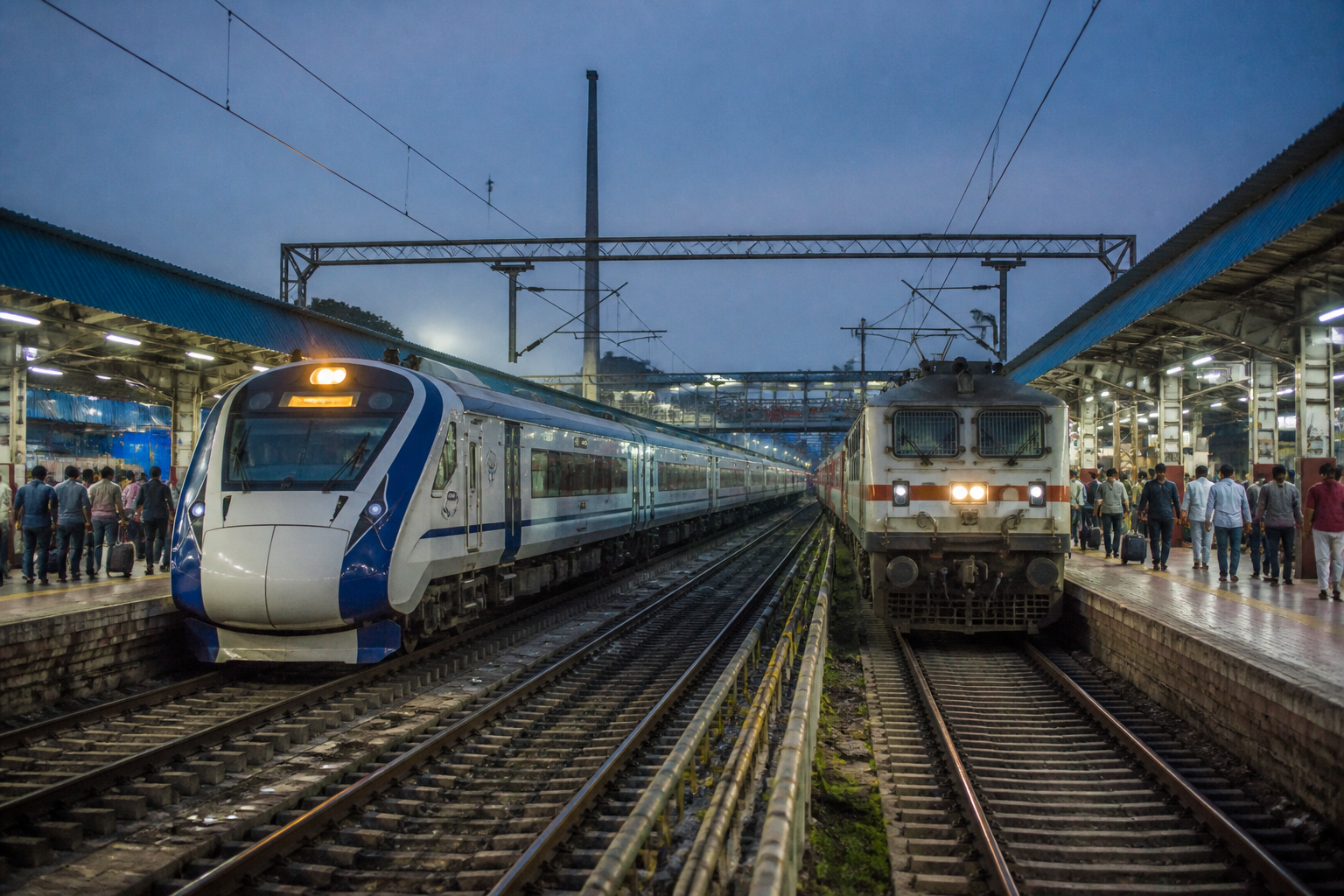
The Vande Bharat vs Rajdhani comparison is no longer simply a contest between a modern daytime train and a traditional overnight service. With the arrival of Vande Bharat sleeper trainsets, Indian Railways is bringing newer propulsion, passenger amenities and sleeping berths into the same market historically dominated by Rajdhani Express. The shift matters because it reflects a broader change in how premium rail travel is being designed: not only around speed, but also around journey time, onboard comfort, technology and the ability to serve different patterns of intercity movement.
Rajdhani Express established the benchmark for premium long-distance rail travel in India when its first service began between New Delhi and Howrah in 1969. It covered roughly 1,450 kilometres in about 17 hours and 20 minutes, linking the national capital with major cities and state capitals. Air-conditioned coaches, faster travel and overnight sleeping berths gave the service a distinctive position within the railway network.
Vande Bharat represents a different phase of railway development. Its first commercial service began on the New Delhi-Varanasi route in February 2019. The train covered approximately 759 kilometres in around eight hours, positioning the service as a faster intercity option for journeys that could be completed during the day. It was initially developed under the name Train 18 before being renamed Vande Bharat.
That difference in operating purpose remains central to the Vande Bharat vs Rajdhani debate. Standard Vande Bharat services are primarily configured with Chair Car and Executive Chair Car accommodation. Passengers receive reclining seats, while Executive Chair Car provides more space and, on some trainsets, seats with 180-degree or 360-degree rotation. These trains are suited to passengers who want to travel between cities without spending a night onboard.
Rajdhani, by contrast, continues to serve the needs of overnight travellers. Its First AC, Second AC and Third AC classes provide sleeping berths, with First AC offering cabins and coupe-style privacy. The distinction is not merely about age or appearance. It reflects two different passenger requirements: a rapid daytime connection and a long-distance journey in which the ability to sleep is part of the service itself.
Vande Bharat sleeper trains are beginning to narrow that distinction. The sleeper trainset described in the report has 16 air-conditioned sleeper coaches, combining the newer trainset format with overnight accommodation. This gives passengers a choice that standard Vande Bharat could not previously provide: travelling in a modern train with sleeping berths rather than choosing between a seated daytime service and an older locomotive-hauled overnight rake.
However, the arrival of the sleeper variant should not be treated as an official replacement programme for Rajdhani. The report notes that Indian Railways has made no official announcement that Vande Bharat sleeper trains will replace Rajdhani services. The immediate significance is therefore competitive and technological, rather than administrative. The two services currently continue to represent different generations and operating models within the same national rail system.
Speed is the most visible area of difference, but maximum speed alone does not determine the time taken by passengers. Vande Bharat trainsets are designed for speeds of up to 160 kilometres per hour, while trial runs have reached 183 kilometres per hour. Rajdhani Express services generally have an operational maximum of about 130 kilometres per hour. Actual journey times depend on route conditions, track quality, speed restrictions, traffic, station stops and the number of scheduled halts.
The more important technological distinction is acceleration. Vande Bharat uses a self-propelled trainset design, with motors distributed through its coaches rather than relying on one separate locomotive to pull the entire rake. This distributed traction arrangement allows the train to accelerate rapidly. According to the supplied report, Vande Bharat can move from zero to 100 kilometres per hour in 52 seconds.
Most Rajdhani services use a locomotive-hauled design, in which power is concentrated in the locomotive at one end of the train. That does not make Rajdhani an inherently slow service. Modern Rajdhani rakes and locomotives can operate at substantial speeds, but the underlying engineering is different. Vande Bharat’s advantage lies in how quickly it can build speed and respond to routes with frequent stops, while Rajdhani’s design has historically supported long-distance overnight travel.
The distinction is important for Indian cities because intercity rail is not a single market. Some journeys connect large urban centres within a working day, making departure time, arrival time and acceleration especially important. Other journeys span distances where passengers value sleeping berths, privacy and the ability to travel overnight. The competing services are therefore shaped by the geography of the railway network and by the time budgets of different passenger groups.
Onboard facilities further show how Indian Railways is attempting to modernise the passenger experience. Vande Bharat services include automatic doors, passenger information systems, CCTV cameras, charging points and bio-vacuum toilets. Their interiors and layouts are visibly newer, but the infrastructure surrounding the train remains equally important to the passenger experience. Platform access, station design, punctuality, catering operations and track capacity all affect whether the promise of a modern train is realised.
Rajdhani services are older as a category, but not every rake is unchanged. Upgraded Tejas Rajdhani rakes can include automatic doors, CCTV, fire and smoke detection systems, improved interiors and bio-vacuum toilets. This complicates any simple comparison in which Vande Bharat represents modernity and Rajdhani represents outdated equipment. The more accurate distinction is between the design philosophy of a newer trainset and the upgrades applied to an established long-distance service.
Catering is another area where the difference is less absolute than the branding suggests. Both services provide food during longer journeys, although menus and service schedules vary by route. Vande Bharat catering may include tea, breakfast, lunch, evening snacks and dinner, with items such as poha, upma, paratha, sandwiches, cutlets, dal, vegetables, paneer, chicken, roti, rice, sweets and beverages. On some services, passengers can choose whether to include food while booking, with the fare adjusted accordingly.
Rajdhani’s longer travel duration generally allows for a broader meal schedule, extending from morning tea and breakfast to lunch, evening snacks and dinner. First AC passengers may receive additional items. These differences show that catering is connected to journey length and ticketing choices rather than only to the name of the train.
The introduction of regenerative braking in the Vande Bharat sleeper variant adds an energy-efficiency dimension to the comparison. Under this system, braking can generate electricity, helping recover energy during operation. The supplied material does not establish the scale of energy savings or provide a comparative performance figure against Rajdhani. What it does establish is that the sleeper variant is being presented as a technological evolution rather than simply a new coach arrangement.
For passengers, the practical choice remains relatively clear. A daytime journey of a few hours, especially between cities served by a fast route, may favour standard Vande Bharat’s seating and acceleration. An overnight journey requiring a berth continues to make Rajdhani a strong option. Vande Bharat sleeper changes that calculation by offering sleeping accommodation in a newer trainset, but its availability remains limited compared with the established Rajdhani network.
The larger policy question is how Indian Railways will manage this transition across its network. The comparison is not only about which train looks newer or reaches a higher top speed. It concerns the allocation of premium services, the upgrading of passenger infrastructure, the availability of sleeper capacity and the balance between daytime intercity mobility and overnight long-distance travel.
The evidence supplied in the report confirms that Vande Bharat has already changed the premium rail conversation through faster acceleration, newer passenger systems and a strong daytime intercity role. The sleeper variant is extending that challenge into Rajdhani’s traditional territory. What remains unsettled is the scale at which sleeper trainsets will be deployed, how their fares and routes will compare in practice, and whether Indian Railways will formally alter the role of Rajdhani. Until those decisions are announced, the two services will continue to compete through different strengths rather than as direct substitutes.

