


New Town Durga Puja is entering a new phase in which public cultural space, institutional access and political visibility are becoming closely intertwined. A report by Anandabazar says three prominent pujas in the planned township are being led, advised or publicly represented by figures associated with the Bharatiya Janata Party, creating an implicit contest over scale, identity and public attention.
The three events are not identical in structure. New Town Sarbojanin, held at City Square near Central Mall, is a puja outside the boundaries of a single residential block. The report says its control has moved from the wife of Debashis Sen, the former head of HIDCO, to Rinku Majumdar, the wife of state minister Dilip Ghosh. Dilip Ghosh is serving as chief adviser, while committee president Lakshmikanta Kar has sought his approval for the event. Majumdar is overseeing the arrangements and secured permission from HIDCO to use the ground, according to the report.
That detail is important because New Town’s public spaces are not simply vacant grounds available for informal use. The township is planned and administered through institutional agencies, and large public gatherings require access, permissions and logistical coordination. The account of the City Square ground therefore places the puja within a wider question: who can organise a city-scale cultural event, on which land, and with what institutional support?
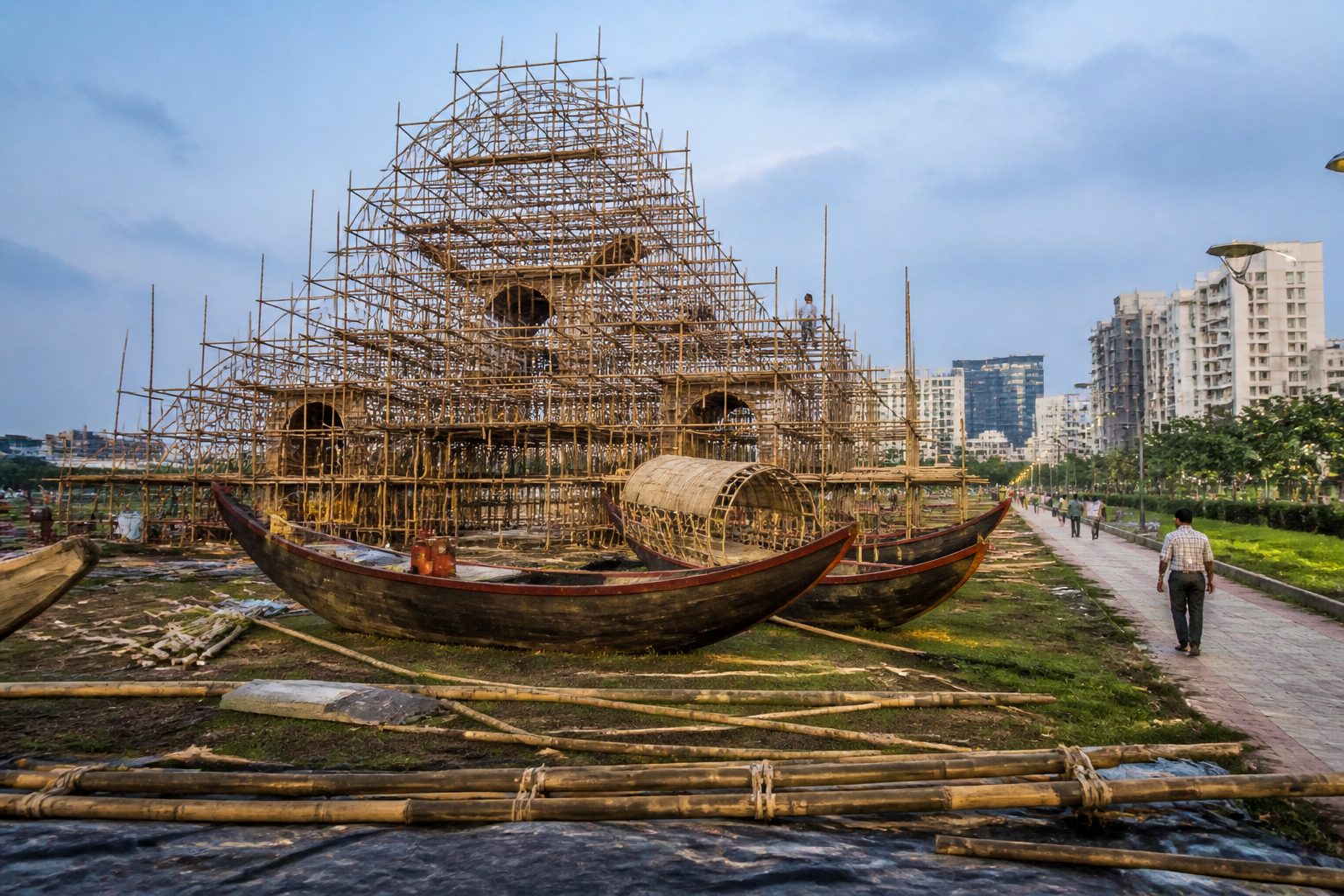
The physical design of the festival also reflects the effort to create a distinct public identity. Boats have been placed in rows across the New Town Sarbojanin ground. Rinku Majumdar told Anandabazar that the theme is “Lotus—Padma Bhushan” and that the boats will represent lotus petals. She did not disclose more details, asking visitors to see the completed mandap during the puja.
The second event, New Town Sanatani Durga Puja, is being held at the New Town Mela Prangan, around 1.25 kilometres from City Square. It began in 2022, when it was inaugurated by Suvendu Adhikari, but was not held in the following two years, the report says. Organiser Barun Biswas claimed that the administration had opposed the puja and that, despite a court ruling in 2024, administrative non-cooperation prevented the event from taking place. He said the organisers did not approach the court again in 2025.
Those claims are attributed to Biswas and are not independently established in the supplied material. They nevertheless point to the administrative vulnerability of public cultural events. A court order, an agency’s permission and the practical cooperation needed to use a public venue can operate as separate layers of access. The report does not provide the court order or the administrative records, so the precise nature of the earlier dispute remains unclear.
This year, the Sanatani puja is presenting itself through a group of high-profile figures. Subrata Gupta, described in the report as the chief adviser to the chief minister, is its public face. Swami Pradiptananda, also known as Kartik Maharaj, is the principal patron, while actor George Baker is the president. Baker was a Bharatiya Janata Party candidate from Howrah in the 2014 Lok Sabha election and was later nominated to the Lok Sabha under the Anglo-Indian quota, according to the report.
The committee denies that it is competing with the other two pujas. Biswas said Gupta was selected because he is a respected New Town resident and that Pradiptananda was chosen for his role in defending Sanatani tradition. He also presented Baker’s presidency as evidence that the puja was open to everyone. The distinction between organisational intent and public perception is central here: a committee may reject the language of competition while its location, leadership and visual presentation place it in direct comparison with neighbouring events.
The third puja is the older DB Block Durga Puja. Its principal organiser for several years has been Anupam Ghosh, a member of the BJP’s state committee and the party’s newly appointed media cell convenor. His wife, Pramita Saha Ghosh, is joint secretary. This year, Ashok Lahiri, described in the report as the vice-chairman of NITI Aayog and a former BJP legislator from Balurghat, has become the chief adviser. Lahiri lives in the DB Block, which does not have a separate puja, and residents of the block largely participate in the DB Block event.
The addition of a prominent adviser changes the visibility of a neighbourhood festival without necessarily changing its underlying social base. Unlike the two larger events at City Square and the Mela Prangan, the DB Block puja is rooted in a residential community. Ghosh told the newspaper that residents participate spontaneously and argued that New Town, like Salt Lake, has not developed a single puja that draws residents from the entire township in the way a city-wide festival might.
That comparison highlights New Town’s fragmented civic geography. The township contains block-level communities as well as larger destinations intended to serve a broader public. Its Durga Puja landscape therefore has two overlapping models: the neighbourhood festival, where residents provide the principal social base, and the large public spectacle, where a venue outside a block can attract attention across the city. The three pujas described in the report sit at different points along that spectrum.
Their themes further reveal how cultural programming is being used to define institutional identity. New Town Sarbojanin is using the lotus as its central motif. New Town Sanatani plans to connect Sanatani tradition with modern science, presenting a journey from figures such as Aryabhata, Kanada and Sushruta to the modern era, along with an account of the origins of the universe. DB Block has chosen the Mahakumbh as its theme, using installations, light and sound to depict the gathering at Prayagraj and the story of the churning of the ocean.
The supplied report does not provide visitor estimates, budgets, security plans, traffic arrangements or details of the permissions issued for the three venues. It is therefore not possible to conclude which puja will attract more people or whether the events will create measurable pressure on New Town’s roads and public facilities. What can be established is that the festivals are being designed as large, differentiated public experiences, with themes and prominent patrons intended to give each committee a distinct profile.
The political dimension is also visible in the way leadership is presented. The source report places the three events within a broader Kolkata pattern in which political leaders have been associated with major pujas and their public appeal. In New Town, that pattern appears in a different urban setting: a planned township with newer residential communities, institutional land agencies and public grounds that sit outside traditional neighbourhood structures.
This makes the issue less about whether one puja defeats another and more about how civic belonging is produced in a new town. In older parts of Kolkata, pujas are embedded in long-standing neighbourhood relationships and familiar street networks. In New Town, public identity is still being assembled across blocks, malls, grounds and institutional spaces. A high-profile puja can become one of the occasions through which residents and visitors decide which parts of the township feel central, accessible and representative.
The report also shows that cultural events can become a channel through which administrative relationships are made visible. HIDCO’s permission for the City Square ground, the earlier dispute over the Mela Prangan event and the association of senior public figures with the committees all connect festival organisation to the functioning of urban institutions. Yet the available material does not establish that any committee received improper assistance or that permissions were granted outside normal procedures. Those questions would require official records, venue agreements and the relevant court documents.
For now, the evidence supports a narrower conclusion. New Town’s Durga Puja is moving beyond the simple model of separate block celebrations. Three events with different organisational histories are using prominent political, administrative, economic and cultural figures to build public visibility. Their competing themes and locations are turning the festival season into a contest over how a planned township represents itself.
The developments that deserve monitoring are practical as much as political: whether the venue permissions are publicly documented, how crowd and traffic management are handled, whether the events remain accessible to residents across communities, and whether the earlier dispute surrounding the Mela Prangan puja is clarified through official records. Until those details emerge, New Town’s festival landscape is best understood as an evolving negotiation between neighbourhood culture, public space and political presence.
