


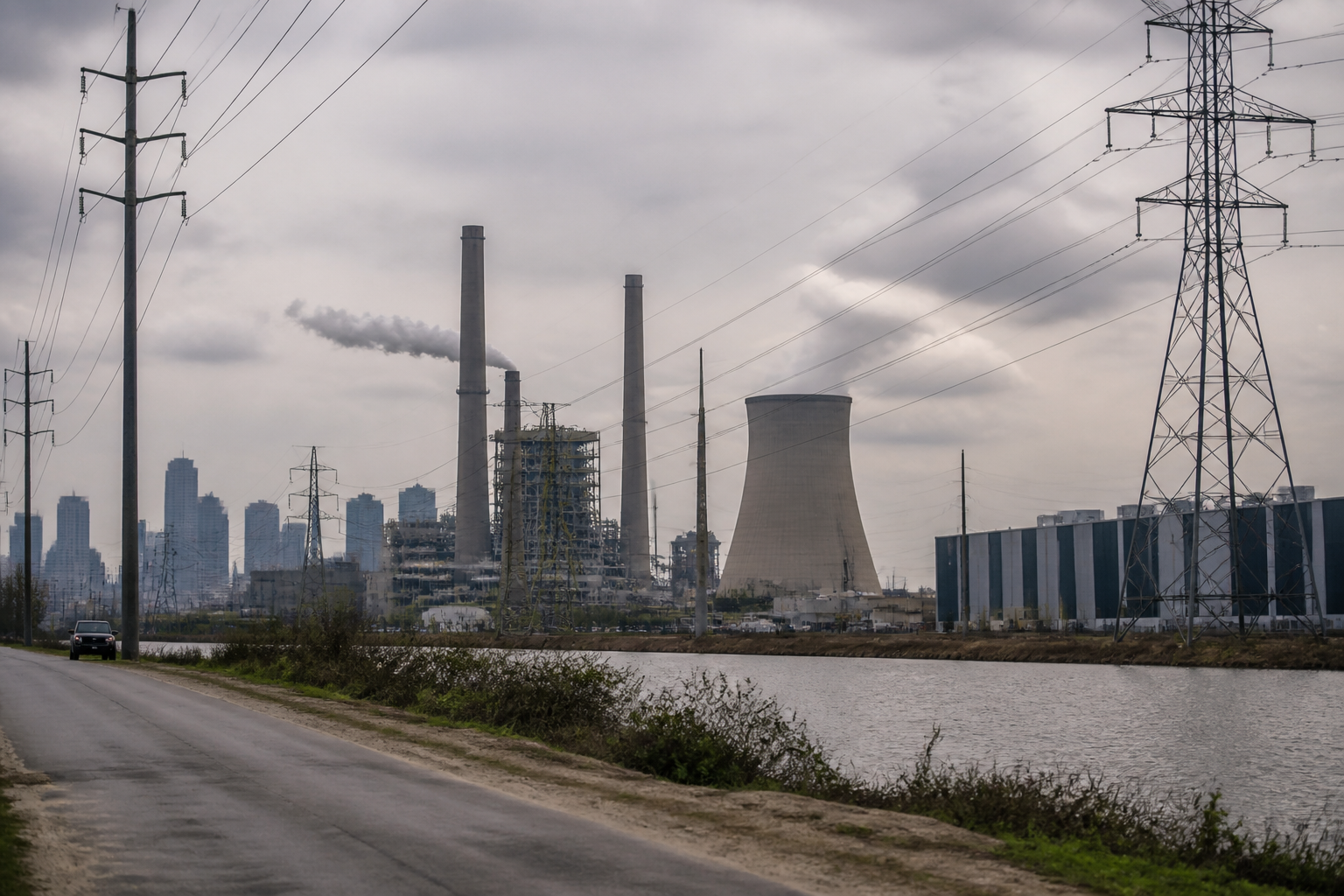
The US Environmental Protection Agency’s decision to repeal carbon-emission limits for coal- and gas-fired power plants is more than a reversal of one climate rule. It is a test of whether the country will meet rapidly rising electricity demand by expanding conventional generation, or by using that demand to accelerate a transition towards lower-emission power.
The announcement, made by EPA Administrator Lee Zeldin on the sidelines of a G20 energy ministers’ gathering in Houston, removes former President Joe Biden’s carbon standards for power plants and proposes withdrawing remaining greenhouse-gas requirements for the sector. The Trump administration says the move will reduce regulatory barriers and make it easier to build generating infrastructure, including capacity needed for energy-intensive artificial intelligence infrastructure.
The decision also exposes a basic tension in power planning. Electricity demand is rising, while the power sector remains one of the largest sources of greenhouse-gas emissions. The administration’s position is that the immediate priority is to expand reliable supply. Environmental and public-health groups argue that weakening emissions rules shifts costs from utilities and generators to communities exposed to heat, storms, wildfires, pollution and other climate-related damage.
That tension is likely to shape the next phase of US energy infrastructure. The question is not simply whether coal and gas plants can remain in operation. It is who will pay for the resulting emissions, how new generation will be regulated and whether the country’s electricity build-out will be designed around short-term capacity requirements or long-term climate risks.
The regulatory reversal
Biden’s carbon-emission rules would have required coal-fired power plants and new natural-gas generators to install equipment capable of capturing emissions before they reached the atmosphere. The rules were designed to reduce greenhouse-gas emissions by 1 billion metric tonnes by 2047, according to the supplied report. They also made zero-emission alternatives such as solar and wind more attractive by increasing the compliance burden on fossil-fuel generation.
The new EPA proposal challenges the legal foundation of those requirements. The agency says it does not have authority under the Clean Air Act to regulate greenhouse-gas emissions from the power sector. Alongside repealing the existing standards, it has proposed rescinding remaining greenhouse-gas requirements to prevent future climate-focused regulations from targeting power plants.
This makes the announcement broader than a change in compliance deadlines or technical standards. It seeks to narrow the federal government’s ability to regulate carbon emissions from the electricity sector in the future. Utilities would therefore face a different regulatory landscape at the federal level, even though state-level emissions rules would continue to apply in some jurisdictions.
The legal and administrative question is central because power plants operate within overlapping systems of federal and state regulation. The EPA’s action addresses federal carbon rules, but the supplied report notes that utilities still face emissions-reduction requirements in different states. The result will not be a uniform national framework. Instead, generators could operate under different emissions expectations depending on the state in which they are located.
The infrastructure argument
The administration has presented the repeal as an infrastructure measure. Zeldin said that preventing future federal regulation of greenhouse-gas emissions would enable the United States to build the generating infrastructure required to meet “skyrocketing electricity demand”. He described the policy as an effort to cut red tape and support new power-generating capacity.
The reference to AI infrastructure gives the policy a current technology dimension. Artificial intelligence facilities require large amounts of electricity, and their expansion has intensified the debate about how quickly the US can add generation and grid capacity. In the administration’s framing, delaying or making fossil-fuel generation more expensive could restrict the electricity supply needed for new industrial and digital infrastructure.
But the supplied evidence does not establish that repealing carbon standards alone will resolve the power sector’s capacity challenge. The announcement concerns emissions regulation, while the broader demand problem also involves generation construction, transmission, grid connections and the timing of new supply. The report identifies the administration’s stated need for more generating infrastructure but does not provide a forecast of how much additional capacity AI facilities will require or how quickly it can be built.
That distinction matters for urban and regional planning. Large energy-consuming facilities are not separate from the places around them. They require land, grid connections, water and supporting infrastructure, while new power plants and transmission lines affect nearby communities. A policy that accelerates generation construction can therefore influence industrial development and local infrastructure decisions even when its immediate legal subject is emissions regulation.
The cost dispute
The strongest disagreement between the administration and its critics concerns how the costs of the repeal should be measured. Zeldin said the proposal would save the industry $370 million in direct compliance costs. That figure represents the burden that power companies would avoid by no longer having to meet the carbon-capture-based standards.
The Biden EPA, by contrast, estimated that its rule would produce $370 billion in net benefits. The supplied report says the earlier rule was expected to reduce 1 billion metric tonnes of greenhouse-gas emissions by 2047. Its benefits calculation therefore included avoided climate and health damage, rather than only the direct cost of installing or operating compliance equipment.
Environmental and public-health advocates argue that the new EPA approach effectively treats those wider damages as negligible. Dena Adler of the Institute for Policy Integrity said the agency had ignored earlier estimates based on uncertainty. Maggie Coulter of the Center for Biological Diversity’s Climate Law Institute linked the rollback to risks from heatwaves, storms and wildfires.
The disagreement is not merely about two competing numbers. It reflects two different accounting systems. One counts the immediate cost to utilities of complying with emissions rules. The other counts the potential damage avoided when emissions are reduced. The first approach makes deregulation appear as a saving to the electricity industry. The second treats emissions as a liability whose costs may be experienced by households, public agencies and communities rather than recorded on a power company’s balance sheet.
The source material does not establish which estimate will ultimately prevail in legal or administrative review. It does, however, show that the economic case for the policy depends on whether climate and public-health effects are included in the calculation. That accounting choice will influence future regulatory decisions as much as the technology used by power plants.
Coal’s uncertain return
The rollback is also intended to support coal-fired electricity, which has been declining in the United States because cheaper natural gas and renewable energy have become more available. Under Secretary of Energy Kyle Haustveit said the new rules would lift up coal-fired electricity and described coal as reliable, affordable and secure.
The supplied report does not indicate that the repeal will reverse the market conditions that have driven coal’s decline. Removing a federal carbon requirement may reduce one barrier, but coal plants still compete with natural gas and renewable energy on cost and availability. The Edison Electric Institute, representing the country’s largest investor-owned utilities, welcomed the repeal of the carbon-capture and storage standards but said it would continue working with the EPA to ensure regulatory certainty.
That response is significant because utilities must make long-term infrastructure decisions. Power plants, transmission networks and other energy assets require substantial capital and operate over many years. Regulatory uncertainty can affect whether companies invest in new capacity, extend the life of existing plants or shift towards other generation sources. The industry’s support for repeal, combined with its call for certainty, suggests that the regulatory framework remains as important as the removal of any single rule.
The state-federal divide
The proposed federal rollback will not eliminate all emissions regulation from the US power sector. Utilities remain subject to rules in different states, according to the supplied report. This creates a fragmented policy environment in which federal deregulation and state-level climate requirements can operate simultaneously.
For utilities, that may mean different compliance obligations across their operating territories. For state governments, it preserves a role in setting emissions expectations even as the federal government retreats from sector-wide carbon regulation. For communities, the practical effect will depend on the plants operating nearby, the applicable state rules and whether new generation is built under federal or state approval processes.
The fragmented framework could also complicate infrastructure planning. Electricity markets and transmission systems cross state boundaries, while emissions rules may not. The source does not provide details on how the competing requirements will be resolved, but it establishes that the repeal will not produce a single regulatory outcome across the country.
The wider urban question
The debate over US power plants is ultimately a debate about the physical systems that support cities, industries and households. Reliable electricity is required for transport networks, buildings, data infrastructure, hospitals, water systems and communications. At the same time, the production of electricity affects air quality, climate exposure and the cost of protecting communities from extreme events.
The administration’s case prioritises faster power expansion and lower direct compliance costs. Its critics focus on public-health and environmental damages that may accumulate over time. Neither side disputes that the United States needs infrastructure capable of meeting electricity demand. The disagreement is over the standards that should govern that expansion and the costs that should be counted before new capacity is approved.
What the evidence currently confirms is that the EPA has initiated a major federal shift: existing carbon limits for coal- and gas-fired plants are being repealed, future federal greenhouse-gas regulation of the sector is being challenged, and the administration is linking the move to energy security and AI-driven electricity demand. What remains unresolved is how the proposal will interact with state rules, whether utilities will invest in coal capacity, how the legal challenge to federal authority will proceed and how public-health and climate damages will be valued.
Those questions will determine whether the policy becomes a durable framework for US power infrastructure or another stage in the country’s repeated changes of direction on climate regulation.
