


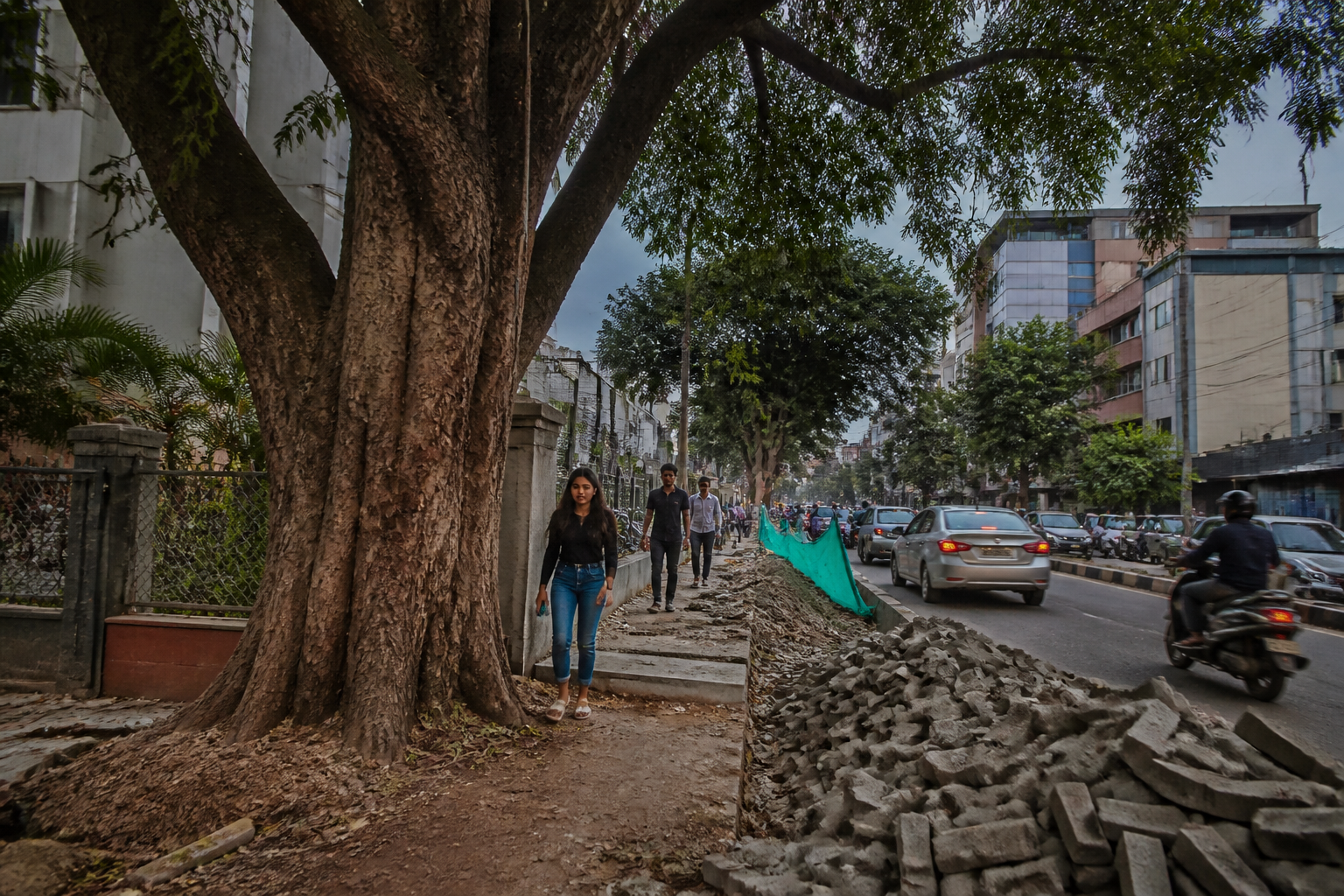
Bengaluru’s tree-cutting controversy is no longer limited to isolated disputes between residents and property owners. Reports of two trees allegedly poisoned in Vijayanagar, a contested tree-felling incident in Indiranagar and the overnight removal of three established trees in HRBR Layout point to a wider problem: permissions and enforcement are not necessarily producing protection on the ground.
The latest concerns, reported by Bangalore Mirror, connect the loss of trees to another everyday failure in the city’s built environment. In Indiranagar, residents allege that construction material has been dumped on footpaths, pushing pedestrians onto the road. The two issues appear different administratively—one involves the Forest Department and tree officers, while the other concerns civic engineers and construction-site enforcement—but they share a common feature. Public space and environmental assets are being treated as matters to be cleared or permitted without adequate supervision.
That distinction matters because Bengaluru’s green cover and pedestrian network are managed through different institutional channels, yet residents experience them as part of the same urban system. A tree that is removed to facilitate vehicle parking changes the street’s shade, stormwater absorption and visual character. A footpath occupied by construction debris changes how people move and exposes them to traffic. In both cases, the formal process may exist, but the public outcome depends on whether officials monitor compliance after permission or regulation is issued.
The Indiranagar incident illustrates the gap between a limited permission and what residents fear can become a much larger intervention. According to the report, a property owner applied to the Forest Department to trim four branches of a tree next to the property. The Tree Officer and Deputy Conservator of Forests granted permission because the branches were allegedly obstructing vehicle parking. Residents and environmentalists, however, allege that a large tree was felled or excessively cut during the operation.
The available account does not establish the precise extent of the work carried out, whether the permission conditions were breached, or whether an official inspection followed the operation. Those unanswered questions are central to the dispute. A permission to trim branches is not the same as authorisation to remove a tree, and the difference can only be enforced when the work is observed, recorded and checked against the approved scope.
Sneha Nandihal of I Change Indiranagar called for a designated BBMP official to be physically present during every tree-trimming operation. Her demand identifies an institutional weakness: the authority that grants or oversees permission may not be present when contractors or property owners act at the site. Without a documented before-and-after record, including the approved number of branches, the condition of the tree and the identity of the people carrying out the work, residents have limited ability to challenge an operation after it is complete.
Environmental and urban strategist Vinod Jacob argued that permissions are being treated as licences to fell trees and called for investigation, penalties and enforcement by the Forest Department. His claim is an allegation, not an established finding in the report, but it raises a question that applies beyond one neighbourhood: what mechanism verifies that a permission has been used only for the purpose for which it was granted?
The report places the Indiranagar dispute alongside two trees allegedly poisoned in Vijayanagar and the earlier removal of three established trees in HRBR Layout. In the HRBR Layout case, residents reportedly protested after the trees were removed overnight, and the Forest Department registered an FIR. The report does not state the outcome of that investigation. The existence of an FIR demonstrates that enforcement action was initiated in that case, but it does not by itself establish who was responsible or whether prosecution followed.
The sequence is significant because it shows the different forms that alleged tree loss can take. One case concerns suspected poisoning, another concerns a permission to trim branches, and the HRBR Layout incident involved alleged unauthorised overnight felling. These cases cannot be treated as identical. They require different evidence, including site inspection, tree records, permission documents, contractor details, photographs, witness accounts and, where relevant, forensic examination. But they all test whether Bengaluru’s tree-protection system can identify violations quickly enough to prevent permanent loss.
The institutional arrangement also creates room for uncertainty. The Forest Department and its officers are involved in permissions and enforcement relating to trees, while the BBMP and its associated civic bodies manage roads, footpaths and construction-related public-space violations. Residents therefore have to navigate more than one authority when a single street-level incident involves a tree, a building site, a parking demand and pedestrian movement.
That fragmentation becomes more consequential when enforcement is complaint-driven. A resident may report tree cutting after the work has already been completed or alert officials only after construction debris has blocked a footpath for weeks. In such cases, the system is responding to damage rather than preventing it. The report does not provide data on the number of complaints, inspections, permissions or prosecutions in Bengaluru, so it cannot establish the scale of the problem across the city. It does, however, show how residents perceive repeated incidents as evidence of weak enforcement.
The footpath dispute in Indiranagar adds a second layer to the same governance question. Residents allege that construction material from a building being developed on Krishna Temple Road has occupied the footpath, forcing pedestrians to walk on the road. They also allege that Bengaluru Central City Corporation engineers treat street vendors differently from politically influential property owners when clearing encroachments. These are serious allegations, and the report does not include a response from the engineers, the property owner or the political figure named by residents.
The absence of an official response leaves important facts unresolved. It is not clear whether the construction site had been issued a notice, whether the material was stored within an approved boundary, whether a penalty had been imposed, or whether the BCCC had inspected the location. Those details would determine whether the problem was non-compliance by the site, delayed enforcement by the civic body, or both.
The pedestrian consequences are more immediate. When a footpath is blocked, the burden is shifted from the construction site to people walking. They must negotiate traffic, parked vehicles and road edges, while older people, children and people with disabilities face greater difficulty. This is not merely a question of visual clutter or inconvenience. A footpath is part of the city’s mobility infrastructure, and its obstruction changes the risk profile of the street.
The same logic applies to trees. A tree is not only an object standing on private or public land. It occupies a position in the street network, provides shade to pedestrians and influences the local environment. The report does not quantify the ecological value of the affected trees or establish their age, species or canopy area. That information would be necessary for a full assessment. What is clear is that replacement cannot automatically recreate the benefits of an established tree, particularly when removal is linked to parking or construction activity.
Bengaluru’s current disputes therefore reveal a problem of implementation rather than simply a lack of rules. The city appears to have formal channels for tree-cutting permissions, complaints, FIRs and footpath enforcement. The contested point is whether those channels are sufficiently transparent and supervised at the moment when a tree is cut or a public walkway is occupied.
A stronger enforcement record would require facts that are not included in the current report: how many tree-trimming permissions were issued, how many involved physical inspections, how many violations were recorded, how many FIRs led to charges, and how quickly footpath encroachment complaints were resolved. Without those measures, residents and officials are left arguing from individual incidents and perceptions of unequal enforcement.
For now, the available evidence confirms a pattern of conflict across Indiranagar, Vijayanagar and HRBR Layout, but it does not establish a citywide rate of illegal tree loss or prove a nexus between contractors and elected representatives’ offices. Those claims require independent investigation. The immediate administrative tests are more specific: whether the Indiranagar tree was cut beyond the approved permission, whether the alleged poisoning in Vijayanagar is investigated, what happened after the HRBR Layout FIR, and whether the BCCC clears the Krishna Temple Road footpath.
These cases deserve monitoring because they sit at the intersection of environmental protection, parking pressure, construction regulation and pedestrian safety. Bengaluru’s urban challenge is not only how to create new infrastructure, but how to ensure that routine permissions and everyday enforcement do not steadily remove the natural and public assets that make neighbourhoods usable. The next step is for the relevant authorities to disclose the inspection findings, enforcement actions and timelines for each case.
