


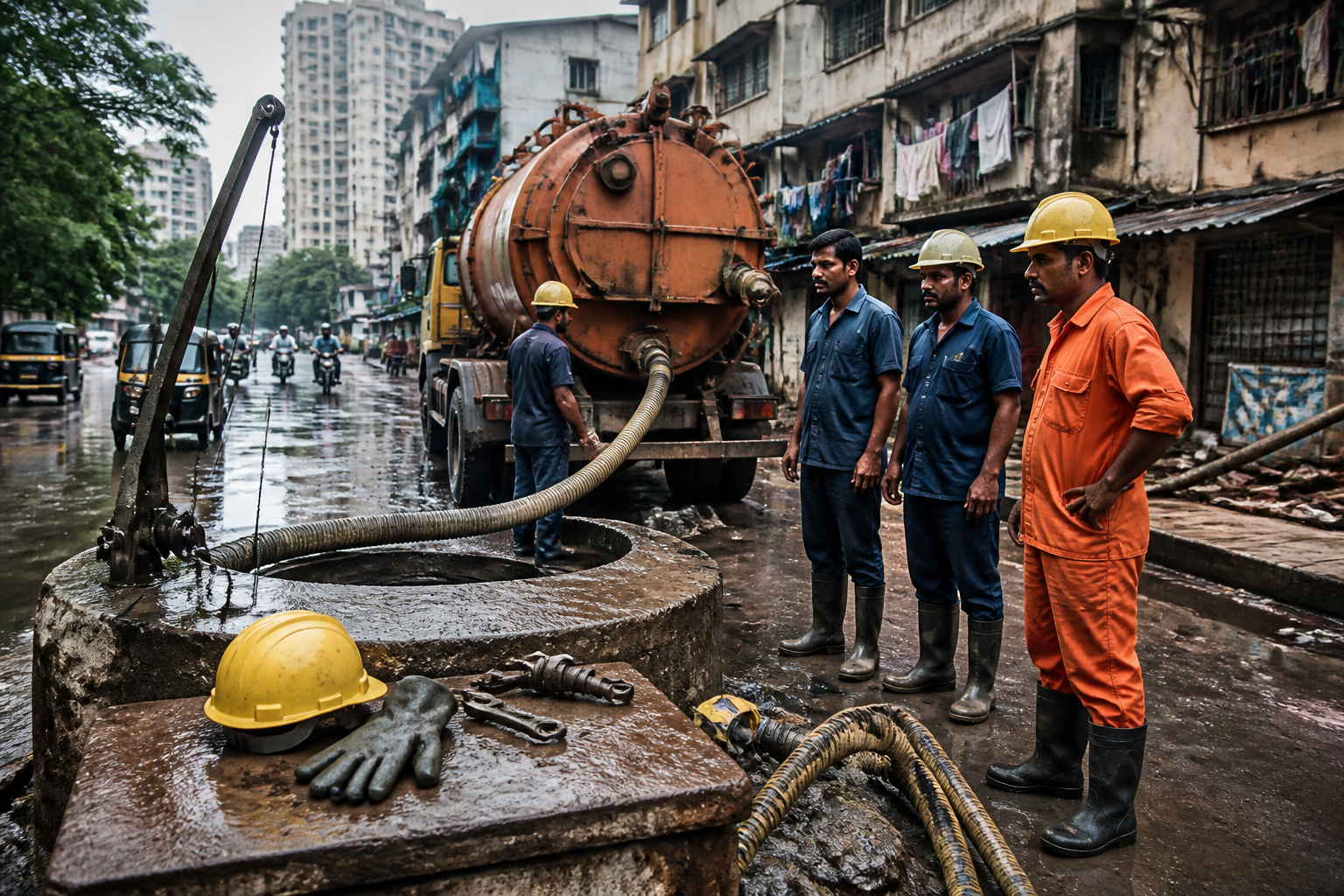
The continuing deaths of sanitation workers in Mumbai’s extended urban region, followed by years of waiting for statutory compensation, expose a gap between India’s legal ban on manual scavenging and the way sanitation services still operate on the ground. Workers continue to enter septic tanks, sewers and sewage plants without safety equipment because informal and contract-based work remains available while enforcement, identification and rehabilitation remain uncertain.
The cases reported from Uran, Panvel, Powai and Govandi show that the issue is not limited to a single unsafe worksite. It involves contractors, housing societies, suction-truck operators, municipal and state authorities, police procedures and compensation rules. For families who lose a breadwinner, the legal promise of relief often becomes another administrative process, even after courts have clarified that the state cannot simply shift responsibility to a private employer.
Arjun Chauhan, a contract worker from Panvel, has been entering septic tanks and sewers for 15 to 20 years. He told the Times of India that he is aware that the work is supposed to be done by machines and that protective gear is mandatory. Yet when contractors, buildings or housing societies call, he accepts the job. His reported daily earnings range from Rs 700 to Rs 1,000 from a contractor and Rs 1,500 to Rs 2,000 from other clients.
That dependence on daily wages is central to understanding why the ban has not ended the practice. A prohibition changes the legal status of the work, but it does not by itself remove the demand for low-cost cleaning or provide workers with a reliable alternative livelihood. In the absence of effective mechanisation and enforcement, the most dangerous part of sanitation work can remain invisible until a worker dies.
The National Commission for Safai Karamcharis recorded 332 sanitation-worker deaths in 18 states and Union territories during hazardous cleaning of sewers and septic tanks between January 1, 2021 and June 30, 2026, according to the report. Maharashtra recorded the highest number, with 58 deaths. At the same time, data tabled by the state in July 2025 showed zero deaths in Mumbai between 2021 and 2024, a figure activists disputed.
The conflicting numbers point to a basic governance problem: the scale of hazardous sanitation work depends on how authorities define, identify and record it. If a worker is hired through a private contractor, a housing society or a suction-truck owner, the incident can fall into a fragmented chain of responsibility. The family may know who employed the worker, but that does not necessarily translate into a prompt police case, a recognised workplace death or automatic payment of compensation.
The deaths of Chandan Jaiswar, 22, and Vikas Kisan Tak, 33, in Uran illustrate that chain. The two entered a septic tank to rescue another worker who had collapsed. An FIR was lodged against the contractor, the suction-truck owner and one of the homeowners, according to the report. Jaiswar’s father, Ratanlal, was still awaiting compensation after his son’s death in December 2024. Tak’s widow, Archana, and other members of the family were working as domestic workers to pay rent after losing the household’s main earner.
The families’ circumstances also show why compensation is not merely a post-incident payment. It is linked to housing security, education, migration and the ability to exit hazardous work. Tak had worked as a driver-cleaner on a suction truck and also cleaned septic tanks, earning Rs 17,000 a month, mostly in cash. His widow said her immediate priority was ensuring that their five-year-old son completed his education.
In Powai, Akshay Mandal, 23, and Fulchand Kumar Saw, 29, died in November 2025 while cleaning a sewage plant. Mandal’s family received Rs 10 lakh from the contractor on humanitarian grounds but was still awaiting the statutory compensation. In Govandi, the widows of three workers who died while cleaning a tank in 2019 received Rs 10 lakh each nearly seven years later, while the balance remained pending.
These cases reveal a recurring distinction between ex gratia assistance and statutory compensation. A payment made voluntarily by a contractor may offer immediate relief, but it does not replace the amount mandated by law or the rehabilitation obligations attached to a worker’s death. When families must negotiate separately with contractors, employers and public authorities, the system places the burden of proving entitlement on people who are already dealing with loss, insecure work and limited institutional access.
The legal position has also evolved. In 2023, the Supreme Court raised compensation for sewer and septic-tank deaths to Rs 30 lakh and directed governments to provide rehabilitation, including employment for the next of kin and education for children. The reported cases show that the enhanced amount has not consistently reached families in a timely manner.
A further complication arose in Maharashtra from government resolutions issued in 2019 and 2025. In the Jaiswar and Tak matter, the state argued that because the workers had been engaged by a private contractor, compensation should be recovered from the employer. The Bombay High Court, however, held in August that the state must pay the compensation even where workers are privately engaged and can recover the amount from the employers later. It struck down Item 11 of the two government resolutions, which required private societies or contractors to pay instead of the state.
That ruling addresses an important administrative question: whether the state’s obligation depends on the formal identity of the employer. In a sanitation system built around contractors, building societies and private operators, transferring the first responsibility for compensation to the state can prevent families from being trapped in prolonged disputes over contractual arrangements. The state can pursue recovery separately, but the family’s access to relief is not made conditional on that process.
The case also highlights the difference between outsourcing a service and outsourcing accountability. Private agencies may perform cleaning work, but public authorities remain responsible for ensuring that sanitation is carried out safely and legally. Housing societies and contractors may be the immediate employers or clients, yet the wider system is governed by public rules on occupational safety, mechanisation, police registration, compensation and rehabilitation.
The continuing presence of workers like Chauhan suggests that mechanisation is not only a technology question. Machines must be available, affordable and used for the kinds of tanks and sewer systems found across the urban region. Buildings, societies and contractors must also be prevented from treating manual entry as the quickest or cheapest option. Where equipment is unavailable or poorly maintained, the ban can exist on paper while the work continues through informal arrangements.
The reporting also raises questions about how Mumbai’s sanitation infrastructure is planned and maintained. Septic tanks, sewage plants and sewer networks operate across municipal boundaries and through multiple forms of ownership. A worker may be called by a contractor for a private building, a chawl, a sewage plant or a suction-truck operation. This fragmented geography makes it difficult to build a single, reliable record of hazardous cleaning and deaths unless authorities coordinate across local bodies, police departments, contractors and labour agencies.
The data dispute around Mumbai is therefore significant beyond the numbers themselves. A recorded total of zero deaths between 2021 and 2024 cannot be assessed without knowing how incidents were identified, what categories were used and whether deaths involving private facilities were included. Activists’ challenge to the figure and the national commission’s wider count indicate that official absence of recorded deaths should not automatically be treated as evidence that hazardous work has ended.
The government’s position that a survey found no manual scavengers in India also reflects a definitional challenge. Workers may not describe themselves as manual scavengers, particularly when they are hired as contract labourers, drivers, cleaners or sanitation workers. Yet the practical danger remains if they enter a confined space to clean human waste without protective equipment or mechanical support. The legal label and the working condition can diverge.
The compensation system cannot resolve that divergence on its own. Timely payment can protect families after a death, but prevention requires identification of hazardous tasks, enforcement against unsafe entry, functioning equipment, transparent contractor records and rehabilitation that includes employment and education. The Supreme Court’s directions encompass several of these elements, while the reported delays suggest that implementation remains uneven.
For Mumbai and its surrounding urban areas, the larger question is whether sanitation will be treated as essential infrastructure or as low-visibility work that can be pushed down the contracting chain. The answer affects not only workers but also residents, housing societies and local authorities that depend on reliable waste and wastewater systems. A city cannot claim that hazardous cleaning has ended solely because the practice is prohibited.
The evidence in the reported cases confirms three unresolved problems: workers continue to enter dangerous spaces for income, families wait for compensation that courts have already defined, and official records do not command universal confidence. The Bombay High Court’s ruling may simplify responsibility for payment, but its practical effect will depend on whether authorities release compensation promptly and pursue recovery separately. The next test is whether legal protection becomes visible at the worksite, before another worker is asked to climb into a tank.

