


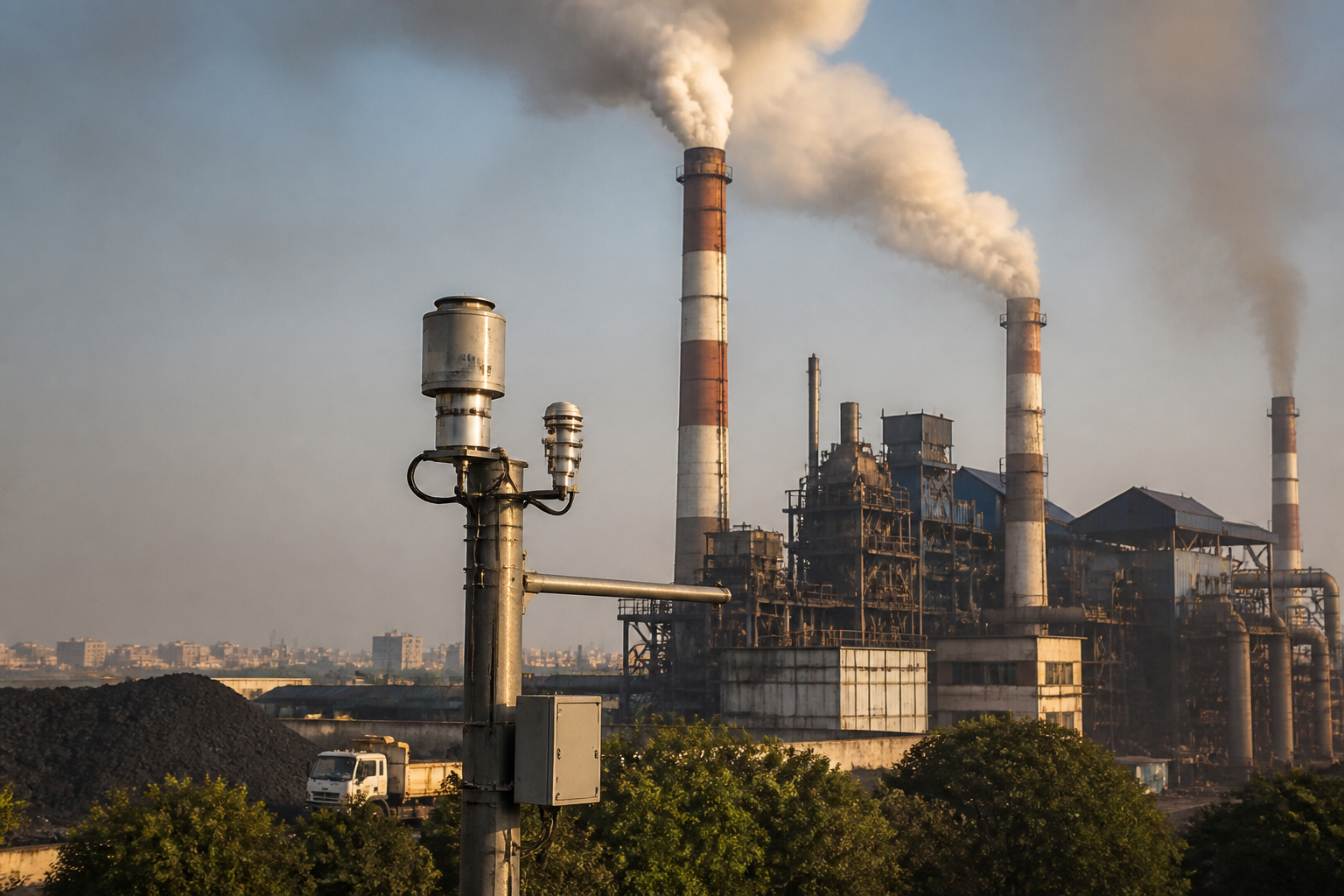
An emissions trading scheme developed in Gujarat is gaining international attention after Rio de Janeiro signed a letter of intent to examine adapting it for industrial particulate pollution. For Delhi-NCR, where winter air pollution repeatedly exposes the limits of inspections, penalties and temporary restrictions, the Gujarat experiment offers a different regulatory proposition: make industries compete to reduce emissions while allowing them flexibility over how they comply.
The model began with a question that Indian regulators, engineers and economists had been examining for nearly 15 years: could factories be persuaded to cut pollution without treating every breach as a potential shutdown? The answer emerging from Gujarat is not that regulation can be removed, but that it can be redesigned around a fixed pollution cap, tradable permits and measurable performance.
Under the emissions trading scheme, regulators establish a maximum pollution limit for an industrial cluster and divide that limit into permits. A factory that cuts emissions beyond its target can sell surplus permits to another plant for which pollution reduction is more difficult or expensive. The arrangement preserves an overall cap while giving individual factories more than one route to compliance.
That structure differs from the conventional approach described in the report, in which industrial pollution control has largely depended on periodic inspections and shutdown notices when plants exceed emission limits. Conventional regulation can identify violations and impose penalties, but it may offer little flexibility to factories facing different technologies, costs or operating conditions. The Gujarat model attempts to use those differences rather than ignore them.
The first major test took place in Surat in 2019, through work involving researchers affiliated with the Energy Policy Institute at the University of Chicago and J-PAL, along with the Gujarat Pollution Control Board. The pilot covered 162 of Gujarat’s 317 large coal-burning industrial plants. The remaining plants continued under conventional regulation, creating a comparison between the two systems.
The results reported from the randomised trial were significant. Participating plants reduced particulate emissions by 20% to 30% and lowered pollution-control costs by 11%. Compliance reached 99%, compared with roughly two-thirds under conventional regulation. Researchers estimated that the benefits exceeded the costs by at least 25 times.
The reported emissions figures show how the reduction worked at plant level. A typical plant under the conventional system emitted around 1,300 kilograms of particulate matter a month. Similar industries operating under the emissions trading scheme reduced that figure to roughly 900 to 1,000 kilograms. The reduction continued across all 10 compliance periods during the nearly two-year study, which ran from April 2019 to 2021.
The duration of the result matters because it distinguishes the experiment from a short-term compliance drive. The reduction was reported across repeated monitoring periods rather than only immediately after an inspection or enforcement action. At the same time, the evidence in the report relates to the participating industrial plants and the particulate pollution covered by the Surat pilot. It does not establish that the same percentage reduction would automatically apply across Delhi-NCR’s wider air-pollution system.
That distinction is central to any discussion of Delhi. The Gujarat experiment was conducted in an industrial cluster with a defined group of large coal-burning plants. Delhi-NCR’s pollution challenge, as the report notes, is more complex than Surat’s industrial cluster. The region’s air-quality problem involves multiple sectors and recurring episodes, while the experiment tested a specific regulatory arrangement for industrial particulate emissions.
The Gujarat experience therefore offers Delhi a regulatory idea, not a ready-made transplant. Its relevance lies in the institutional mechanism: setting a measurable limit, tracking plant-level performance and allowing trading within that limit. Whether such a framework could operate across a more complex regional airshed would depend on the design of the cap, the quality of monitoring, the authority responsible for enforcement and the sectors included. The supplied evidence does not establish how those questions would be resolved for Delhi-NCR.
The political economy of compliance is another important part of the experiment. Kaushik Deb, executive director of the Emissions Market Accelerator, said the initial reaction from industrial units was to question why another form of regulation was necessary. The scheme was designed, he said, so that there were no losers. The report also quotes Deb as saying that only one industrial closure occurred under the system in seven years.
That account points to the difference between formal regulation and regulation that industries can realistically implement. A factory may be required to reduce emissions, but the cost and technical difficulty of doing so can vary from plant to plant. A trading system creates a financial value for reductions achieved more efficiently and gives plants facing higher abatement costs an alternative route to meet the overall target. The intended result is not permission to pollute without limit; it is flexibility within a fixed ceiling.
For regulators, this changes the administrative task. Instead of relying mainly on episodic inspections and individual shutdown decisions, the system requires reliable emissions measurement, permit allocation, compliance periods and a functioning market. The reported 99% compliance rate suggests that the Surat pilot was able to support those processes among the participating plants. But the report does not provide the technical details of the monitoring system, the permit price or the institutional arrangements required to scale the model.
The programme has since expanded beyond the original experiment. According to the report, it now covers a population of nearly 300 million across the country and is being extended to sulphur dioxide and wastewater pollution. This expansion suggests that the underlying approach is being considered for pollutants and sectors beyond the particulate emissions covered in Surat. It also raises a question about whether a model that works for a defined industrial cluster can retain the same clarity when applied across different pollutants, jurisdictions and regulatory capacities.
Its international movement has been accelerated by visibility outside India. The programme became an Earthshot Prize finalist in 2025, after which its proponents said conversations expanded beyond India. Rio de Janeiro has now signed a letter of intent to examine adapting the approach to its own pollution challenges. If implemented, Rio would become South America’s first emissions trading system for industrial particulate pollution, according to the report.
The proposed international adoption is still at the examination stage. A letter of intent is not an operating scheme, and the report does not say that Rio has approved a final system, set a pollution cap or begun trading permits. That distinction is important because the success of any emissions market depends on implementation details. The Gujarat results provide evidence from one experiment, while Rio’s interest indicates that the problem of designing effective industrial pollution regulation is shared across cities and countries.
For Delhi-NCR, the strongest lesson is therefore institutional rather than technological. The Gujarat model treats cleaner production as a potential economic advantage for firms instead of only as a cost imposed by regulators. That may help reduce the conflict between pollution control and industrial activity, particularly in regions where enforcement is often experienced as a sequence of inspections, penalties and restrictions.
But the model also places greater demands on public institutions. A credible system would require an enforceable regional cap, consistent measurement and transparent administration. Without those foundations, trading could become a transfer of paperwork rather than a reduction in pollution. The supplied evidence confirms that the Surat pilot produced lower emissions, lower pollution-control costs and higher reported compliance. It does not establish whether Delhi-NCR currently has the institutional framework needed to reproduce those results.
The broader urban question is whether cities should regulate pollution only by punishing plants that exceed limits or also by creating incentives for industries to reduce emissions in the most efficient way available to them. Gujarat’s experiment suggests that a market-based framework can produce measurable reductions within a defined industrial cluster. Delhi’s challenge is to determine whether that evidence can inform a much larger and more complicated regional pollution system without losing the monitoring and accountability that made the pilot meaningful.
The developments to monitor are the model’s expansion to sulphur dioxide and wastewater pollution, the continuing spread of the programme across India and Rio de Janeiro’s examination of an industrial particulate emissions market. Those steps will show whether the Gujarat experiment remains a successful cluster-level intervention or develops into a broader regulatory framework for cities facing persistent industrial pollution.
