


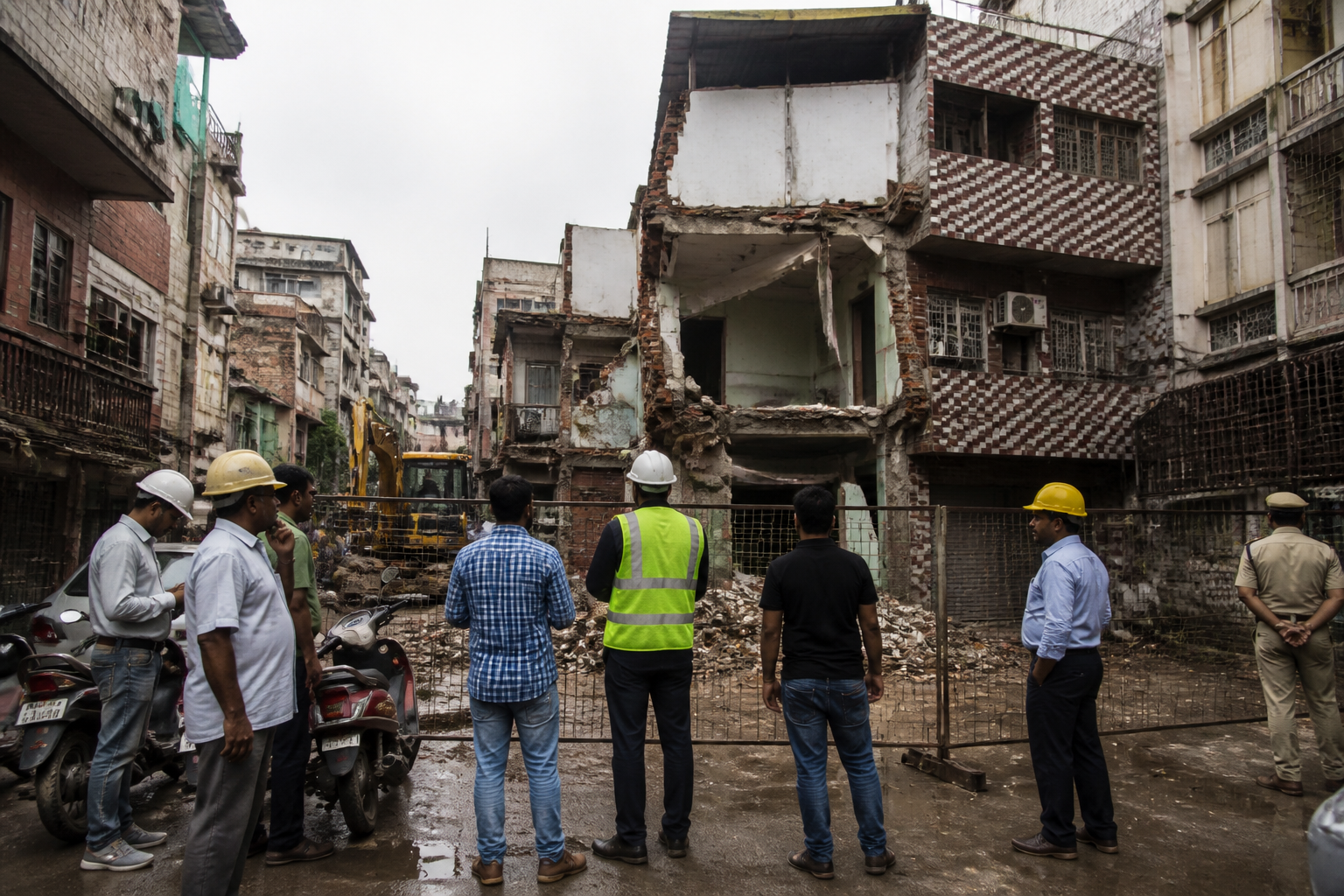
Delhi’s building safety drive has expanded sharply after the collapse of a PG building in Satya Niketan killed seven people, but the figures released by the municipal corporation also reveal a deeper governance problem: dangerous and unauthorised construction is being identified at scale only after enforcement has intensified. Between 1 September and the Sunday covered in the report, the Municipal Corporation of Delhi said it had demolished 213 buildings and sealed 109 properties across its 12 zones.
The immediate trigger was the Satya Niketan incident on 6 September. The collapse placed renewed attention on buildings used for paying guest accommodation and on structures that may have been altered beyond their sanctioned plans. Since then, MCD teams have continued demolition and sealing operations in areas including Bijwasan, Dilshad Colony, Dilshad Garden and parts of Old Delhi. The corporation also reported the demolition of 33 unauthorised buildings and sealing of five properties on the Saturday before the latest action.
These numbers are significant not simply because they record enforcement activity, but because they show how municipal building safety is often experienced as a campaign rather than as a continuous administrative process. A demolition drive is visible and immediate. Preventive inspection, maintenance records, occupancy monitoring and action against unauthorised alterations are less visible, but they determine whether an unsafe building is identified before residents are placed at risk.
The MCD’s survey of PG buildings provides the clearest indication of the scale and structure of the issue. According to the report, the corporation has identified approximately 2,114 buildings operating PG facilities, with capacity for more than 43,000 residents. Four buildings were found to be in dangerous condition and are to be demolished. The four are located mainly in three southern Delhi zones and one in the Keshavpuram zone.
The survey also found that 221 PG buildings require repairs. Of these, 170 need minor or limited repairs, while 51 require more extensive work. The distinction matters because building safety does not divide neatly between structures that must be demolished and those that are safe. A building requiring substantial repair can remain a risk if the repair is delayed, poorly executed or not followed by inspection. The report, however, does not provide details on repair deadlines, compliance monitoring or the responsibility of owners and operators for completing the work.
The survey is therefore more than an exercise in counting PG properties. It is an attempt to create a database for a type of urban accommodation that can be difficult to track through conventional property records. The reported capacity of more than 43,000 residents indicates that PG accommodation is not a marginal use of buildings. It forms part of Delhi’s housing and rental ecosystem, particularly in areas where residents seek flexible or shared accommodation.
At the same time, the available figures do not establish how many PG buildings operate with valid permissions, how many have undergone structural assessments, or how many residents are living in buildings where the sanctioned use differs from actual occupancy. Those gaps are important because the risk described in the report is not limited to visibly abandoned or structurally weak buildings. It also includes unauthorised construction, additional floors, alterations to the original building structure and construction that does not match the approved plan.
MCD officials said that several properties came to light during the action where construction had been carried out without permission. In some cases, additional floors had been built or the original structure had been modified. The corporation said notices were issued in such cases, while serious violations led to demolition or sealing. This indicates that enforcement is operating through multiple legal and administrative stages, but the report does not specify how cases are categorised, how owners can respond to notices, or how residents are protected when a property is sealed or demolished.
That institutional detail is central to understanding the safety question. A building may be unsafe because of its original design, subsequent additions, changed use, poor maintenance or a combination of these factors. Each cause can involve a different responsibility: the owner, occupier, builder, operator, approving authority or enforcement agency. Without a transparent record of the violation and the corrective action required, demolition figures alone cannot show whether the system is reducing risk or merely clearing the most visible cases after a crisis.
The MCD’s reported action across all 12 zones suggests an effort to make the response citywide rather than confine it to Satya Niketan. The locations mentioned in the report span different parts of Delhi and include both established neighbourhoods and areas with mixed-use development. That spread reinforces the point that building safety is not a problem confined to one neighbourhood or one category of property.
However, a citywide enforcement campaign also raises questions about administrative capacity. The same municipal system must identify unsafe buildings, issue notices, conduct inspections, maintain property records, coordinate demolition or sealing, monitor repairs and communicate with occupants. The report does not provide the number of inspection teams, the number of properties assessed beyond PG buildings, or the time available for follow-up. It therefore confirms the scale of reported action but does not establish whether the corporation has the capacity to sustain inspections after the current drive loses visibility.
The PG survey could become useful only if it moves beyond identification. A database can help the corporation map buildings, occupancy and risk, but its public value depends on how often it is updated and whether it records the status of notices, repairs, structural assessments and compliance. The report says the database is being created, but it does not state whether residents, owners or other public agencies will be able to access any part of it.
The figures also show why enforcement cannot be separated from housing conditions. If more than 43,000 people are accommodated in the identified PG buildings, sealing or demolishing unsafe properties may create immediate displacement for residents. The source report does not mention any relocation mechanism, alternative accommodation arrangement or procedure for informing occupants. That omission does not invalidate the enforcement action, but it highlights a practical issue: building safety measures affect not only property owners but also tenants and paying guests who may have limited knowledge of permissions, structural condition or legal status.
The MCD’s position, as reported, is that there will be no concession for dangerous and unauthorised buildings and that any structure considered a threat to people will be demolished. This establishes the corporation’s enforcement stance. The next test is whether the same administrative attention is applied to repairs, preventive inspections and follow-up action. The report identifies 221 buildings needing repairs, but it does not provide a completion rate or a monitoring schedule.
The Satya Niketan collapse has therefore produced two parallel developments. One is the visible enforcement response: 213 demolitions and 109 sealed properties in 13 days, according to the MCD figures cited by the report. The other is an attempt to improve information about PG buildings, including their location, capacity and condition. The second development is potentially more important for prevention, but it remains at the survey and database stage in the supplied evidence.
What the available information confirms is that Delhi’s building safety challenge includes both unauthorised construction and the management of buildings whose use or physical form may have changed over time. It also confirms that a large number of properties are being assessed through a campaign that began after a fatal collapse. What remains unclear is how many risks were known before the incident, how quickly repair orders will be completed, how residents will be protected during enforcement, and whether the survey will become a permanent compliance system.
The immediate official next steps are the continuation of action against dangerous and unauthorised buildings and the completion of the PG-building survey and database. The effectiveness of the response will depend on whether those steps produce sustained inspection, documented repair and transparent follow-up across all 12 MCD zones, rather than only a short-term rise in demolitions and sealing actions.
