


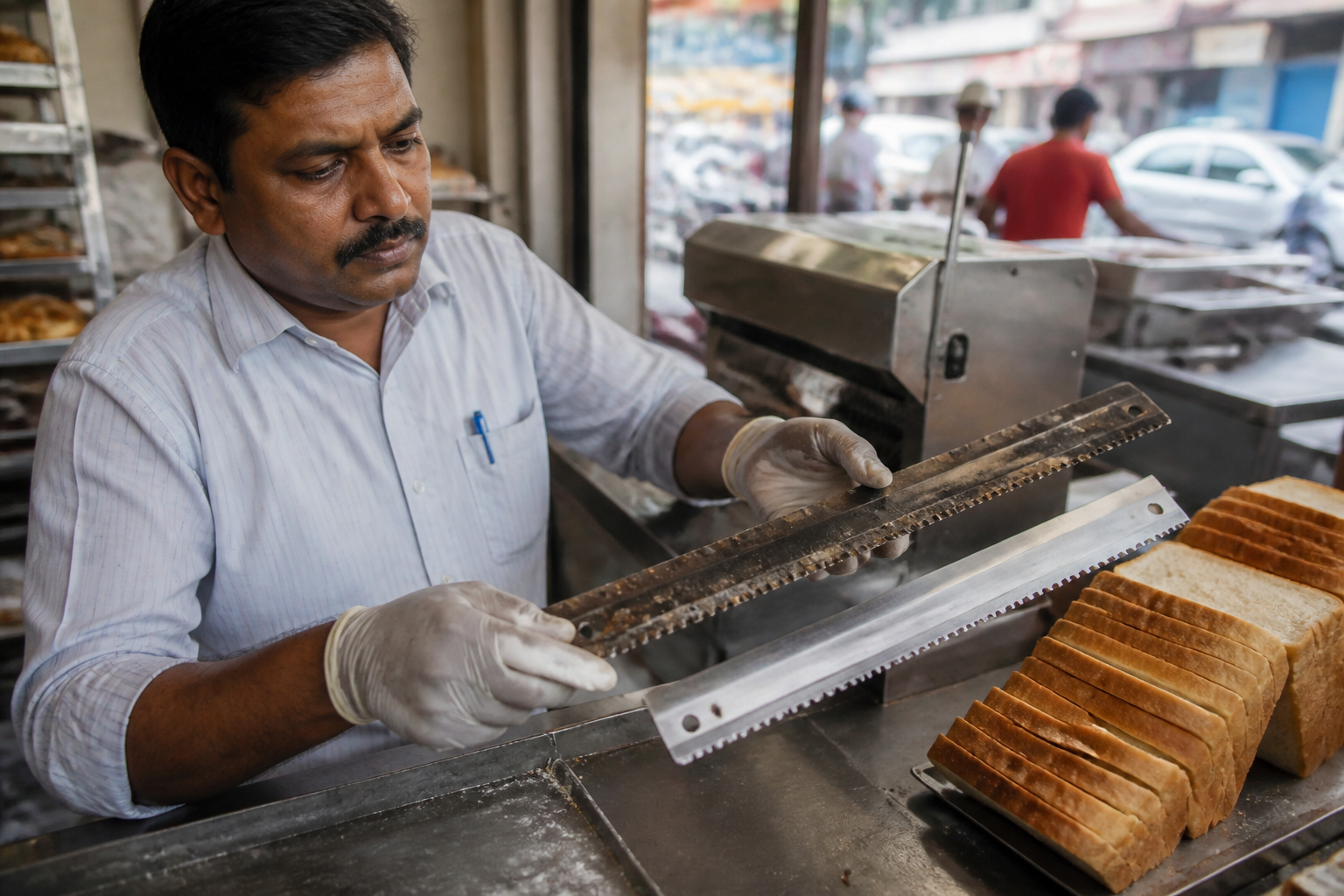
The Food Safety and Standards Authority of India’s advisory against rusted, corroded, painted, chipped or damaged knives and blades has turned an apparently minor question about bread-slicing equipment into a wider test of India’s food-safety enforcement. The advisory followed a five-year campaign by Hyderabad-based food safety activist Anirudh Gupta, who documented the use of unsuitable food-contact tools and pursued the matter through representations, Right to Information applications, photographs and official correspondence.
The reported action is significant because it addresses an everyday point of contact between urban residents and the food system: the tool used to cut, slice or handle food before it reaches the consumer. Bread shops, bakeries, street-food vendors and other food businesses routinely depend on knives and blades, but the condition of those tools is often treated as an operational detail rather than a regulatory concern. The FSSAI advisory brings that detail into the formal food-safety conversation by identifying damaged equipment as a possible source of physical, chemical and microbiological contamination.
The episode also shows how a regulatory issue can remain unresolved for years before it receives a national response. According to the report, Gupta began questioning the use of what he described as “rusted, corroded and unsuitable” blades five years ago. His campaign later expanded into a public effort involving social-media outreach, surveys of street-food markets and a news conference in April 2024. He compiled nearly 100 pages of photographs, correspondence and official records and submitted the dossier to the Prime Minister’s Office and Union ministries.
That sequence matters because food-safety enforcement often begins with a visible problem but depends on documentation before it can move through institutions. Photographs, RTI responses, representations and official records converted a complaint about individual blades into a question for the national regulator. The reported meeting with the FSSAI chief executive in May, followed by the advisory on June 15, marked the point at which the issue moved from advocacy into formal regulatory guidance.
The FSSAI bread-blade advisory is therefore more than a warning about rust. It establishes a basic principle: equipment that comes into contact with food must be suitable for that purpose and maintained in a condition that does not create contamination risks. The categories listed in the advisory—rusted, corroded, painted, chipped or damaged tools—also indicate that the problem is not limited to one type of defect. A tool may be unsafe because it can shed material, carry contaminants or introduce foreign particles into food.
What the advisory does not establish, based on the reported material, is a detailed national standard for every food-contact knife or blade. Gupta said the advisory was an important foundation but argued that a notification, clearer standards and effective enforcement would make the response stronger. His criticism points to the difference between identifying an unsafe practice and creating an implementable compliance system.
That distinction is central to how regulation works in India’s food economy. A broad advisory can communicate a safety expectation across food businesses, but enforcement requires officials and operators to interpret that expectation consistently. Businesses need to know what equipment is acceptable, how damage should be assessed, when a blade must be replaced and what records or procedures may be expected during inspection. Inspectors, in turn, need a clear basis for determining whether a tool is merely worn or presents a food-safety violation.
The reported concerns from the bread industry reflect this implementation question. The All India Bread Manufacturers Association was contacted but did not respond, according to the report. Its concerns over the implications for businesses suggest that the advisory may affect routine operations and equipment management in commercial bakeries. The available material does not specify the industry’s objections, the cost of compliance or whether the regulator has issued separate technical guidance for large and small businesses.
That absence of detail is important. India’s food businesses operate at very different scales, from organised bread manufacturers to small shops and street vendors. A national direction that applies to all food businesses must eventually be translated into procedures that can be understood and followed across that range. Without clarity, enforcement may become uneven: some businesses could replace equipment promptly, while others may remain uncertain about what the advisory requires or wait until an inspection raises the issue.
The urban dimension is especially visible in street-food markets, where the activist reportedly conducted surveys in April 2024. Urban food systems are made up of thousands of small transactions taking place across markets, neighbourhood shops and informal vending areas. A food-contact tool may appear insignificant when viewed individually, but the same practice repeated across many outlets becomes a public-management issue. The challenge for regulators is not only to issue guidance but also to reach dispersed businesses operating in crowded and highly varied urban environments.
The case also exposes a familiar institutional pattern: responsibility may be distributed across central regulators, state departments, local enforcement machinery and food businesses. The FSSAI can issue national guidance, but the practical effect of that guidance depends on how it is communicated, inspected and acted upon at the local level. The supplied report does not specify which authorities will conduct follow-up inspections, how compliance will be measured or whether states and municipalities have been given implementation instructions.
That gap between national direction and local execution deserves attention. Food safety is experienced locally, at a bakery counter, market stall or shop, even when the applicable guidance comes from a national regulator. If local enforcement systems lack adequate inspection capacity, clear checklists or procedures for documenting violations, an advisory may remain largely informational. Conversely, if enforcement is carried out without clear standards, businesses may face inconsistent interpretations.
The campaign’s five-year duration further raises questions about how regulatory systems receive and process citizen evidence. Gupta’s dossier reportedly included photographs, correspondence and official records, while his representations continued through multiple departments before the FSSAI acted. The material does not establish why the issue took five years to reach an advisory, but the timeline indicates that a visible safety concern did not automatically produce a rapid institutional response.
This is where the episode has value beyond the condition of bread-slicing blades. It shows the importance of traceable complaints and documentary escalation in areas where routine inspections may not capture every risk. It also raises a broader question about whether regulators systematically track repeated complaints about equipment, hygiene and food-contact practices, or whether action depends on individual campaigns that sustain pressure over time.
The evidence currently confirms three things. First, the FSSAI has issued a nationwide advisory covering several categories of damaged food-contact knives and blades. Second, the advisory followed a documented campaign by a Hyderabad activist that included field surveys, photographs, RTI applications and submissions to government bodies. Third, the regulator’s action has not ended the policy debate, because questions remain about standards, enforcement and its implications for bread businesses.
What remains unclear is equally important. The supplied report does not provide the full text of the advisory, a compliance deadline, penalties, inspection data or the number of businesses affected. It also does not establish whether authorities have begun a coordinated enforcement programme or whether state and local agencies have issued follow-up instructions. These are the details that will determine whether the advisory changes practices on the ground.
The next stage, therefore, is not simply wider awareness of rusty blades. It is the conversion of a national warning into a workable system of standards, inspection and accountability. The FSSAI’s advisory has brought a small but consequential part of urban food infrastructure under scrutiny. Its lasting significance will depend on whether the institutions responsible for food safety can make that scrutiny routine rather than campaign-driven.
