


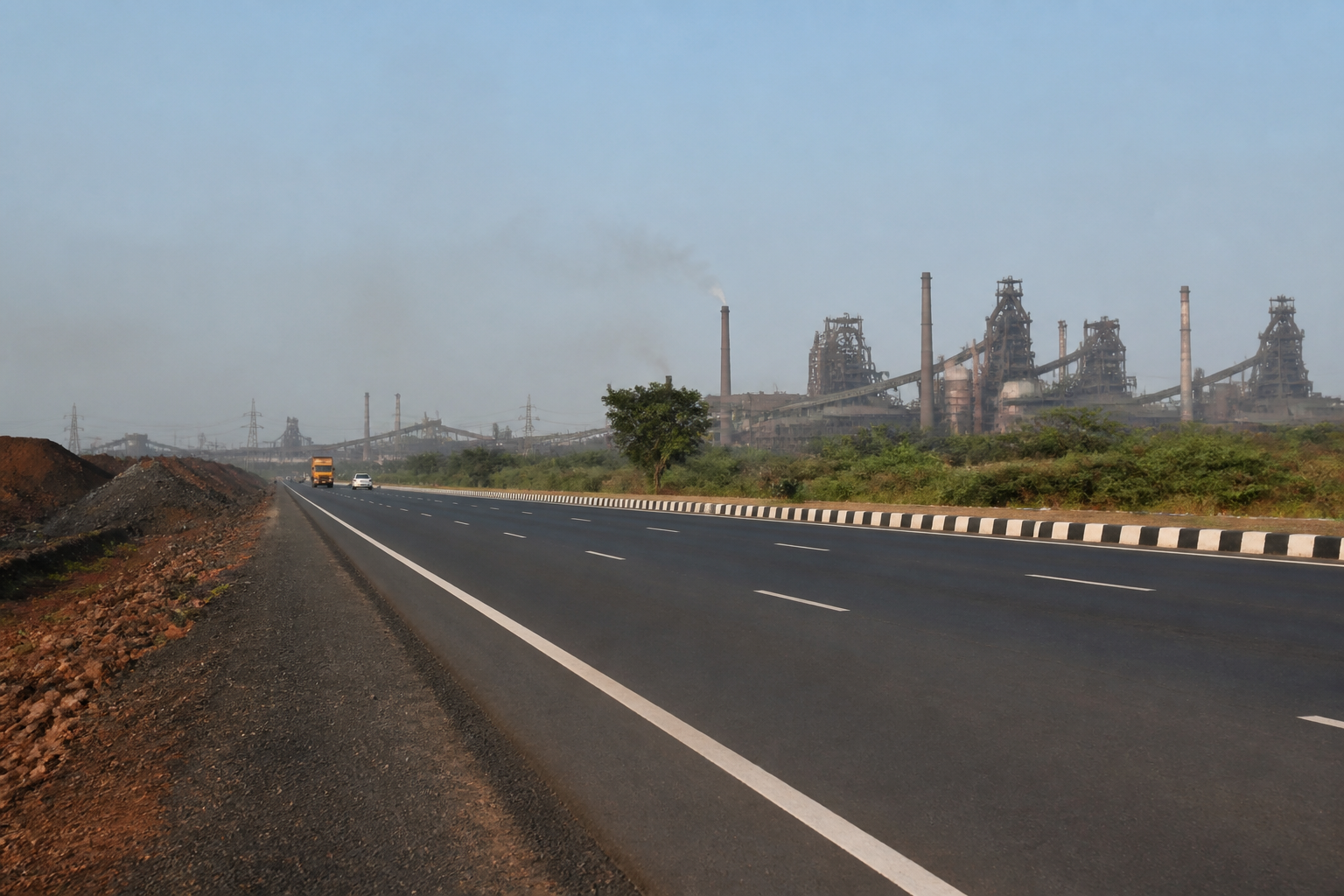
Jindal Steel’s 1.85-km steel slag road in Raigarh, Chhattisgarh, has entered the Guinness World Records, but the more consequential development is its attempt to move an industrial by-product into the centre of India’s infrastructure supply chain. Built with around 2 lakh tonnes of processed steel slag aggregates, the four-lane road offers a working example of how road construction could reduce its dependence on freshly quarried natural materials.
The road was constructed by Jindal Steel Limited in collaboration with the CSIR-Central Road Research Institute (CSIR-CRRI). According to a company statement reported by Business Standard, the project is the longest road built exclusively with processed steel slag aggregates. The recognition gives visibility to a material that is usually treated as a waste stream from steel manufacturing, while also placing the project within the government’s broader emphasis on circular economy practices and waste-to-wealth models.
That distinction matters because road building depends heavily on a steady supply of aggregates. Conventional road construction uses large volumes of stone and other natural materials, which require quarrying, processing and transport. The Raigarh project does not eliminate the need for engineering, processing or quality control, but it demonstrates that a substantial industrial by-product can be converted into a construction input for a major piece of public-facing infrastructure.
Steel slag is generated during the production of steel. In the Raigarh project, the material was processed before being used as aggregate. The supplied report does not provide the detailed treatment process, testing standards or life-cycle assessment for the road, but it identifies the central technical intervention: material that would otherwise require disposal was prepared for use in a four-lane road.
Naveen Jindal, chairman of Jindal Steel Limited and president of the Indian Steel Association, described the project as evidence that science, technology and industry can convert industrial co-products into resources for nation-building. He also linked the initiative to innovation, environmental protection and the government’s focus on a circular economy.
Jitendra Singh, Minister of Science and Technology, said the road demonstrated India’s ability to translate scientific innovation into practical infrastructure solutions. His statement positioned the project not simply as a company-led construction achievement, but as an example of how domestic research and industrial capacity could address a material challenge in the built environment.
The economic case presented for steel slag roads is significant. The report says such roads can be 30 to 40 per cent more cost-effective than roads using traditional construction materials and can last up to three times longer than standard bitumen roads. If these claims are sustained across different road conditions and project types, the implications would extend beyond material substitution. Longer service life could reduce the frequency of repairs and lower the maintenance burden on road agencies.
However, the available information does not establish whether the reported cost and durability advantages apply uniformly across all steel slag road projects. Road performance depends on factors such as the quality and processing of the slag, pavement design, drainage, traffic loads, weather and construction practices. The Raigarh road is therefore best understood as a prominent demonstration project, rather than conclusive proof that steel slag can replace conventional aggregates in every setting.
The report states that steel slag roads are suitable for diverse climatic conditions, ranging from coastal regions to rugged terrain. That claim points to the issue that will determine whether the material can be adopted at scale: performance must be demonstrated across the wide range of environments in which Indian roads are built. A material that works in one industrial region must also meet engineering and operational requirements in areas with different rainfall patterns, soil conditions, traffic volumes and temperature ranges.
The scale of the potential waste stream is already large and is expected to grow. Steel slag generation is projected to reach 60 million tonnes in the next few years as Indian steel plants expand capacity, with the country targeting steel production of 300 million tonnes by 2030-31. This creates both an infrastructure opportunity and an administrative challenge. As steel production rises, the volume of slag requiring productive use or responsible management will also increase.
The Raigarh road uses around 2 lakh tonnes of processed slag, a substantial quantity for one project but a small share of the projected national generation. That gap illustrates why a successful demonstration alone cannot create a circular material system. Larger adoption would require reliable processing capacity, consistent quality specifications, procurement rules, testing protocols and road agencies willing to incorporate alternative aggregates into project design.
The institutional structure described in the report is already beginning to take shape. The steel ministry is promoting steel slag road technology and is collaborating with the Ministry of Science and Technology and the Ministry of Road Transport and Highways. This cross-ministerial involvement is important because the issue sits between industrial production, scientific validation and public works procurement.
Each institution has a different role. Steel producers generate and process the material. Research organisations such as CSIR-CRRI can support testing, engineering assessment and technical standards. The science and technology system can help move laboratory or pilot innovations towards practical applications. The road transport ministry and road-building agencies ultimately influence whether the material is specified, accepted and monitored in public infrastructure projects.
This division of responsibility also means that scale-up cannot depend only on individual corporate initiatives. If processed steel slag is to become a recognised construction input, its use must be supported by transparent specifications and performance evidence that public agencies can rely on. The supplied report does not detail the current national standards, approval procedures or procurement rules governing such use, leaving those mechanisms as an important part of the policy landscape still to be examined.
The project also changes the way infrastructure materials can be understood. Roads are usually discussed through the lens of connectivity, traffic capacity and construction expenditure. Their material base receives less public attention, even though the demand for aggregates links road expansion to quarrying, transport logistics and environmental management. The Raigarh example brings that upstream system into view.
There is a second urban and regional dimension. Steel plants and large industrial facilities generate concentrated waste streams, while roads require continuous supplies of construction material. Using processed slag near production centres could potentially shorten the distance between waste generation and material use, although the available report does not provide transport data or quantify any resulting emissions reduction. Whether this advantage exists in practice would depend on the location of road projects, processing facilities and aggregate markets.
The road’s Guinness recognition may help attract attention, but records do not answer the technical and governance questions that will determine long-term adoption. The important evidence will come from documented performance over time, independent testing, maintenance records and comparisons with conventional pavement systems under similar conditions. The supplied material provides claims about cost, durability and climate suitability, but not the underlying datasets or monitoring period.
What the project confirms is narrower but still important: processed steel slag can be used to construct a four-lane road at a meaningful scale, and India’s research and industrial institutions are actively presenting the material as a possible infrastructure resource. What remains uncertain is how consistently that model can be reproduced across states, road authorities and construction conditions.
India’s projected steel expansion will make that question harder to defer. If slag generation approaches the reported 60 million tonnes in the coming years, disposal and utilisation will become increasingly connected to industrial planning and infrastructure procurement. The next phase will require more than symbolic demonstration projects. It will depend on whether public agencies can establish credible technical rules, whether contractors can work with the processed material at scale and whether road performance data supports the economic claims.
The Raigarh road is therefore significant less because it sets a record than because it tests a possible relationship between two expanding systems: steel manufacturing and road construction. Its lasting value will be determined by the evidence collected after construction and by the institutional mechanisms used to decide where, when and how steel slag can safely and economically enter India’s road network.

