


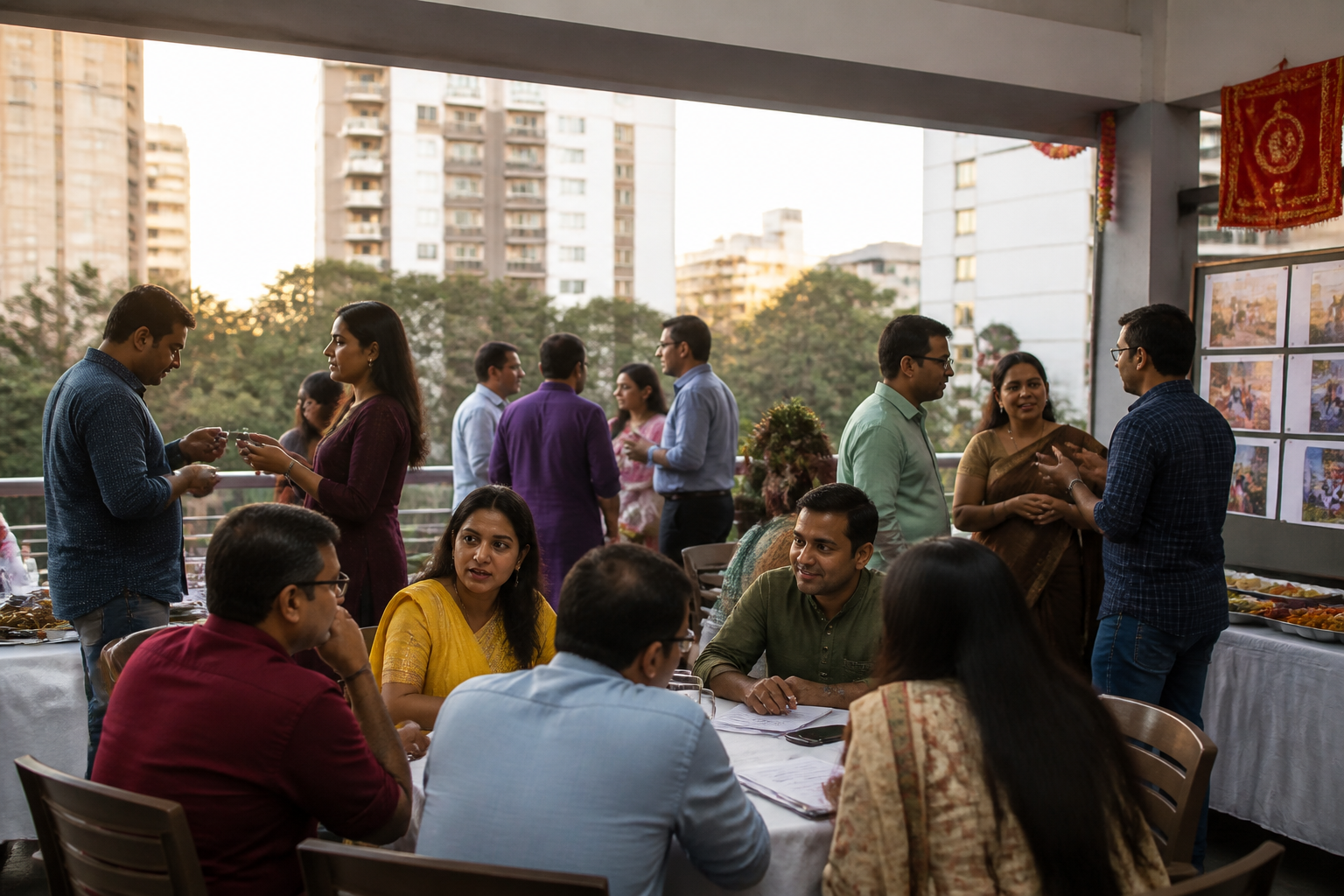
Bengaluru’s Marathi community has grown from a cultural network into an informal support system that helps newcomers find jobs, rental housing, professional contacts and everyday services. The experience of Bangalore Marathi shows how migrant groups often build their own pathways into a city when formal systems do not provide all the social and practical assistance required to settle.
The network, which began about 15 years ago with activities such as Ganesh Chaturthi and haldi-kumkum celebrations, now connects people through employment referrals, business meetings, matrimony assistance, housing leads and digital groups. Its organisers say more than four lakh Marathi-speaking people are connected through Bangalore Marathi and related sub-groups, although the supplied report does not establish how this figure was calculated.
That evolution is important because migration to a large city is not only a question of finding work. New residents must also locate housing, identify reliable service providers, understand neighbourhoods, build social contacts and manage periods of vulnerability. For people arriving without an established local network, these tasks can determine how quickly they become secure and economically settled.
### From cultural association to settlement infrastructure
Bangalore Marathi’s activities illustrate how a community organisation can perform functions that resemble informal urban infrastructure. Marathi Connect, the network’s employment and business arm, promotes job referrals and organises monthly entrepreneur conferences and social meetings. According to co-founder Kapil Ingale, participants come from sectors including real estate, finance, hospitality, pharmaceuticals, travel, lifestyle, sports and manufacturing.
The network helped Harish Bhosale after a career break made it difficult to pass the initial screening stage for jobs. Bhosale, who is originally from Solapur, had spent time exploring the Western Ghats and Sharavati Valley before returning to the workforce in 2013. Members referred him for jobs, eventually helping him enter an Indian service-based company. He later changed jobs several times, including through referrals, before joining a multinational semiconductor firm. He now assists others through the same job forum.
This is more than a story about professional networking. Recruitment systems often reward familiarity, referrals and access to people who can explain how an industry works. A community job forum can therefore reduce the disadvantages faced by migrants whose skills may not be easily visible through formal applications. The supplied account does not provide placement numbers or compare these referrals with formal employment services, but it demonstrates the practical role of trust-based access.
The network also supports entrepreneurship. Varsha Barde, who moved from a two-decade career in information technology into wellness and business, says Marathi Connect generates referrals and helps build trust in her brand. Its meetings and social events provide a recurring platform for contacts that may otherwise take years to develop.
### Housing is part of the migration challenge
The housing experiences described in the report show why social networks matter in a city where newcomers must make rapid and consequential rental decisions. Vivek Yawalkar, a commercial artist from Mumbai’s Sir JJ School of Art, said he initially struggled with language and contacts after moving to Bengaluru. Through Bangalore Marathi, he found a serviced one-bedroom apartment in Brookfield for Rs 25,000 a month. He moved to a larger unit when his family visited.
The example does not establish whether the rent was below the prevailing market rate, and it cannot represent Bengaluru’s wider rental market. It does, however, show how community networks can connect residents to housing options that may not be visible through mainstream listings. A recommendation from a known contact can also reduce uncertainty around landlords, locations, services and short-term accommodation.
Ingale’s own hospitality business provides another link between community networks and the city’s rental economy. He says about half of the guests at his accommodation business come from the Marathi community. Cultural and theatre events also bring celebrities and crews to these properties, increasing their visibility. The relationship illustrates how migration networks can create demand for accommodation while directing that demand towards businesses with community connections.
For many residents, housing is not a one-time transaction. It is tied to employment, family visits, school arrangements, commuting patterns and access to familiar services. A person who finds a job through one contact may find a room through another and later identify a doctor, plumber or food supplier through the same network. In this sense, housing assistance becomes part of a broader process of urban settlement.
### Digital groups extend the city’s social map
Bangalore Marathi’s online presence has become a major part of this support system. Ingale says the organisation has more than 1,13,000 Instagram followers and over 20,000 Telegram members. WhatsApp and Facebook groups are used to share information about doctors, plumbers, Marathi food and shared travel.
These groups create a parallel information layer over the formal city. Bengaluru’s official systems may provide public services, but they do not necessarily tell a newcomer which doctor is trusted by other members, where familiar food is available, how to locate a service provider or whom to contact during a housing search. Digital communities make such knowledge portable and searchable within a known social environment.
The network also connects cultural activity with economic opportunity. Marathi-owned homestays, food suppliers and home cooks receive promotional support when theatre companies arrive in the city. Artisans, including Ganesh idol makers, are promoted through the community. Events such as a haldi-kumkum programme in HSR Layout, attended by about 1,000 married women according to Itkelwar, provide both social connection and a platform for community businesses.
The result is a network that does not separate culture from livelihoods. Festivals, screenings, food sessions and handicraft workshops create occasions for people to meet, while those meetings can lead to employment, accommodation, business referrals or practical assistance. For migrants, cultural familiarity becomes an entry point into the wider urban economy.
### The language question is also a governance question
Several accounts in the report point to language and belonging as central parts of the settlement experience. Itkelwar said that language challenges faced when she settled in Bengaluru eventually faded and that, after nearly two decades, the city feels like home. Ragini Satish Naik, who moved to Bengaluru to look after her daughters, described missing familiar faces before connecting with the Marathi community through a film screening and later finding accommodation through a Maharashtrian contact.
Bengaluru is a multilingual city, but the existence of a large Marathi support network does not mean that language barriers disappear for everyone. It shows instead that migrants often manage these barriers collectively. Bangalore Marathi also has a BM Learn Kannada group, indicating that community identity and integration into the host city can coexist rather than operate as opposites.
This distinction matters for urban policy. A city can be economically open to migrants while remaining difficult to navigate socially and administratively. The ability to find housing, understand local practices and access trusted services is part of whether a migrant can participate fully in urban life. Community organisations can reduce that friction, but their reach depends on digital access, language, existing contacts and willingness to participate.
### What the evidence confirms—and what it does not
The reported experiences establish that Bangalore Marathi and Marathi Connect provide practical support across employment, entrepreneurship, housing, services and cultural life. They also show that the network has expanded beyond periodic celebrations into a more continuous system of referrals and assistance.
The available material does not establish the organisation’s legal structure, funding model, membership criteria or accountability mechanisms. It does not provide independently verified figures for the number of people connected, the number of jobs facilitated, the volume of housing referrals or the economic value generated by participating businesses. Nor does it compare the experience of Marathi residents with that of other migrant communities in Bengaluru.
Those gaps do not erase the urban significance of the network. They define the questions that require further reporting. If community organisations are becoming important intermediaries for work and housing, their role deserves to be understood alongside formal recruitment platforms, rental markets, local government services and resident welfare structures.
Bengaluru’s Marathi community offers a clear example of how migrants build belonging through mutual support. Its story also reveals a wider feature of city life: the ability to settle is shaped not only by income and infrastructure, but by access to trusted people who can make an unfamiliar urban system easier to navigate. The next question is how many other communities are performing similar functions, and how these informal networks interact with the city’s formal institutions.
