


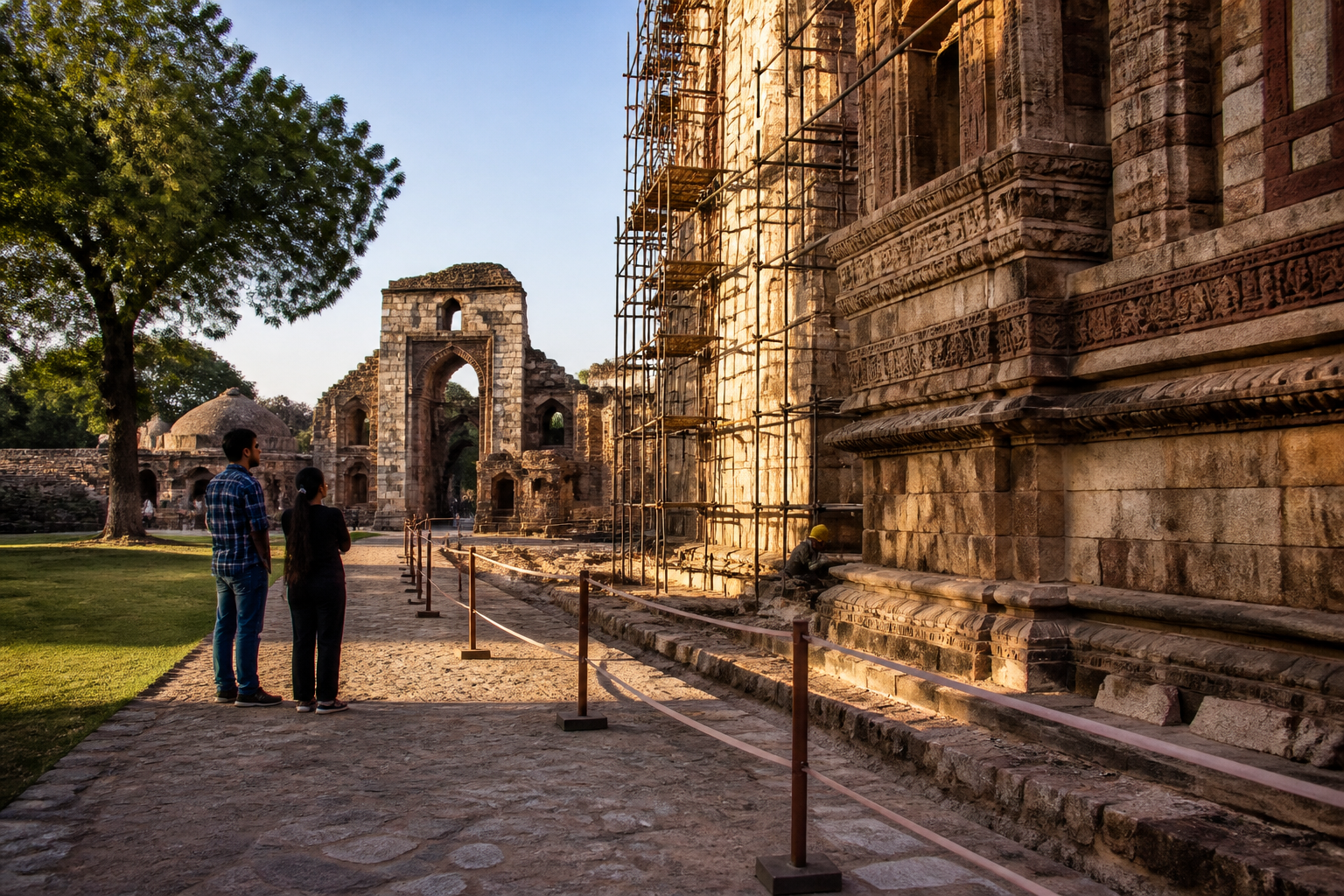
Access restrictions at several of Delhi’s best-known monuments reveal a difficult balance between preserving fragile heritage structures and keeping the city’s historic public spaces open to visitors. An RTI response cited in a report by Live Hindustan – NCR says that parts of Hauz Khas, Jantar Mantar, Agrasen ki Baoli, the Red Fort and the Qutub Minar complex are either undergoing repair, being upgraded for visitors or remain closed because of conservation concerns.
The information covers 10 monuments under the Delhi Circle of the Archaeological Survey of India. It identifies work ranging from structural repairs and conservation to improvements in visitor facilities. The response does not establish when all the restrictions began, and it does not provide a common reopening schedule. That lack of a clear timeline is significant because the closures are not part of a single temporary disruption. Some are linked to active works, while others, particularly at the Red Fort and Qutub Minar, have continued for years.
The result is a fragmented visitor experience across the capital’s heritage network. At Hauz Khas, access to part of the monument complex has been restricted while repairs are carried out. The complex is organised around a medieval reservoir built during the reign of Alauddin Khalji, with a madrasa, tomb and other structures associated with the period of Sultan Firoz Shah Tughlaq. Its significance is therefore not limited to an individual building: the site combines water infrastructure, architecture and the remains of an older urban settlement.
At Jantar Mantar and Agrasen ki Baoli, visitor movement has also been restricted. Jantar Mantar, built in 1724 by Jaipur ruler Maharaja Sawai Jai Singh II, is known for its large stone instruments used for astronomical observation. Agrasen ki Baoli represents another kind of urban heritage: a stepwell whose architectural value is closely tied to the city’s historic relationship with water and public space. The RTI response, however, does not specify the nature or duration of the restrictions at either site.
The Red Fort presents a more complex access problem. The Delhi Circle has restricted entry to six buildings inside the complex: the Hammam, Moti Masjid, Diwan-i-Khas, Khas Mahal, Rang Mahal and Sheesh Mahal. These structures served different functions within the Mughal-era complex, from a royal bathhouse and private mosque to reception, residential and palace spaces. According to the information cited in the report, the Hammam and Moti Masjid have been closed to visitors for years because the delicate marble and carved work could be damaged by heavy footfall.
This points to a central challenge in monument management. Opening every space to visitors can increase public access, but uncontrolled or high-volume movement can place pressure on surfaces, structures and decorative elements. Closing spaces reduces that immediate pressure, but it also narrows public access to heritage and can make the experience of a major monument less complete. The available RTI information does not say whether the Archaeological Survey of India has published visitor-capacity assessments, phased-opening plans or conservation-based access criteria for these buildings.
The Qutub Minar complex illustrates the same tension between preservation and access. The response mentions restrictions at the first floor of the Hindu Remains Corridor, the tomb of Jamali Kamali and the inner portion of the Qutub Minar. Entry inside the minar has been restricted for a considerable period after a stampede in 1981. The report does not provide current visitor-capacity figures or indicate whether the old restriction is being reviewed as part of the present improvement work.
The Qutub Minar entry issue is important because access is not determined only by the physical condition of a structure. It can also be shaped by safety risks created when large numbers of people move through narrow or enclosed spaces. In such cases, conservation and visitor management overlap. A monument may be structurally stable in parts but still unsuitable for unrestricted entry if circulation, emergency access or crowd control is inadequate. The supplied information confirms the continuing restriction but does not establish the present safety assessment behind it.
Other sites are being handled through repair and facility upgrades rather than only closures. At Tughlaqabad Fort and the tomb of Ghiyasuddin Tughlaq, visitor facilities are being improved. At the Salimgarh Fort, repair and renovation work is under way at the Signal Regiment Building and a toilet block. At the Red Fort, conservation work includes the parapet at the Lahore Gate and the area containing a well. At Safdarjung’s Tomb, repairs are being carried out at the mosque and associated chambers, while facilities for visitors are being improved at Humayun’s Tomb.
Taken together, these projects show that visitor infrastructure is part of conservation management rather than a separate tourism issue. Toilets, access routes and circulation areas determine how people move through a monument and where pressure is concentrated. Repairing a toilet block or improving access can therefore affect the functioning of an entire site. At the same time, facility upgrades do not automatically make every historic structure suitable for public entry. The RTI response distinguishes between conservation, repairs and visitor-facility improvements, but it does not provide project-wise completion dates or budgets.
The spending figures offer a limited but useful view of the Delhi Circle’s conservation workload. The RTI response says that ₹19.10 crore was allocated in 2021-22, with almost the entire amount spent. Allocation increased to ₹30.50 crore in 2022-23, and spending was also reported at approximately ₹30.50 crore. In 2023-24, ₹36.61 crore was allocated and around ₹36.57 crore was spent. The allocation then fell to ₹17.85 crore in 2024-25, with spending of approximately the same amount. For 2025-26, ₹28.70 crore was allocated and around ₹28.67 crore was spent.
Across the five years listed, the reported allocations total ₹132.76 crore, while spending totals approximately ₹132.69 crore. That is a difference of about ₹0.07 crore, or ₹7 lakh, between the total allocation and reported expenditure. The figures suggest a high level of utilisation within the Delhi Circle during the period covered. They do not, however, show how much was spent at each monument, how much went to structural conservation versus visitor facilities, or whether spending levels corresponded to the scale of work required at individual sites.
The annual pattern is also uneven. Allocation more than doubled from ₹19.10 crore in 2021-22 to ₹36.61 crore in 2023-24, before falling to ₹17.85 crore in 2024-25 and rising again to ₹28.70 crore in 2025-26. Without project-level records, it is not possible to determine whether these changes reflect the start and completion of large works, shifts in conservation priorities or variations in administrative approvals. The spending data shows the scale of public expenditure, but not yet its physical outcomes.
That distinction matters for a heritage network spread across multiple sites with different structural conditions and visitor pressures. A large complex such as the Red Fort contains buildings with different conservation needs from an astronomical observatory such as Jantar Mantar, a water-linked site such as Hauz Khas or a stepwell such as Agrasen ki Baoli. A single annual spending figure cannot explain whether the most vulnerable structures are receiving priority or whether visitor facilities are being upgraded in line with conservation restrictions.
The RTI response also leaves several operational questions unanswered. It does not state the exact number of monuments within the 10-site group where access is restricted, the expected completion dates for ongoing repairs, the criteria used to close individual structures or the process through which visitors are informed. It also does not clarify whether restrictions apply to entire complexes, individual buildings, particular floors or specific pathways, except where individual structures are named.
For visitors, that uncertainty can turn a heritage trip into an unpredictable experience. A person may be able to enter a monument complex but find that its most significant buildings are closed. In other cases, the site may remain open while a portion is under repair. Clear information on access conditions, work schedules and alternative visitor routes would be important, but the supplied material does not indicate whether such a consolidated system exists.
The larger urban question is how Delhi can treat heritage monuments as living parts of the city rather than isolated attractions. These sites occupy neighbourhoods, connect to public transport and open spaces, and carry evidence of the city’s changing relationship with water, administration, religion, science and royal power. Their management therefore involves more than repairing walls. It requires decisions about public access, crowd movement, safety, facilities and the long-term survival of historic material.
The evidence currently confirms three things: access restrictions exist across several major monuments; the Archaeological Survey of India is undertaking conservation and visitor-facility work; and the Delhi Circle has reported substantial expenditure against its annual allocations. What remains unclear is when each restriction will be lifted, how access decisions are measured and what conservation outcomes the spending has produced. Those are the next details needed to understand whether Delhi’s heritage policy is successfully balancing preservation with public access.
