


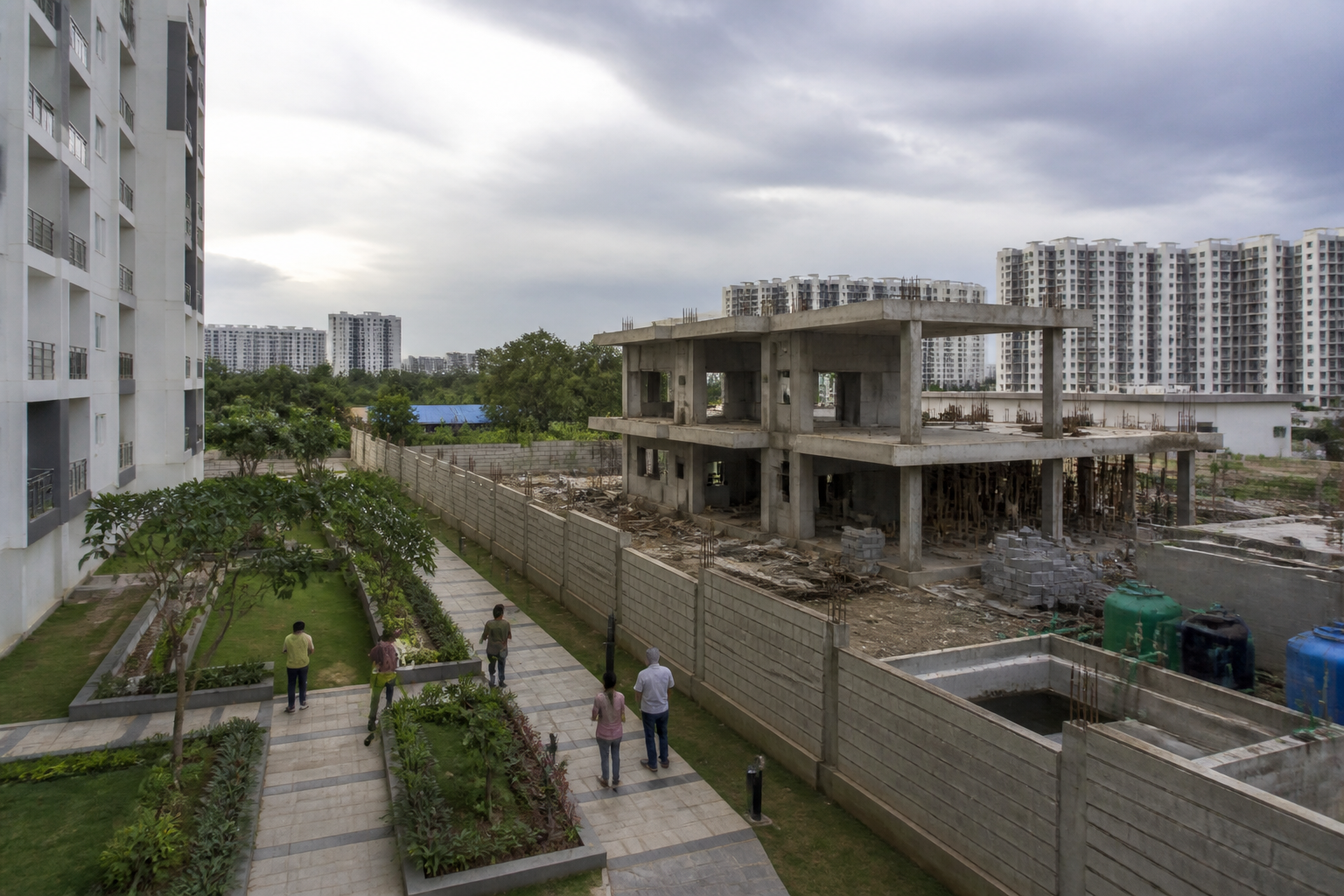
A Karnataka RERA order awarding Rs 10 lakh to four homebuyers over undelivered amenities has placed a familiar housing dispute at the centre of a larger question: what exactly does a buyer purchase when a residential project is marketed as a lifestyle development rather than simply a collection of flats?
The case concerns a housing complex in Jala Hobli, Bengaluru North, where four purchasers from R T Nagar bought flats for Rs 2.08 crore each. The sale deeds were executed in 2022. According to the report and the authority’s findings cited by Economic Times, the project’s promotional material, allotment letters and agreements referred to amenities including a senior citizen park, open gym, spa, open amphitheatre, badminton court, tennis court, children’s play area, clubhouse and other facilities. Several of these were either incomplete or had not been constructed.
The Karnataka RERA authority, in an order dated September 4, 2026, directed the builder to pay Rs 10 lakh in compensation to the homebuyers within 60 days. If the amount is not paid within that period, interest will become payable. The order was heard by Smt Maheshwari S Hiremath, adjudicating officer of Karnataka RERA.
The significance of the decision lies less in the amount awarded than in the authority’s treatment of amenities as part of the promised housing product. The buyers had not complained merely about a delayed optional facility. They argued that a substantial set of features shown to them during the purchase process had not been provided even after the sale deeds were executed. The authority’s observation, as reported, was that “mere execution of a sale deed in favour of the allottee is not sufficient without completion of the project by providing all amenities / facilities as agreed.”
That distinction matters in Bengaluru’s apartment market, where brochures and sales presentations routinely describe projects through pools, clubhouses, landscaped parks, sports facilities, wellness spaces and community areas. These features influence the price a buyer is willing to pay and shape the development’s promised standard of living. When such facilities are absent, the dispute is not simply about an unfinished recreational space. It is about whether the representations that helped sell the home remain binding after possession or registration.
The evidence in this case came from a joint inspection conducted on May 14, 2026, following a court order. The inspection involved the homebuyers and the builder, and photographs were taken at the project. Although representatives identified in the report as Manjula and Keerthi were present, they did not sign the inspection report. The authority nevertheless relied on colour photographs that, according to the report, showed their presence at the premises and documented the state of the facilities.
Those photographs reportedly showed an incomplete compound wall, unfinished SBR tanks, an incomplete clubhouse, an unfinished sewage collection tank, an STP and WTP plant room that was not complete, an absent entrance gate, open STP chambers and shortcomings in water treatment. The project also faced issues involving a borewell, sewage treatment plant and water treatment plant. Poor maintenance of the STP and WTP was reported to have resulted in bad odour.
The inspection also established that not every promised feature was absent. The children’s play area, park and yoga deck were reportedly complete. But the authority found that several other facilities remained incomplete or had not been constructed, including the badminton and tennis courts, open gym and key parts of the clubhouse. The reported absence of a pool, spa, guest rooms and indoor games area was particularly important because these facilities formed part of the project’s marketed amenity package.
This division between completed and incomplete amenities is important for the operation of real estate regulation. A project cannot necessarily be assessed through a simple completed-or-not-completed label. A development may have an occupancy certificate or registered sale deeds while still lacking the common infrastructure that residents were promised. The case shows how inspection evidence can separate facilities that exist from those that remain claims in marketing material.
The authority’s reasoning was also tied to Section 12 of the Real Estate (Regulation and Development) Act, which concerns the veracity of advertisements and prospectuses. The Karnataka RERA authority held, as reported, that a promoter has an obligation to provide amenities in accordance with the advertisement or prospectus for the project. In practical terms, this means that the promotional stage can remain relevant after the contract is signed, particularly where the same promises appear in the allotment documents or agreements.
That approach addresses one of the persistent institutional imbalances in home purchases. Sale agreements and conveyance documents are generally drafted by developers and presented to buyers as standard-form instruments. A buyer may sign a document containing clauses that appear to narrow the developer’s responsibilities, even though the project was sold through a wider set of visual and written promises. The authority reportedly described such documents as one-sided instruments prepared by the builder, noting that buyers often have little practical choice but to sign them.
The case therefore tests the relationship between three layers of project documentation: the advertisement or brochure, the allotment letter or agreement, and the final sale deed. The buyer’s argument was that the promised amenities were identifiable across these records and were not erased merely because the sale deed had been executed. The authority’s reported conclusion was that the builder could not treat the sale deed as proof that all obligations had been completed when the physical project showed otherwise.
At the same time, the order did not impose liability for every unfinished facility. The report states that the builder’s obligation to complete the clubhouse was linked to Clause 12.1 of the sale agreement, which required completion within 18 months from the date of a site release order issued by the Bengaluru International Airport Area Planning Authority, or BIAAPA. Because BIAAPA had issued only a partial release order and had not released the final order, Karnataka RERA held that the builder could not yet be held liable for failing to deliver a fully constructed clubhouse under that particular clause.
This qualification is significant. It shows that the authority’s decision was not a blanket declaration that every incomplete amenity automatically creates compensation liability. The contractual trigger, the planning authority’s release order and the evidence of actual construction all mattered. The same decision that held the promoter responsible for several undelivered amenities also recognised that an obligation tied to a specific regulatory milestone could not be enforced before that milestone was established.
The case also illustrates why approvals and construction progress are inseparable in apartment delivery. A buyer may see a promised clubhouse or landscaped common area in a brochure, but completion can depend on planning permissions, site release orders, utility systems and the sequencing of civil works. In this project, the reported problems extended beyond lifestyle amenities to compound walls, sewage infrastructure, water treatment and access-related works. These are common facilities that affect basic operation and maintenance, not just resident convenience.
The distinction between statutory infrastructure and lifestyle facilities can also become blurred in a large housing complex. A pool or spa may be understood as a premium amenity, while an STP, WTP, entrance gate or compound wall is essential to the functioning and safety of the development. When both categories appear in the same project promise, residents experience them together as part of the delivered home. The inspection findings suggest that the dispute involved this wider project-completion problem rather than a single missing facility.
The compensation order also demonstrates the role of documentary and photographic evidence in RERA proceedings. The homebuyers relied on a joint inspection conducted in the presence of builder representatives. The photographs reportedly captured the condition of the project and helped establish that the facilities were not merely delayed in paperwork but were physically incomplete or absent. The presence of the builder’s staff, even without their signatures on the inspection report, became part of the authority’s assessment of the evidence.
For buyers, the case reinforces the importance of preserving the material used to sell a home: brochures, application forms, allotment letters, agreements, payment records, photographs, correspondence and possession-related documents. The report also cites legal practitioner Asha Kiran Sharma, who said the decision indicates that developers cannot rely on drafting techniques to avoid obligations when the promised facilities have not been delivered. She also noted that an incorrect project registration number would not necessarily defeat a complaint when the project and promised amenities are otherwise clearly identifiable from the record.
That observation is relevant to the accessibility of housing regulation. Real estate complaints often involve ordinary purchasers rather than parties with specialist knowledge of registration numbers, planning permissions or contract drafting. If a genuine clerical error were enough to defeat a complaint, the regulatory mechanism would become dependent on procedural precision rather than the underlying condition of the project. The reported order suggests that Karnataka RERA focused on identifying the project, the promises and the evidence of non-delivery.
However, the decision does not resolve every question affecting residents. The report does not establish whether all incomplete works will eventually be completed, whether the compensation is collective or individually payable to each of the four homebuyers, or whether the builder has challenged the order. It also records that BIAAPA had not released the final order, leaving the contractual obligation relating to the clubhouse subject to a separate planning milestone. These unresolved elements will determine how far the order changes the project on the ground.
The immediate direction is clear: the builder must pay Rs 10 lakh within 60 days, failing which interest will apply. Beyond that payment, the larger test is whether the project’s incomplete common facilities are delivered and maintained. The case confirms that a registered sale deed is not, by itself, evidence that a residential project has fulfilled every promise made to its buyers. It also shows that enforcement depends on the interaction of marketing material, contractual language, planning approvals, physical inspection and evidence from the site.
