


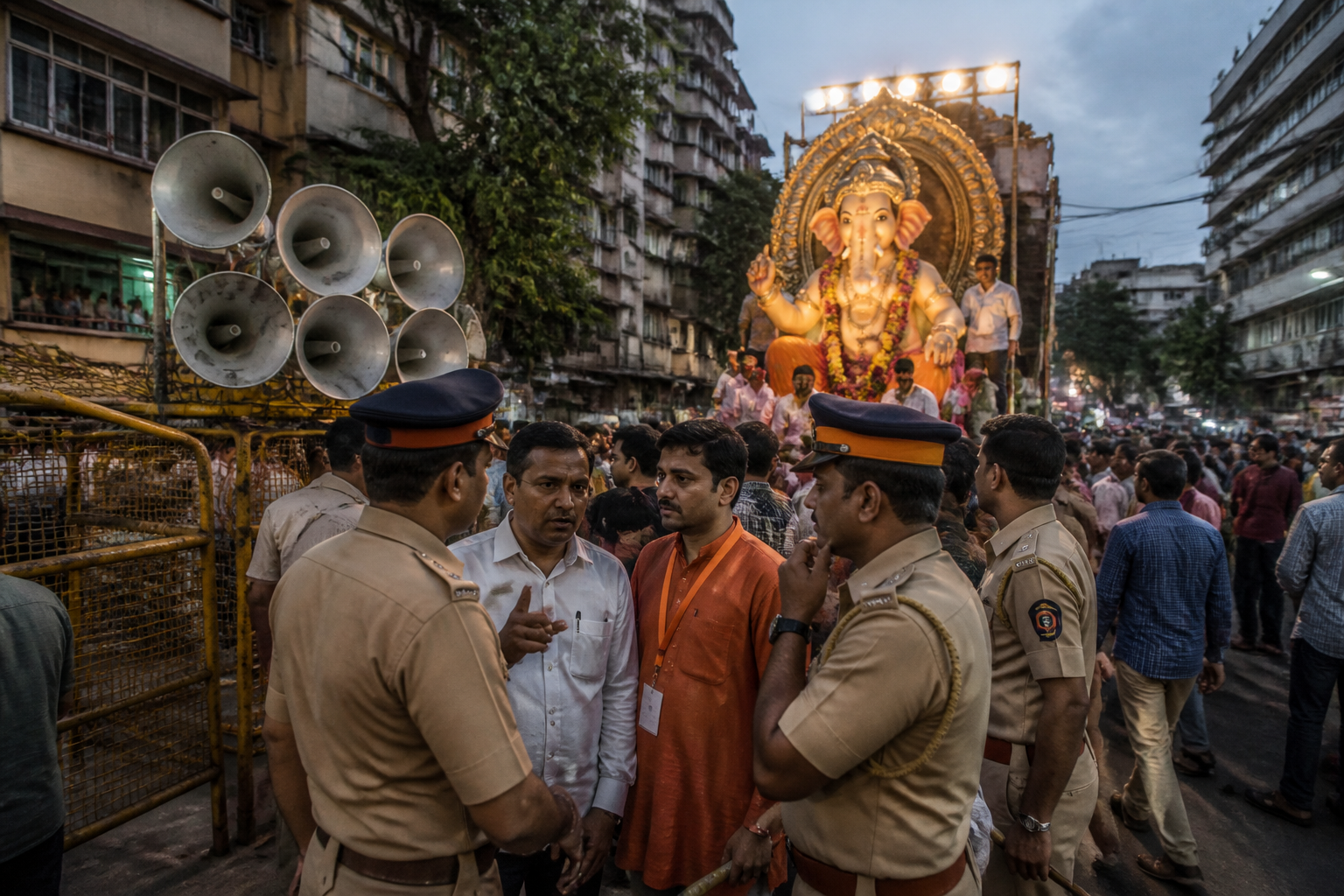
Thane Ganeshotsav noise pollution rules are again under scrutiny as public Ganesh mandals begin seeking police permission for loudspeakers, arrival and immersion processions, and programmes at pandals across the Thane Commissionerate area. Police are reportedly instructing organisers to comply with prescribed noise limits and other regulations, but the extent of enforcement during the festival remains uncertain.
With Ganeshotsav only a few days away, office-bearers of public Ganesh mandals have begun visiting police stations to obtain permission for loudspeakers and related events. The permissions cover the use of sound systems during idol arrival and immersion processions as well as activities held at festival pandals, according to a report by Loksatta – Thane.
The Thane Commissionerate area is expected to host 1,076 public Ganesh idols this year, while more than 150,000 household idols are likely to be installed. The scale of the festival means that sound systems will be used across residential neighbourhoods, commercial areas and procession routes over several days.
The police have been informing mandal representatives about the need to follow noise-pollution rules while processing applications. However, residents have questioned whether the administration will carry out active monitoring and take action against violations, or whether its responsibility will end with issuing instructions and permissions.
Noise levels typically become a recurring civic concern during Ganeshotsav because processions, public performances and pandal programmes can continue across densely populated parts of the city. The report states that complaints about violations emerge every year despite the existence of legal and regulatory restrictions. The immediate issue for Thane is therefore not only whether permissions are issued, but also how conditions attached to those permissions are monitored during the festival.
The matter also has a legal background. The report refers to directions issued by the Bombay High Court following a petition by Thane-based social activist Dr Mahesh Bedekar concerning noise pollution. It also notes that the Supreme Court has held that the right to live in an environment free from noise pollution forms part of the right to life under Article 21 of the Constitution.
These legal principles place obligations on public authorities beyond merely communicating rules to organisers. Police and civic agencies must deal with permissions, complaints and alleged violations within the framework of the applicable noise-pollution regulations and court directions. The material available in the report does not specify the number of enforcement teams, monitoring locations, permissible operating hours, decibel limits or penalties planned for this year’s celebrations.
The noise question has also gained wider attention in Maharashtra. The report cites protests in Pune after activist Vidyanand Bapat raised concerns about noise pollution and citizens organised against the excessive use of DJs. That episode brought the issue into broader public discussion, but the report does not establish whether the protests led to a uniform enforcement mechanism across the state.
For residents of Thane, the coming festival period will test how the city balances large-scale public celebrations with the constitutional and regulatory protections associated with a quieter living environment. The next operational steps are the processing of loudspeaker and procession permissions by local police stations, followed by enforcement during idol arrival, pandal programmes and immersion processions.
