


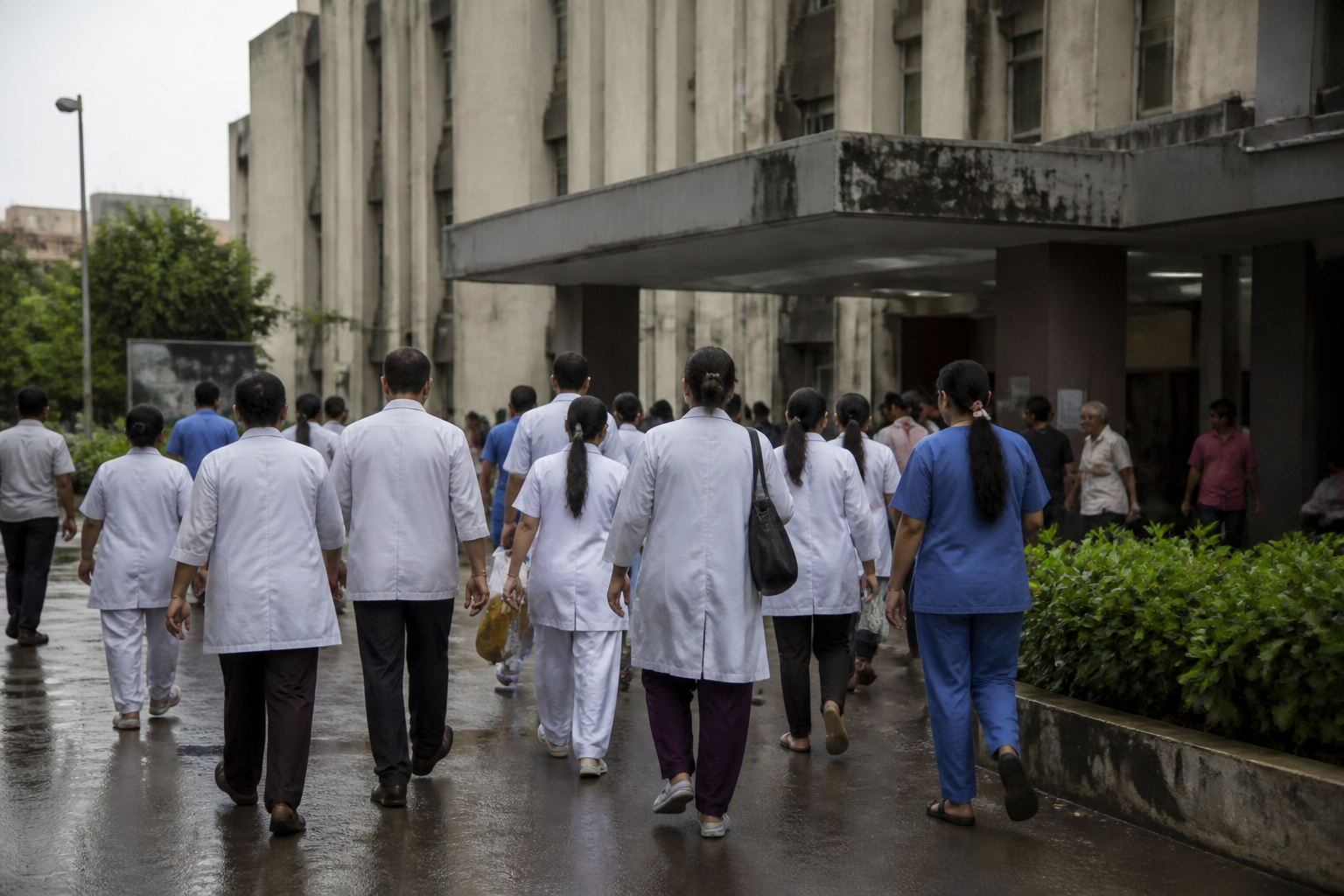
The Bombay High Court has directed the Vasai-Virar City Municipal Corporation (VVCMC) to regularise 479 contractual employees, ruling that they cannot be required to take a written examination as a condition for regularisation. The court ordered the civic body to issue regularisation orders within two weeks and struck down communications that had introduced the examination requirement.
The judgment by Justices Girish Kulkarni and Aarti Sathe set aside a January 21 letter issued by the urban development department and VVCMC’s follow-up communication of January 28. The directions followed petitions filed by doctors, paramedical workers and administrative staff employed in VVCMC hospitals, clinics and primary health centres.
The petitioners had worked with the civic corporation for eight to 10 years, including during the Covid-19 pandemic. They were selected through walk-in interview advertisements but were appointed for six-month periods, followed by a one-day technical break intended to establish that their service had not continued without interruption.
VVCMC argued that the employees had no vested right to seek regularisation. The petitioners’ advocate, Abhijeet Desai, told the court that the state government had approved regularisation in other municipal corporations and had also regularised 33 similarly placed VVCMC employees.
The judges held that a different standard could not be applied to the petitioners, who had continuously performed what the court described as perennial and indispensable public health duties. The court said their long service had created a legitimate expectation of absorption, particularly because they had been engaged early in their working lives and could face age-related limitations in finding other employment.
The judgment also distinguished the employees’ appointments from illegal or backdoor recruitment. The court noted that they had been selected through a transparent process and said VVCMC could not continue to retain them on contractual posts when permanent, ongoing work was available.
The court criticised what it called the cultivation of ad hocism in public employment, saying it had displaced the creation and maintenance of a robust permanent cadre. It also said such arrangements were counterproductive to the smooth delivery of vital public-welfare functions. The ruling stated that imposing a written examination on employees who had served continuously was not justified and that the refusal to regularise them was arbitrary and illegal.
VVCMC has been directed to complete the regularisation process and issue orders to the 479 employees within two weeks of the judgment.
