


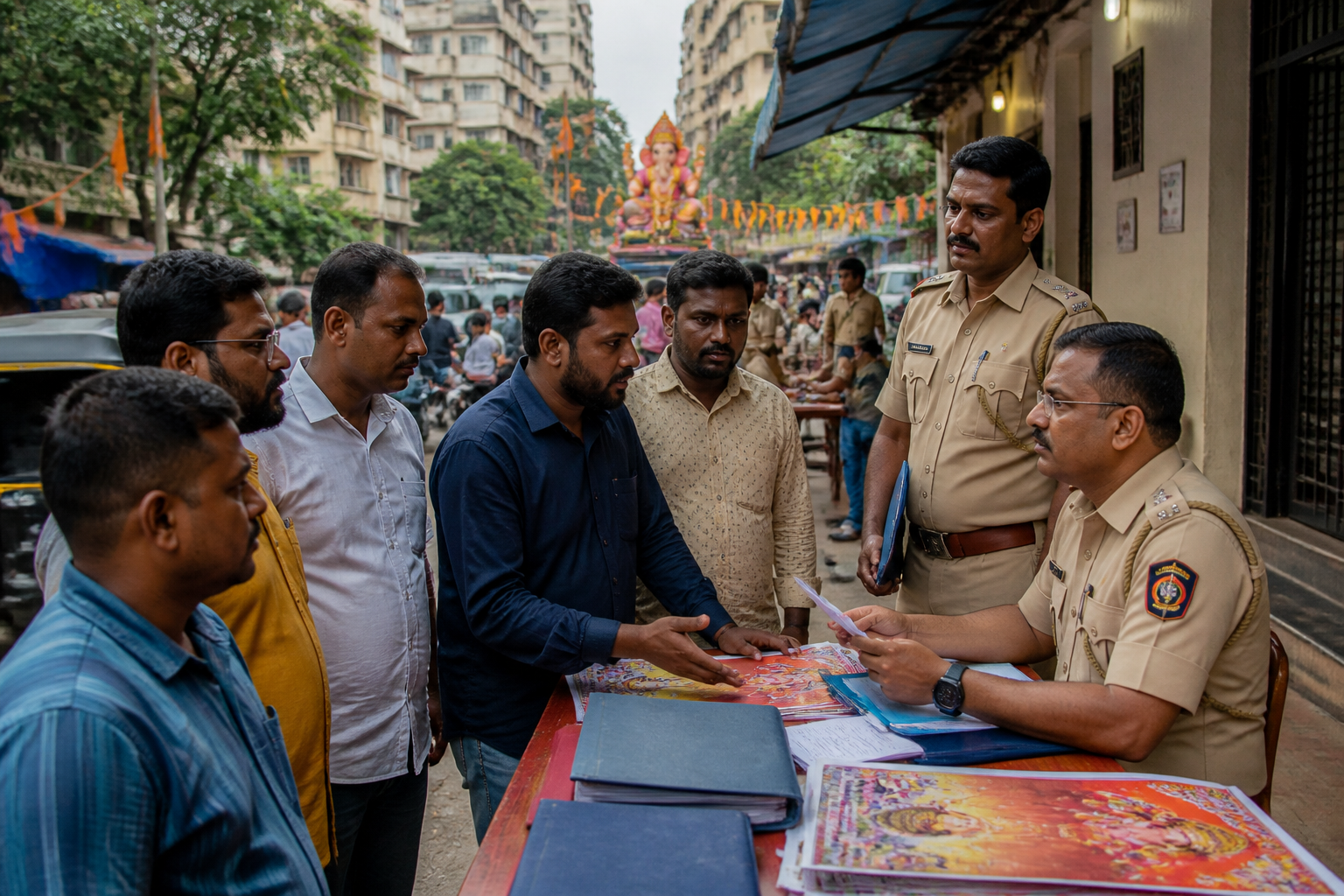
Thane police are advising public Ganeshotsav organisers to follow noise-pollution rules while seeking permission for loudspeakers, processions and mandap programmes ahead of the festival, but questions remain over how firmly the rules will be enforced during the celebrations.
With Ganeshotsav only a few days away, office-bearers of public Ganesh mandals have begun visiting police stations across the Thane Commissionerate to obtain permission for loudspeakers. The permissions cover arrival and immersion processions as well as loudspeakers used for programmes at festival mandaps.
According to the report, police officials are informing organisers about the applicable noise-pollution rules while processing their applications. The Thane Commissionerate is expected to see 1,076 public Ganesh idols installed this year, in addition to more than 150,000 household idols. The scale of the festival means that processions, public programmes and amplified sound will take place across several parts of the urban region.
Noise pollution has become a recurring issue during Ganeshotsav because of the extensive use of loudspeakers and sound systems. Residents have questioned whether mandals that violate the rules are subject to action during the festival, or whether the administration’s responsibility ends with issuing instructions at the permission stage.
The report refers to directions issued by the Bombay High Court following a petition by Thane-based social activist Dr Mahesh Bedekar concerning noise pollution. It also notes that the Supreme Court has held that the right to live in an environment free from noise pollution forms part of the right to life under Article 21 of the Constitution.
Despite these legal principles, complaints about violations during festivals are reported every year. The enforcement challenge involves not only granting permissions but also monitoring sound levels, procession routes and event timings across a large number of public venues and streets. The available report does not specify the number of enforcement teams, monitoring arrangements, permissible sound levels being applied in individual cases or the penalties planned for violations.
The issue has also drawn attention elsewhere in Maharashtra. In Pune, activist Vidyanand Bapat raised concerns over noise pollution, after which some residents organised a protest against the excessive use of DJ systems. The debate subsequently expanded to other parts of the state.
For Thane, the immediate test will be whether the instructions given to Ganesh mandals are followed by visible enforcement during arrival processions, mandap events and immersion processions. Police permissions and festival-period enforcement will determine how the city balances public celebrations with residents’ legal right to protection from excessive noise.
