


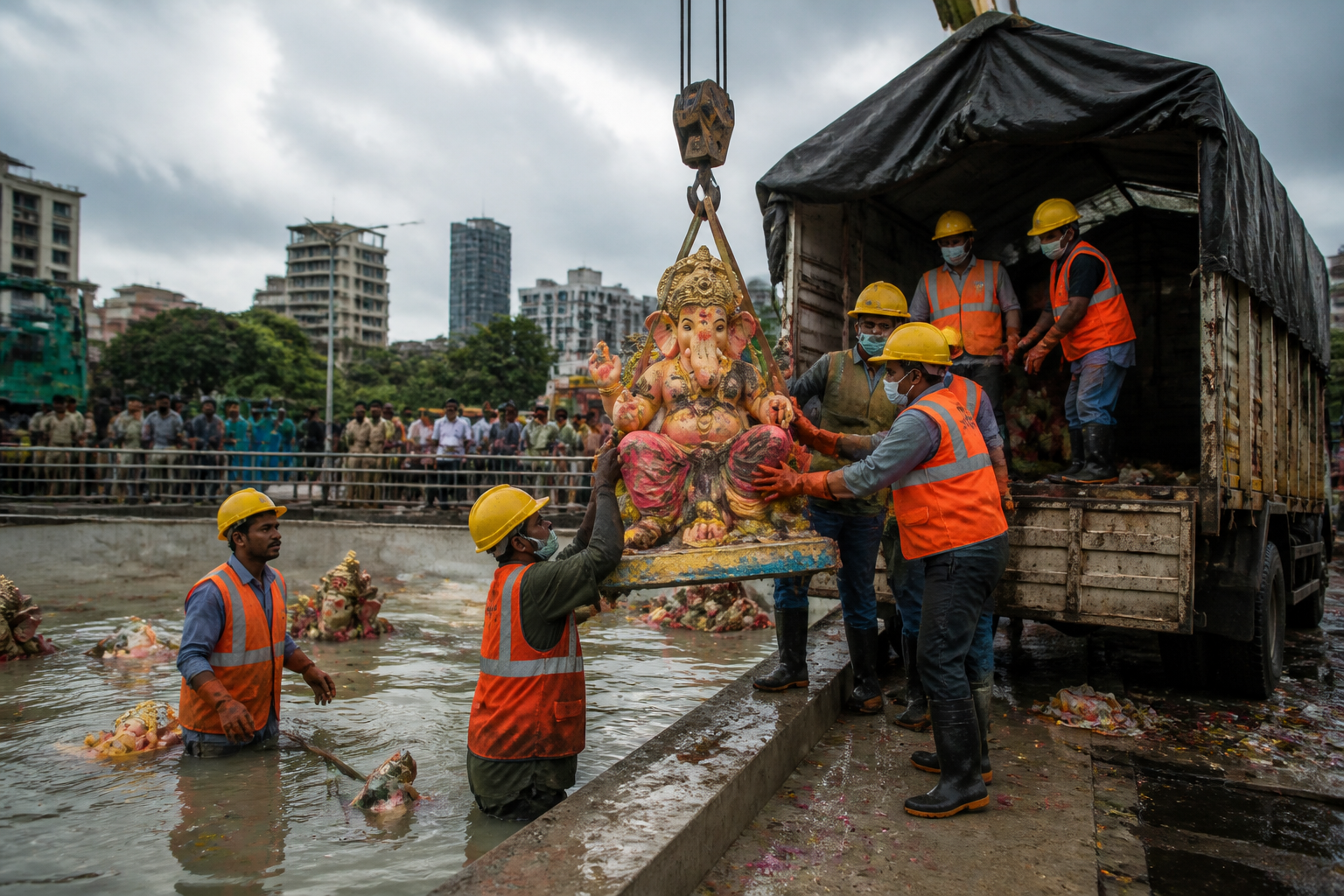
The Brihanmumbai Municipal Corporation has launched an integrated system to collect, safely store, scientifically process and recycle plaster of Paris Ganesh idols immersed across Mumbai, after directions from the Bombay High Court. The civic body has issued a standard operating procedure to all departmental assistant commissioners, setting out responsibilities from retrieval at immersion sites to final reuse of the processed material.
Under the procedure, idols immersed in artificial ponds, temporary immersion tanks and water bodies must be removed within 24 hours. The BMC’s solid waste management department has also called tenders for handling 2,850 tonnes of material, according to the report. The civic instructions cover both idols retrieved from temporary facilities and larger idols immersed in natural water bodies under the court’s directions.
The High Court’s August decision allowed Ganesh idols taller than six feet made from POP to be immersed in natural water bodies, as in the previous year. The BMC’s operational plan requires these idols to be collected after immersion and disposed of through an environmentally safer process. The reported procedure does not permit the material to remain unmanaged in the water bodies after the festival.
Each civic ward will have to appoint a coordination officer and arrange the personnel, personal protective equipment, cranes and appropriately covered vehicles needed for the operation. Retrieved idols are to be transported only to the designated idol unloading and storage facility in Mulund. The specified transport and storage chain is intended to keep the material contained while it awaits processing.
The BMC has also made documentation mandatory at each stage. Ward-level records, weighbridge receipts, photographs and video recordings of the operation must be preserved. Assistant commissioners will monitor daily work under the supervision of zonal deputy municipal commissioners, according to the reported SOP.
The processed material is expected to be reused in products and industrial applications including new idols, plasterboard, ceramics, medical plaster, bricks and filler material for the cement industry. The plan therefore links festival immersion management with municipal solid-waste handling and material recovery rather than treating the idols only as post-festival debris.
The civic procedure applies to the collection, covered transport, storage, processing and reuse of the POP idols. The next operational steps are the deployment of ward-level staff and equipment, retrieval within the prescribed 24-hour period, movement of the material to Mulund and maintenance of the records required by the BMC.
