


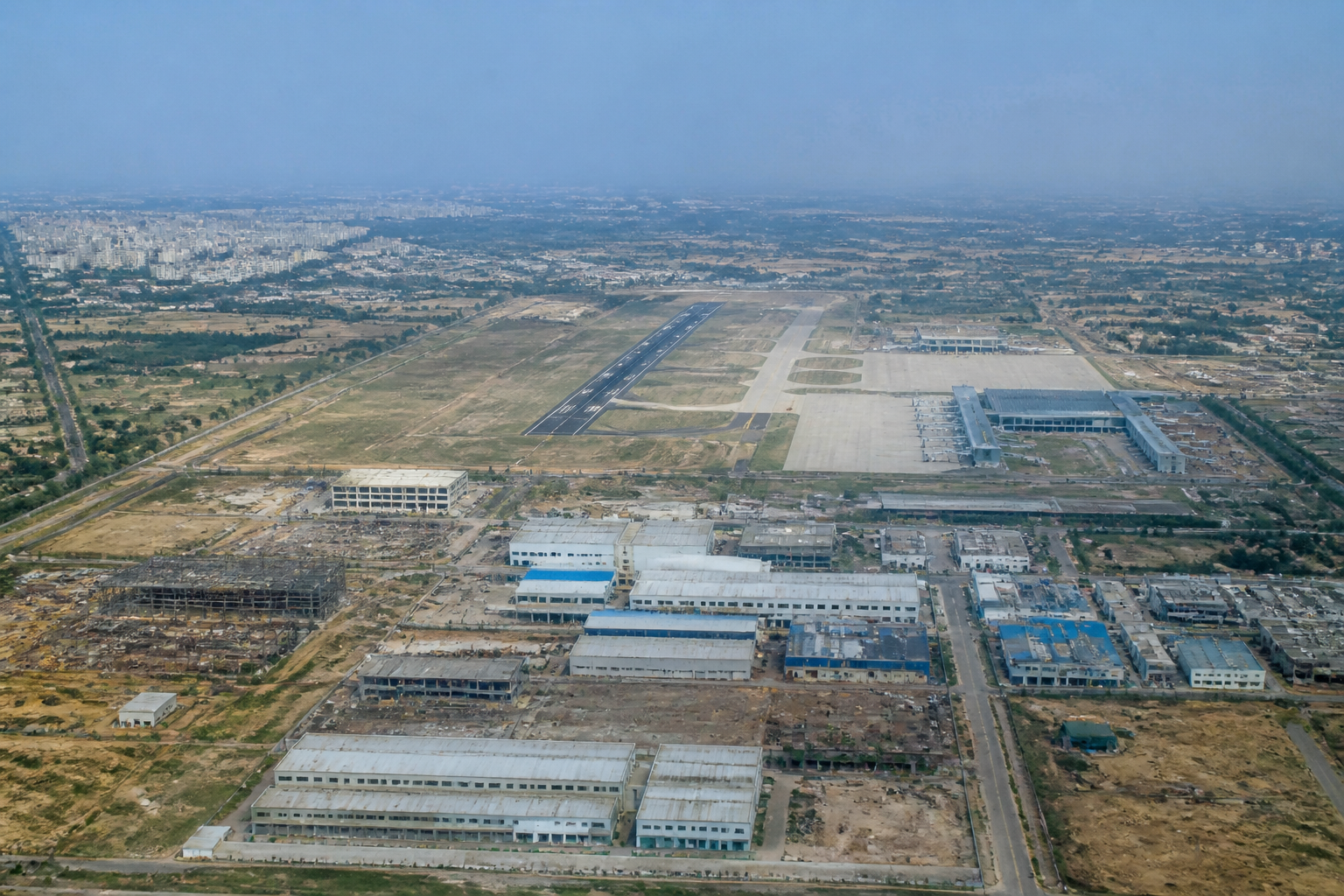
Subheadline: A proposed 2,000-hectare aviation cluster near Noida International Airport could connect airport operations with maintenance, repair, manufacturing and industrial land use.
Standfirst: The Yamuna Authority has reserved about 2,000 hectares near Noida International Airport for a civil aviation industry hub, according to a report by Navbharat Times. The land-use provision has reportedly been incorporated into the 2041 master plan, while adjoining airport land is being acquired in phases. The proposal goes beyond the construction of passenger facilities: it envisages a cluster where aircraft maintenance, repair and overhaul activities could be accompanied by companies making aviation components. The available information does not establish the investment value, participating companies, employment projections, infrastructure costs or implementation schedule. What it does show is how the airport is being planned as the anchor for a larger industrial and urban development zone in the Yamuna City area.
The proposed civil aviation hub near Noida International Airport is significant because it places industrial land use alongside airport expansion. According to the Navbharat Times report, the Yamuna Authority has reserved approximately 2,000 hectares for the hub and changed the land use of the area accordingly. The provision has also reportedly been included in the authority’s 2041 master plan. The plan is intended to attract large civil aviation companies from India and abroad, including manufacturers of aircraft components.
The immediate event is therefore not the announcement of a new airline route or a passenger terminal. It is a planning decision that links an airport to an aviation production and services ecosystem. The proposed arrangement would allow activities ranging from aircraft operations to maintenance and component manufacturing to be located in proximity to the airport. The report does not state whether any company has formally committed to the site, nor does it provide details of a tender, concession, investment agreement or construction deadline.
The proposal is being developed alongside the land acquisition and operational expansion of Noida International Airport. The report says that nearly 5,000 hectares are being acquired for the airport project in three phases. Land acquisition for the first two phases, covering 1,334 hectares and 1,365 hectares, has reportedly been completed. Acquisition for the third phase, covering 2,053 hectares, is described as being close to completion.
These figures indicate that the airport project is being organised as a phased land and infrastructure programme rather than as a single construction parcel. The first phase is described as the land on which airport operations began on June 15, with one runway currently in use. The report says that an additional runway will be built in that phase as passenger numbers increase. The second and third phases are expected to include passenger facilities as well as a maintenance, repair and overhaul, or MRO, hub.
The relationship between the MRO hub and the proposed civil aviation industry area is central to the plan. Aircraft maintenance requires access to specialised parts, equipment and technical services. The report presents the component-manufacturing proposal as a response to that requirement. In planning terms, this would place service functions and manufacturing activities within the same airport-linked development system, although the available material does not specify the industries that would be permitted, the environmental conditions that would apply or the supporting utility requirements.
The 2,000-hectare allocation also raises questions about the scale and sequencing of Yamuna City’s development. The source describes the area as being adjacent to the airport project and identifies the 2041 master plan as the document in which the civil aviation hub has been provided for. That makes the proposal part of a longer-term spatial framework rather than only an airport-side commercial project.
However, the available report does not provide the master plan’s land-use map, the exact location of the 2,000 hectares, the boundaries of the site or the transport connections planned for it. It also does not specify how the aviation hub will relate to nearby settlements, logistics areas, passenger access roads or other industrial zones. Those details will determine whether the area functions as an integrated aviation cluster or develops as a collection of separate airport-adjacent uses.
The airport’s phased land acquisition is another important part of the planning context. The first phase is already associated with airport operations, while the second and third phases are linked to passenger facilities and MRO activity. The report does not state when the second and third phases will become operational, how the additional runway will be financed or what passenger threshold will trigger its construction. It says only that the additional runway is planned as passenger numbers rise.
This sequencing matters because an aviation industry hub depends on more than land reservation. It requires a functioning airport, technical facilities, reliable access, utilities and a regulatory framework for aviation-related manufacturing and maintenance. None of the supplied information confirms the status of these supporting systems. The proposal should therefore be understood as a land-use and development framework at this stage, rather than evidence that the full industrial cluster has been secured.
The report’s reference to MRO facilities provides the clearest link between the airport’s operational role and its industrial ambitions. MRO activity can occupy a different position from passenger infrastructure: it is connected to aircraft servicing and fleet operations rather than directly to passenger movement. The source indicates that the second and third airport phases will include an MRO hub, but it does not identify the operator, the planned capacity, the types of aircraft to be serviced or the construction status of the facilities.
Similarly, the proposal to attract component manufacturers remains at the planning stage in the information available. No company names, investment commitments or production targets are given. The report says that the Yamuna Authority is preparing to bring major domestic and international civil aviation companies to the area. That statement establishes the authority’s stated direction, but not the outcome of the investment process.
The policy landscape described in the report is led by the Yamuna Authority’s master planning and land-use decisions. The authority is responsible for the area in which the airport and the proposed hub are being developed. By incorporating the civil aviation hub into the 2041 master plan, it has created a stated planning basis for reserving the land. The report does not identify any separate approval from the state or central government, nor does it describe the administrative arrangements under which aviation regulation, industrial approvals, environmental permissions and municipal services would be coordinated.
That institutional coordination will be important if the proposal moves beyond land reservation. Airport operations, MRO facilities and component manufacturing involve different regulatory and infrastructure requirements. The supplied material does not say how these responsibilities will be divided between the airport operator, the Yamuna Authority and other agencies. It also does not explain whether the 2,000 hectares will be developed directly by the authority, offered to private companies or divided among multiple projects.
The numerical picture currently available is limited but clear. Nearly 5,000 hectares are being acquired for the airport project across three phases. The first two phases account for 2,699 hectares, while the third covers 2,053 hectares. Separately, about 2,000 hectares near the airport have been reserved for the civil aviation industry hub. The report does not clarify whether this 2,000-hectare area is included in, adjacent to or separate from the land being acquired for the airport phases. That distinction requires confirmation because it affects the total development footprint.
The airport is described as operating with one runway since June 15. A second runway is planned in the first phase when passenger numbers increase. The report gives no current passenger volume, airport capacity figure or target date for the additional runway. It also provides no estimate of the number of aviation companies, workers or support businesses that the proposed hub could accommodate.
These gaps are not minor details. They determine how the plan should be evaluated and how much land may ultimately be required for aviation-related uses. Without an official master-plan document, a site map, a development schedule and confirmed investor information, the present evidence supports the existence of a planning provision and an institutional intention, but not the scale of eventual construction or economic activity.
The larger urban question is whether Noida International Airport will function only as a transport gateway or become the organising centre of a wider industrial district. The reported land-use decision points towards the second model. It places airport operations, MRO services and component manufacturing within a common planning narrative. That could give the airport a broader role in shaping Yamuna City’s land use, but the supplied material does not yet establish how the surrounding urban system will be built to support it.
For residents, landowners, businesses and planners, the next evidence will be more specific than the announcement itself: the publication of the relevant master-plan provisions, the identification of the hub’s exact boundaries, formal investment commitments, approvals for MRO and manufacturing facilities, and timelines for the airport’s later phases. Until those details are available, the 2,000-hectare civil aviation hub is best understood as a major planning provision linked to Noida International Airport, rather than a completed industrial project.
