


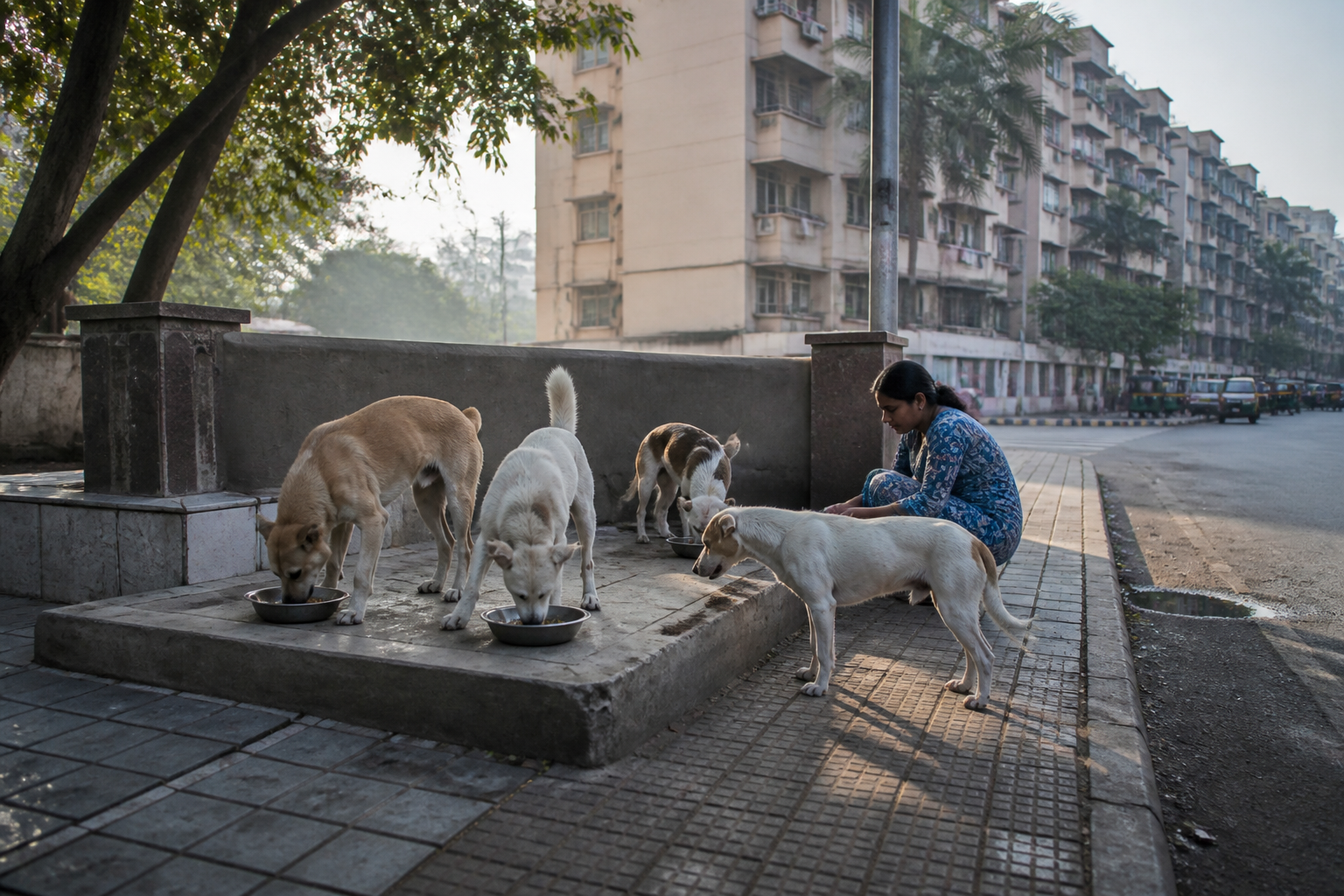
Mira-Bhayandar’s decision to impose a fine of up to Rs 5,000 for feeding stray dogs outside municipal feeding centres has brought a long-running urban management problem into sharper focus. The order is intended to address public complaints about unclean public spaces, inconvenience to residents and disputes between animal feeders and other citizens. But the wider question is whether enforcement can work when the city’s feeding, sterilisation, vaccination, sanitation and monitoring systems remain under pressure.
The fine changes the immediate relationship between residents and the municipal corporation. People who feed stray dogs in locations not designated by the Mira-Bhayandar Municipal Corporation may face financial penalties. The measure is presented as a way to regulate feeding rather than allow it to take place at any public location. Yet its implementation will depend on whether residents have practical access to suitable alternatives and whether the designated centres are adequate for the number and distribution of dogs across the city.
The municipal corporation has established 30 feeding centres in different parts of Mira-Bhayandar. Animal welfare groups, however, have argued that the number is insufficient in relation to the city’s stray-dog population and the areas in which individual dogs typically remain. Dogs generally stay within a familiar territory. Moving them, or arranging for them to be moved, to a feeding centre located far from that territory may not be feasible. This creates an administrative gap: a resident may be prohibited from feeding at a particular location without having a workable nearby facility available.
That gap matters because a regulation is only as effective as the system that supports it. If feeding centres are too distant, too few or poorly maintained, enforcement could shift the dispute rather than resolve it. Residents may continue feeding dogs informally, while animal feeders may view the fine as an attempt to restrict feeding without providing sufficient infrastructure. The result could be more conflict between citizens, animal welfare groups and the municipal administration.
The condition of the feeding centres is therefore as important as their number. Residents have reportedly complained that leftover food is not always removed promptly. Meat, eggs and other food waste left in the open can contribute to odour and attract flies, mosquitoes and rodents. A facility created to reduce public inconvenience can consequently become another source of sanitation concerns if cleaning arrangements are not regular and visible.
This is a familiar challenge in urban service delivery: creating an asset is not the same as operating it effectively. Feeding centres require clearly defined responsibility, scheduled cleaning, waste removal and monitoring. The supplied report does not establish whether all 30 centres follow a common operating standard, how frequently they are cleaned or whether the municipal corporation publishes inspection records. Without such information, the city’s enforcement framework remains difficult for residents to assess.
The more fundamental issue is population management. Between January and August 2026, the city sterilised 2,701 dogs, according to figures cited in the report. During the same period, 1,009 cats were sterilised. The report also states that more than 100,000 dogs have undergone sterilisation in Mira-Bhayandar over roughly two decades. These numbers indicate sustained administrative activity, but they do not by themselves show whether the programme has controlled the population or reduced public-safety risks.
The distinction between activity and outcome is central. Counting completed sterilisation procedures measures the volume of work performed. It does not reveal how many dogs remain unsterilised, whether sterilised dogs are concentrated in particular neighbourhoods, whether new animals are entering the city’s population or whether sterilisation has affected the number of dogs in areas with repeated complaints. To evaluate the programme, the municipal corporation would need to connect procedure data with location, population estimates, vaccination records and dog-bite incidents.
The report raises concerns about the functioning of the sterilisation centre at Uttan. The centre reportedly performs more than 30 sterilisation surgeries a day and keeps dogs there for five to seven days after surgery before returning them to their territories. It has also reportedly remained closed intermittently. A further centre has been proposed at Uttan because of the growing need, but the municipal corporation is still searching for a site.
This creates a capacity problem at precisely the point where continuity is most important. If the existing centre closes while the additional facility is not yet available, the city’s sterilisation pipeline is interrupted. The report attributes some closures to disputes between the administration and the contractor operating the centre. Whatever the cause, a public-safety service cannot depend entirely on one operational arrangement if the failure of that arrangement stops the work altogether.
The report also refers to complaints alleging irregularities in sterilisation work, including possible collusion between officials and contractors. The state animal husbandry department has ordered an inquiry into the functioning of the municipal veterinary department and asked for a report. These allegations remain allegations; the supplied material does not establish wrongdoing. But the inquiry highlights the need for verifiable records on the number of dogs operated on, the expenditure involved and the results achieved.
Public accountability in this area requires more than a total number. The corporation would need to show how many procedures were completed, where they were carried out, how many dogs were vaccinated, how animals were identified after surgery and how contractor payments were linked to verified work. Without transparent records, high activity figures cannot easily be translated into public confidence.
The reported dog-bite data adds another measure of performance. Between January and August 2026, 1,705 people in Mira-Bhayandar were reportedly bitten by dogs. That is an average of approximately seven cases a day over the eight-month period. The figure does not, on its own, establish the causes of the incidents or demonstrate that sterilisation or feeding practices are responsible. It does, however, show why the municipal response must be evaluated through public-safety outcomes as well as administrative inputs.
A citywide total also conceals important differences between neighbourhoods. The report calls for updated, area-wise information on dog-bite cases, sterilisation and vaccination. Such information would allow the municipal corporation to identify locations where interventions need to be concentrated. It would also help residents understand whether high-complaint areas are receiving an appropriate level of veterinary and sanitation support.
The policy challenge is made more difficult by the competing responsibilities involved. Residents want safer and cleaner public spaces. Animal feeders and welfare groups seek to ensure that dogs are not deprived of food and that municipal action complies with animal-welfare obligations. The municipal corporation must manage public health, sanitation, veterinary services, enforcement and contractor oversight at the same time. A fine may address one visible behaviour, but it cannot substitute for coordination across these functions.
Animal welfare groups are reportedly preparing to challenge the feeding restriction in court. The legal dispute could therefore determine whether the municipal corporation’s enforcement approach is sustainable. The supplied report does not provide details of any petition or court order, so the legal position remains unestablished in the available material. What is clear is that a policy centred on penalties is likely to face greater resistance if designated feeding sites are not accessible, clean and sufficient.
The evidence cited in the report points to a system with several connected components but no single publicly visible performance framework. There are 30 feeding centres, a sterilisation centre at Uttan, plans for another facility, reported sterilisation figures, reported dog-bite cases and a state-ordered inquiry. Each component addresses part of the problem. The unresolved question is how they work together and whether the municipal corporation measures their combined impact.
Mira-Bhayandar’s stray dog policy will therefore be judged not only by the number of fines issued. It will also be judged by whether feeding centres are available and maintained, whether sterilisation and vaccination continue without interruption, whether contractor work is independently verified, and whether dog-bite data is published in a form that supports targeted action. The available evidence confirms the scale of the administrative challenge, while leaving the overall effectiveness of the existing system uncertain. The next important developments are the state inquiry, the continuity of sterilisation services at Uttan, the proposed additional centre and any legal challenge to the feeding restriction.
