


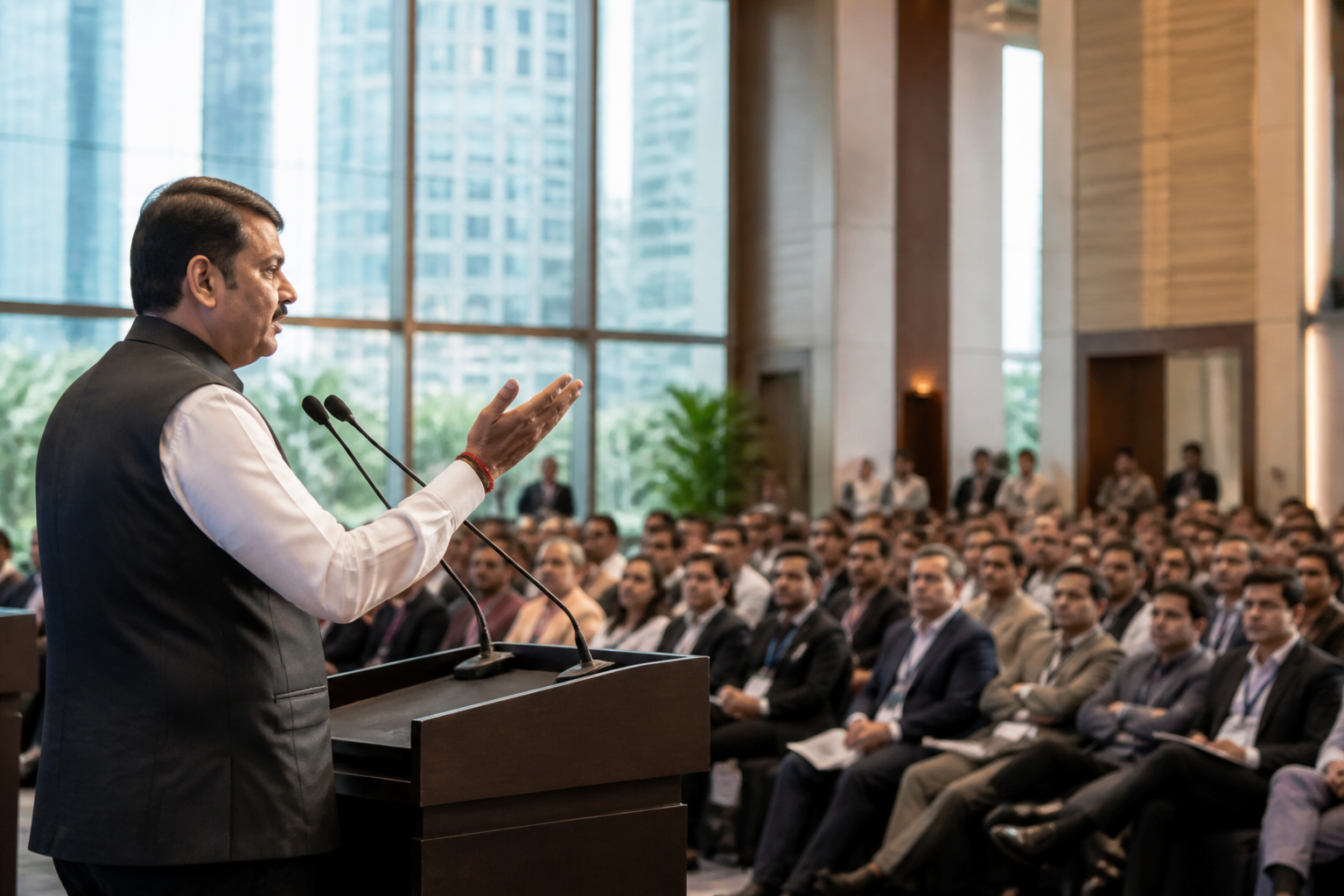
Maharashtra land tokenisation plans moved closer to a formal policy framework on Wednesday, as Chief Minister Devendra Fadnavis said the state had begun work on legislation to enable blockchain-based tokenisation of land and real-estate assets.
Speaking at the Global Fintech Fest 2026 at the Jio World Centre in Mumbai’s Bandra Kurla Complex, Fadnavis said the proposed Maharashtra Digitization and Exchange of Land Token Asset Act, referred to as the Delta Act, would establish the legal basis for the initiative. The state has not yet enacted the proposed law, and details of its implementation, regulatory safeguards and timeline were not provided in the announcement.
Fadnavis said the framework was being developed with inputs from the Securities and Exchange Board of India, the Bombay Stock Exchange, the National Stock Exchange, technology and law experts, and academic institutions. He described tokenisation as a mechanism that could convert capital locked in real estate into productive economic opportunities by improving transparency and creating liquidity.
The chief minister said Maharashtra had expressed its ambition at the previous Global Fintech Fest to become India’s first tokenised state. The latest announcement marks the state’s stated move towards creating a legal and institutional structure for that ambition, although the precise categories of land and property that could be tokenised were not specified.
Fadnavis linked the proposal to Maharashtra’s broader fintech and financial-inclusion strategy. He said the state was examining the use of Agentic AI, tokenisation and quantum technology to make financial services more accessible to farmers, women entrepreneurs, startups, micro, small and medium enterprises, and other citizens.
He said India’s success with the Unified Payments Interface had demonstrated how digital infrastructure could transform financial services. The next stage, he said, should extend digital access to credit, investments, ownership rights and financial information. Fadnavis cited the possibility of a farmer in Vidarbha, a business in Kolhapur or a woman entrepreneur in Pune accessing financial services comparable to those available to large institutions.
The chief minister also said Agentic AI could alter how citizens interact with financial products. An entrepreneur’s AI assistant could identify financial requirements and recommend options, while farmers could receive financial guidance in their mother tongue. He added that final control should remain with citizens even when artificial intelligence is used to provide services.
The announcement placed Mumbai, Pune and Navi Mumbai within the state’s proposed technology and finance network. Fadnavis described Mumbai as India’s largest financial ecosystem, Pune as a centre for technical and engineering talent, and Navi Mumbai as an emerging location for data infrastructure and global connectivity.
He invited financial and technology companies to treat Maharashtra as a real-world testing ground for solutions in agriculture, small-business finance, urban development, healthcare, mobility, fraud prevention and public finance management. The state government, he said, would support the large-scale testing of promising technologies.
Separately, an agreement related to the expansion of facilities in the Bandra Kurla Complex was handed over during the event in the presence of Fadnavis. The agreement involved the Mumbai Metropolitan Region Development Authority, SEBI, the National Stock Exchange and the Enforcement Directorate. The announcement did not provide details of the proposed facilities, project cost or completion schedule.
The next formal step for the land-tokenisation proposal will be the development and consideration of the Delta Act framework. Until legislation and accompanying rules are published, the scope, ownership protections, trading mechanisms and regulatory responsibilities for tokenised land assets remain unspecified.
