


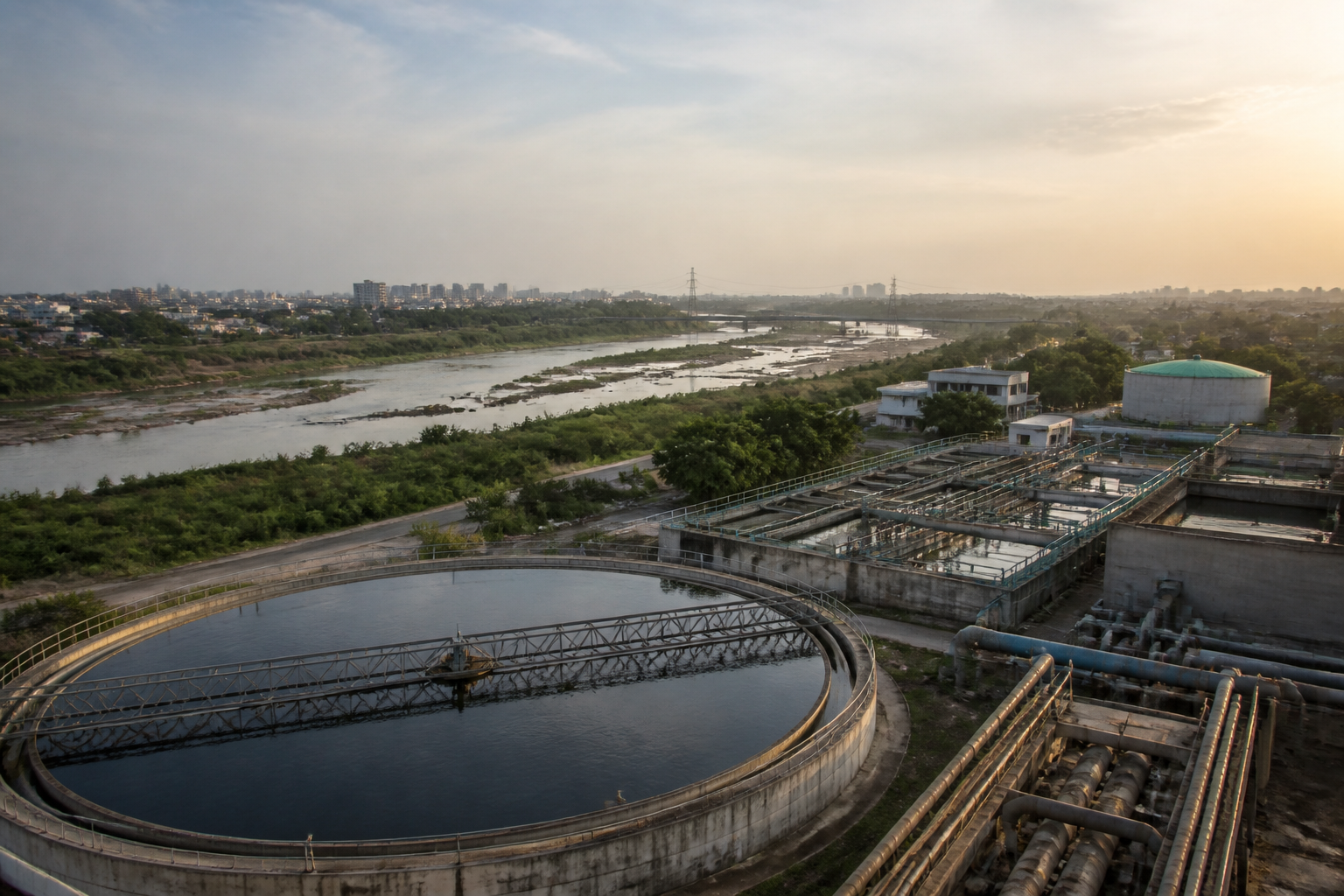
A compliance affidavit filed by the Telangana government before the National Green Tribunal has placed Hyderabad’s sewage treatment network under renewed scrutiny. The filing records repeated exceedances of prescribed limits for biological oxygen demand, chemical oxygen demand, total suspended solids and total coliform at sewage treatment plants linked to Hussain Sagar, the Musi river and several city lakes during tests conducted in 2025.
The affidavit, filed on September 7 by chief secretary Sanjay Jaju, does not establish that the plants are currently breaching standards. It does, however, provide a plant-wise record of instances in which treated effluent exceeded permissible parameters at different points during the year. That distinction matters. The document is evidence of repeated non-compliance in the monitoring record, not a direct measurement of conditions on the day of filing.
The larger urban question is whether Hyderabad’s sewage infrastructure is operating as a dependable pollution-control system or merely as a network whose performance varies significantly across plants, months and receiving water bodies. The data submitted to the tribunal suggests that the challenge is not confined to one facility or one lake. It extends across major treatment plants serving different parts of the city and discharging into multiple environmental systems.
Three plants connected to Hussain Sagar were identified in the affidavit: the 20 MLD Khairatabad plant, the 30 MLD KIMS/Picket plant and the 133 MLD Fatehnagar plant. Together, they have an installed capacity of 183 million litres per day. Each recorded at least one exceedance during the monitoring period.
At Khairatabad, BOD levels were above prescribed limits from March to August and again in October 2025. Total coliform exceeded the standard in August, while COD crossed the permissible level in October. The KIMS/Picket plant recorded BOD exceedances in March, April and from July to October. It also recorded a COD exceedance in October and was under maintenance in May.
The Fatehnagar plant’s record was more marginal in some months but extended over a substantial part of the monitoring period. BOD measured 11 to 12 milligrams per litre in March and April against a prescribed limit of 10 milligrams per litre. Levels remained above the standard from May to July, while total coliform exceeded the limit in June.
These figures are important not because each exceedance necessarily represents the same operational failure, but because they show variation in treatment performance across plants serving the same broad urban water system. The affidavit does not provide, in the supplied material, a single explanation for the breaches. It records the results and the relevant treatment facilities, leaving the operational causes to be examined through the tribunal’s compliance process.
The Musi-linked plants present another part of the pattern. The 339 MLD Amberpet sewage treatment plant recorded BOD and COD exceedances in October. The facility also receives partially treated industrial effluent from common effluent treatment plants at IDPL and PETL. The affidavit records exceedances at these CETPs in parameters including total dissolved inorganic solids, COD, BOD, total suspended solids and ammoniacal nitrogen during certain months.
This connection makes the treatment chain more complex than a single municipal plant discharging into a river. The quality entering a downstream facility may depend partly on the characteristics of waste received from other treatment systems. The filing does not state that the CETP discharges caused the Amberpet exceedances, but it identifies the interaction between municipal and industrial effluent as part of the system under review.
The 172 MLD Nagole plant recorded BOD exceedances in March, April and July, with a marginal exceedance in May. Total coliform levels were above standards in April, July and August. Plants at Nalla Cheruvu recorded exceedances in BOD, COD, TSS and total coliform during different months. Two Attapur plants discharging into the Musi also recorded BOD exceedances.
The geographical spread is equally significant. The affidavit lists plants discharging into Pedda Cheruvu, Durgam Cheruvu, Khajaguda lake, Saroornagar Cheruvu, Bhagiradha or Manikonda Cheruvu, Noor Mohammed Kunta, Safilguda lake, Rangadhamuni Cheruvu and Langer House lake. The record therefore links treatment performance not only to the Musi and Hussain Sagar, but also to a network of urban water bodies that receive treated effluent from local plants.
Among the lake-linked facilities, the 10 MLD Nacharam or Pedda Cheruvu plant recorded BOD exceedances from March to July and again in October. The 17.5 MLD Pedda Cheruvu-HMT Nagar plant reported BOD exceedances through much of the monitoring period, along with TSS and COD exceedances in October. The repeated appearance of BOD in the monitoring record indicates that organic pollution was a recurring parameter of concern across several facilities, although the supplied material does not establish a uniform cause.
For urban governance, the significance lies in the gap between installed capacity and verified treatment performance. The figures show that the city has large treatment assets: Amberpet at 339 MLD, Nagole at 172 MLD, Fatehnagar at 133 MLD and smaller facilities serving specific lakes and neighbourhoods. Capacity, however, is not the same as consistent compliance. A plant can have substantial installed capacity and still record exceedances in particular months or parameters.
The affidavit also illustrates why compliance cannot be assessed only through citywide totals. Plant-wise testing reveals where problems occur, which parameters are affected and whether the pattern is isolated or repeated. Khairatabad’s BOD exceedances, Nagole’s BOD and total coliform results, and Pedda Cheruvu-HMT Nagar’s combination of BOD, TSS and COD exceedances describe different performance profiles. Those distinctions are relevant to maintenance, process control and regulatory follow-up.
The tribunal’s role is central to the next stage. The affidavit was filed after the NGT sought clarifications during a February 25 hearing on earlier submissions, including the performance of sewage treatment plants. The filing therefore forms part of an ongoing compliance process rather than a standalone announcement. The supplied material does not specify the tribunal’s next order or prescribe a particular corrective measure.
The state’s submission also mentioned a municipal solid waste processing gap of 1,856 tonnes per day and a target to complete additional processing infrastructure by December 31. That issue is separate from sewage treatment, but its inclusion in the same compliance context points to the breadth of the environmental-management obligations before the state. Urban pollution governance involves multiple infrastructure systems whose performance must be measured, reported and followed up through accountable institutions.
What the evidence confirms is limited but important. Several Hyderabad sewage treatment plants recorded exceedances of prescribed standards at various points in 2025, and the affected facilities are connected to major water bodies and multiple urban lakes. What it does not confirm is whether those plants remain non-compliant today, why each breach occurred, or whether corrective actions have already restored performance. Those questions require updated monitoring results, plant-level explanations and further proceedings before the tribunal.
The immediate significance of the filing is therefore institutional as much as environmental. Hyderabad’s sewage network is being assessed not simply by the amount of infrastructure installed, but by the reliability of the treatment delivered at the point of discharge. The next meaningful developments will be the NGT’s response, updated compliance data and evidence showing whether the exceedances recorded in 2025 were temporary episodes or part of a continuing pattern.
