


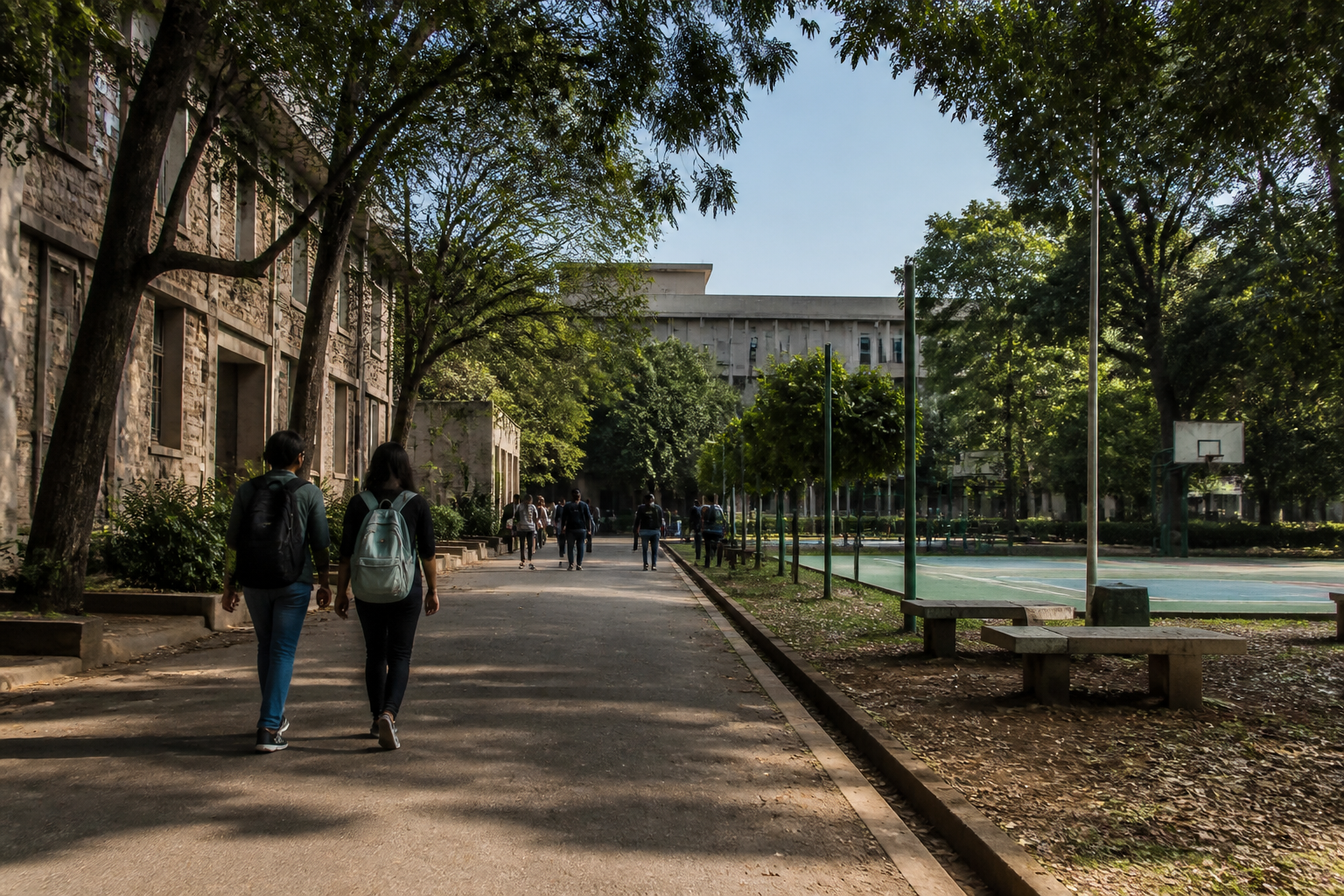
A student survey at the Indian Institute of Science in Bengaluru has linked mental-health distress to a combination of academic workload, financial pressure, inadequate support systems and the shrinking availability of informal campus spaces. Conducted by the students’ council after the suicide deaths of two IISc students in August, the survey received 1,035 responses and has brought a wider institutional question into focus: whether a campus can protect student well-being when the academic, financial and physical systems around students are all under pressure.
The findings do not identify a single cause of distress. Instead, they describe a connected set of pressures. Eighty per cent of respondents attributed their distress to their financial situation, while 50% said mandatory academic workload caused significant distress. Almost half, or 46%, said disruptions in the supply of basic amenities contributed significantly to their distress. The survey also recorded concerns about the adequacy of psychiatric support, access to existing services and the ability of students to participate in decisions that affect their daily lives.
This distinction matters. Mental-health policy on campuses is often framed around counselling, awareness campaigns and individual help-seeking. The IISc survey, as reported by the Times of India, presents student distress as an institutional and built-environment issue as well. Students described how tuition and living costs, laboratory culture, attendance rules, amenities, recreation areas and administrative procedures combine to shape their ability to cope. The evidence supplied in the report does not establish that any one factor caused the deaths. It does show that students see their mental health as closely connected to how the institution operates.
The survey’s strongest demands concern the conditions in which students study and work. Seventy-four per cent of respondents called for an improved work environment, making it the most widely cited urgent need. Greater financial assistance was identified by 68%, while 64% sought student-friendly attendance policies and changes to academic workload. Fifty-four per cent wanted greater participation in decision-making. Half called for more awareness, accessibility and transparency in mental-health support.
These responses suggest that students are not viewing wellness as a service located outside the academic system. They are connecting it to the organisation of academic time, the distribution of financial risk and the design of everyday campus life. A counselling centre may provide an essential point of support, but it cannot by itself resolve a workload that students consider unmanageable, a leave process they find difficult to navigate or an income that no longer keeps pace with expenses.
The financial figures cited by students illustrate the pressure. Undergraduate tuition is reported to have increased eight-fold, from Rs 10,000 a year to Rs 80,000 for the 2026 batch onwards. The amenities component of fees has also risen from approximately Rs 2,000-2,500 to Rs 3,500. Students expect another 50% increase the following year, although that expectation is not presented in the supplied material as a confirmed institutional decision.
For doctoral students, the concern is different but related. PhD fellowships have remained at Rs 37,000 since 2023-24, according to the report, while monthly mess bills are projected to rise from approximately Rs 6,000-7,000 to Rs 10,000-11,000. Students describe this as a decline in real income: the nominal fellowship remains unchanged while essential monthly costs increase. The supplied report does not provide a full household-cost index or an institutional budget comparison, but the figures indicate why financial assistance emerged as the second most common priority in the survey.
Affordability also affects the meaning of access. A student who has to spend more on tuition, food and amenities has less flexibility to seek external support, take time away from laboratory work or participate in activities that provide social connection. The survey found that 85% of respondents wanted increased reimbursement for external mental-health support. That demand implies that students do not consider campus services sufficient for all needs, or that external treatment may impose costs that many cannot easily absorb.
The survey also points to an infrastructure dimension. Students told the Times of India that spaces once used for informal socialising have become less available. A previously open ground has been converted into a bookable, partly commercialised stadium, while the swimming pool has been drained citing water scarcity. Students also said security personnel restrict informal gatherings in some common areas. These changes may appear operational or administrative when considered separately. Taken together, students experience them as a reduction in the unplanned social spaces that allow them to rest, meet peers and decompress without scheduling, payment or formal permission.
One PhD student described the practical consequence of that shift: students with packed schedules cannot always plan and pay to use a facility, whereas they could previously go spontaneously to a playground. This is a significant observation about campus planning. Informal spaces are not merely recreational extras. They are part of the social infrastructure of an institution, particularly for residents whose work and accommodation are concentrated on campus. When every space becomes bookable, restricted or unavailable, the campus offers fewer low-cost opportunities for interaction.
The reference to water scarcity also shows how environmental constraints can have social consequences. The report does not establish the full reasons for the pool’s closure, its duration or whether alternative facilities were provided. It does, however, show that decisions involving water, land use and security are experienced by students through their effect on everyday routines. Infrastructure management and student welfare are therefore not separate policy domains. A facility decision can alter how people move, gather and recover during demanding periods.
Academic governance is another recurring concern. Students described what they called a toxic work culture in some laboratories and rigid attendance policies. They said that obtaining approval for genuine medical or mental-health leave could become a prolonged process. These are student allegations reported by the Times of India and are not independently established in the supplied material. They nevertheless identify a governance problem that extends beyond counselling: whether institutional rules allow students to disclose difficulty without fearing academic or administrative consequences.
The survey’s call for student participation in decision-making is relevant here. With 54% seeking a greater role, students appear to be asking not only for better services but also for a voice in the rules that shape those services. Participation could include decisions about attendance, leave, fee structures, amenities and access to support, although the supplied survey summary does not set out a proposed governance model. What it does establish is a gap between the decisions students experience and the influence they believe they have over them.
The mental-health support findings reinforce that gap. Forty-seven per cent of respondents said psychiatric support on campus was inadequate, while 84% called for greater awareness and accessibility of existing support. The difference between these figures is important. It indicates that students may see two problems at once: the capacity or quality of the support available, and the ability of students to understand, reach and trust it. Improving visibility without improving capacity would leave one part of the problem unresolved; expanding services without making them accessible could produce a similar result.
The report also describes frustration with institutional communication after student suicides. Students said administrative messages urging them to stay positive and talk to people were not followed by sufficient policy changes, and that similar concerns had recurred since 2021. The supplied material does not include a detailed account of the institute’s response, its current policies or any official reply to the survey’s findings. That absence limits what can be concluded about implementation. It does, however, make the next institutional steps central to assessing whether the survey leads to structural action rather than another cycle of reassurance.
For IISc, the challenge is therefore not simply to expand a wellness centre. It is to examine how the campus functions as a live-work environment. Fees, fellowships, mess costs, laboratory expectations, attendance rules, leave approvals, shared amenities and social spaces all form part of the conditions under which students study. A mental-health strategy that treats these factors as unrelated will struggle to respond to the pattern identified by the survey.
The evidence currently available is substantial enough to show the breadth of student concern but not sufficient to settle every question. The survey records perceptions and priorities from 1,035 respondents; it does not, in the supplied material, provide a breakdown by programme, year, gender, residence, discipline or income. It also does not establish how representative the respondents are of the full IISc student population. Those details would help determine whether particular groups face distinct levels of financial, academic or access-related pressure.
The institute’s response will determine what happens next. Key issues to monitor include whether IISc publishes a formal response to the survey, reviews academic workload and leave procedures, addresses the affordability gap facing students, clarifies the availability of campus facilities and strengthens independent access to mental-health care. The central finding is already clear: IISc students are describing mental-health distress not as an isolated personal problem, but as a measure of how the institution’s academic, financial, governance and physical systems are working.
