


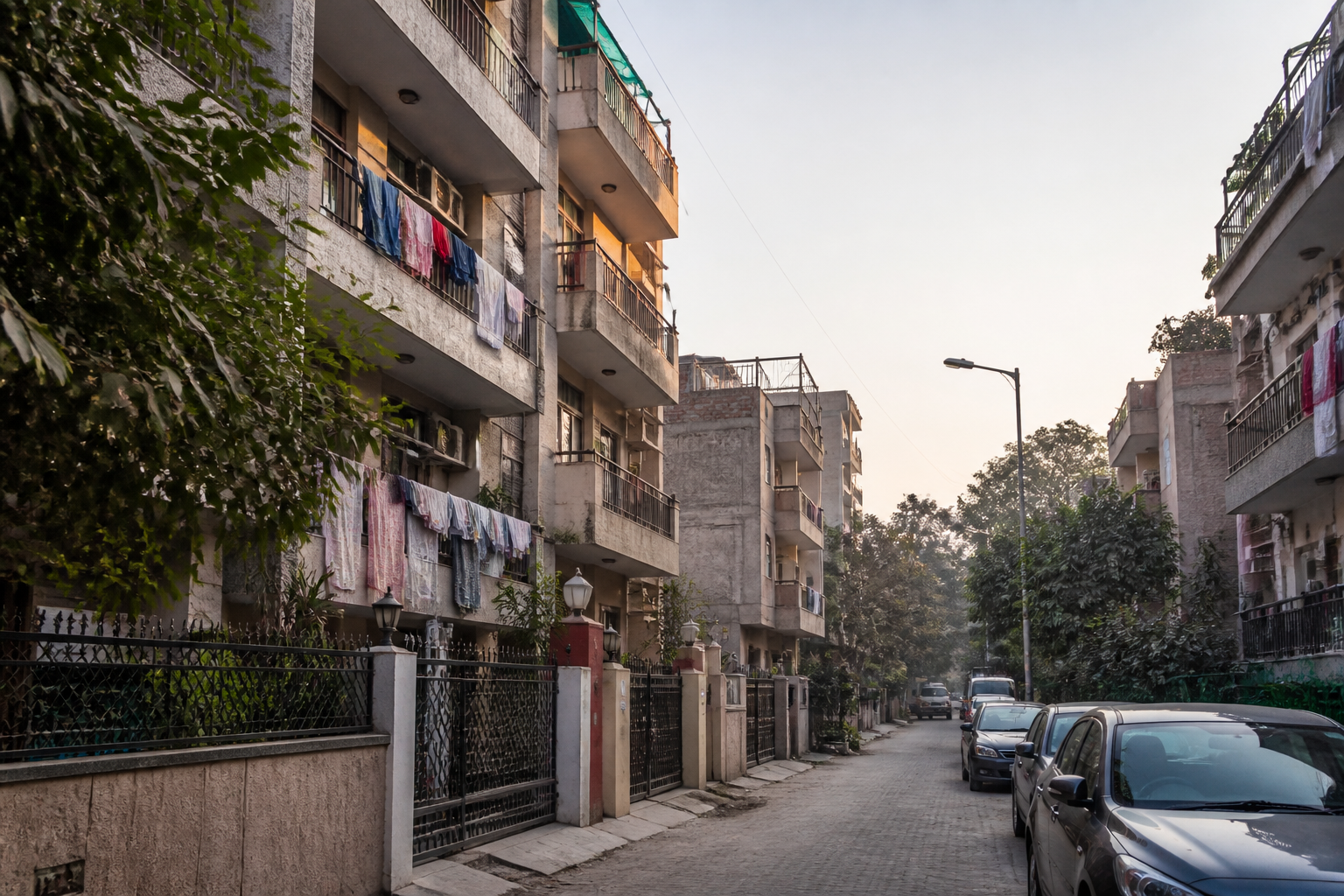
The collapse of a five-storey building operating as a paying guest accommodation in south Delhi’s Satya Niketan on September 6, in which seven people died, has exposed a housing system that has expanded faster than the rules governing it. Across neighbourhoods such as Munirka, Satya Niketan, Kalu Sarai and Laxmi Nagar, private paying guest facilities have become an essential part of the city’s student and early-career housing supply. The tragedy has turned attention to the safety conditions inside that parallel market.
The immediate question for many tenants is whether the buildings in which they live are structurally safe. The deeper question is why so many students and young professionals depend on privately operated accommodation in the first place, and why the city has struggled to establish a consistent framework for the properties serving them.
Delhi attracts students and young professionals from other parts of India and from abroad. Most arrive without a home in the city and need rental accommodation close to colleges, workplaces and transport links. In the absence of sufficient institutional hostel capacity, many move into shared rooms or beds in privately operated PGs. The report describes arrangements in which homes have been converted into hostels, with narrow buildings, multiple floors, bunk beds, shared facilities and high tenant turnover.
According to the material published by NDTV Business, students commonly pay between Rs 8,000 and Rs 20,000 a month for a shared bed. The report also cites the National Trade Confederation as estimating that students living in rental accommodation in Delhi contribute Rs 45,000 crore to the market. These figures are presented as estimates, but they indicate the scale of the economic activity surrounding student housing. What began as a fragmented rental arrangement has become a substantial urban property segment.
Real estate advisor Dipesh Garg, co-founder of SouthDelhi1, separately estimated that Rs 11,000 crore to Rs 15,000 crore is spent annually on PG rentals. The difference between the two figures reflects the varying definitions and coverage of the market, but both estimates point to the same structural fact: student accommodation is no longer marginal to Delhi’s residential economy.
That economic scale has not been matched by a comparable system of oversight. The report says students living in similar buildings have described cracked walls, water seepage during the monsoon and interior partitions added after approval. These accounts are not presented as a citywide survey, and they do not establish that every PG building is unsafe. They do, however, show how tenants may be expected to assess risks that are difficult for non-specialists to identify and that are rarely visible in rental listings.
The market also places tenants in a weak bargaining position. A student seeking accommodation may prioritise proximity to a college, workplace or public transport because alternatives are limited. When demand is high and formal hostel supply is insufficient, landlords can compete primarily on location, room availability and convenience. Safety, ventilation, maintenance and legal compliance may be difficult for tenants to compare before moving in, particularly when there is no accessible public certification system.
This imbalance is closely connected to the shortage of university and college hostel accommodation. Delhi University colleges do not have enough hostel beds for the number of students arriving from outside the city, according to the report. Only a small fraction can obtain campus accommodation, while some existing hostels are described as being closed for repairs. Former leaders of the Delhi University Teachers’ Association have also pointed to a mismatch between investment in new academic buildings and the condition of existing hostel infrastructure.
The shortage does not simply push students into the private market. It changes the terms on which that market operates. When institutional housing cannot absorb demand, privately managed rooms become a necessary substitute rather than an optional convenience. A student who finds a bed in a crowded or poorly maintained building may still accept it because the alternative is a longer commute, a higher rent or no accommodation at all.
The geography of Delhi’s PG market reinforces this pressure. The report identifies established South Delhi neighbourhoods such as Greater Kailash, Defence Colony, Panchsheel Park, Hauz Khas and Vasant Vihar as locations that command rents because of connectivity and access to social, commercial and educational centres. These are not merely residential preferences. They are part of the infrastructure of access to colleges, employment and urban networks.
As demand rises, residential properties are being used in ways that may not have been anticipated when they were approved or developed. The conversion of homes into shared accommodation can alter the number of occupants, internal layouts, fire-safety requirements, waste generation, water use and the intensity of movement through common spaces. It can also create tension between the formal classification of a property and its actual use.
Garg described the change as a broader transition in residential property usage, rather than only a PG issue. In his assessment, tenants are increasingly looking beyond rent and location to building quality, ventilation, security, amenities, maintenance and compliance. For landlords, he said, structurally sound and legally compliant properties may be better placed to earn tenant trust and higher rents over time.
That shift, if sustained, could make safety and compliance more visible in the rental market. But it cannot substitute for public regulation. Tenants may express a preference for safer buildings, yet they cannot independently conduct structural audits, verify approvals or determine whether changes to a building have weakened its safety. The responsibility for establishing minimum standards therefore remains with authorities, owners and operators.
The Delhi government has responded to the Satya Niketan collapse with a proposed framework for regulating PG accommodation. Urban Development Minister Ashish Sood has outlined a plan under which operators would require a formal licence, along with police and municipal verification before opening. The Municipal Corporation of Delhi is also expected to introduce periodic structural audits and mandatory safety certifications. Under the proposed approach, a property without the required certificate would not be permitted to operate.
The report also refers to a possible relaxation of Floor Area Ratio norms so that hostels can be rebuilt legally with greater capacity. This proposal reflects the central tension in the system. If authorities restrict occupancy without expanding legitimate housing supply, students may continue to seek beds in unregistered properties. If they allow capacity to grow without enforcing structural, fire and occupancy standards, regulation may legitimise unsafe density rather than solve it.
The Master Plan for Delhi 2047 is described in the report as leaving PG regulation unclear, with restrictions in some colonies but without a fully developed framework for these establishments. This gap matters because enforcement is difficult when the rules do not clearly define what a PG is, which standards apply to it, which authority must approve it and how responsibility is divided among municipal, police, planning and educational institutions.
A workable system would therefore need to connect licensing with the actual conditions of operation. A certificate cannot be meaningful if it verifies only paperwork while ignoring internal alterations, occupancy levels, emergency access, stairways, ventilation or maintenance. Periodic audits would also need to account for the fact that buildings can change after approval as owners add partitions, beds and facilities to meet demand.
The same problem extends beyond the building itself. Student housing is shaped by the supply of hostels, the location of colleges, the affordability of transport and the availability of rental homes. Regulation focused only on PG operators may improve compliance in individual buildings but leave the underlying shortage untouched. Without more formal housing choices, students may continue to accept risk because they cannot afford to reject scarce accommodation.
The figures cited in the report illustrate this demand-and-supply imbalance. Monthly shared-bed rents of Rs 8,000 to Rs 20,000 place private accommodation within reach of some students and young professionals, but also make the market commercially attractive to property owners. The reported annual PG rental spending of Rs 11,000 crore to Rs 15,000 crore, alongside the National Trade Confederation’s broader Rs 45,000-crore estimate, suggests that the financial incentives to convert residential space are considerable.
Yet market size alone does not demonstrate market quality. A large rental economy can coexist with weak information, uneven enforcement and significant tenant vulnerability. The key issue is whether public agencies can make safety and legality as visible and enforceable as location and rent. Without that, the economic success of the sector may continue to depend on tenants accepting conditions they cannot properly evaluate.
The Satya Niketan collapse has made the risk visible, but the report does not establish how many Delhi PG buildings are unsafe or how many operate without valid approvals. It also does not provide a verified citywide inventory of facilities, hostel beds, structural audits or enforcement actions. Those gaps are important. They show that the next stage of the policy response will require more than announcements: authorities will need reliable information on the buildings, operators and occupants that make up the sector.
Delhi’s student housing challenge is therefore not only about private landlords or one collapsed building. It is about the relationship between educational capacity, urban land use, rental demand and municipal oversight. The proposed licensing, verification and audit system could provide a foundation for safer accommodation, but its effectiveness will depend on clear rules, consistent enforcement and sufficient legal housing supply. The developments to monitor are the final regulatory framework, the implementation of structural certifications, the treatment of converted properties and whether institutions expand or repair hostel capacity.
