


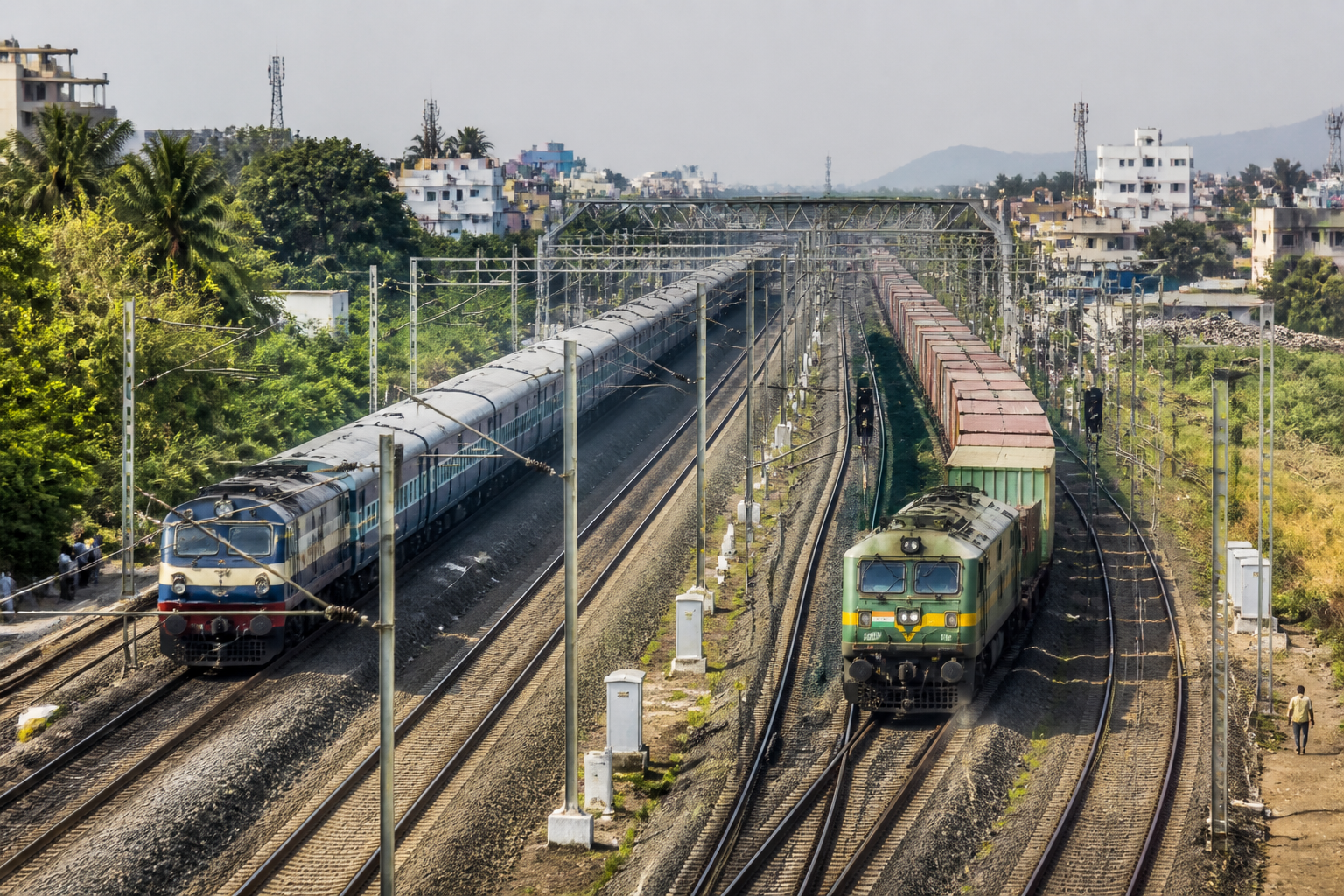
The Centre has approved three railway capacity-enhancement projects covering 383 km in Tamil Nadu, with the works aimed at easing congestion, improving operational reliability and expanding freight capacity across key routes, according to a report by Times of India – Chennai published on Wednesday.
The approved works comprise the construction of third and fourth lines along the 77-km Arakkonam-Renigunta route, doubling of the 147-km Hosur-Omalur section, and doubling of the 159-km Salem-Karur-Dindigul section. Together, the three Tamil Nadu projects form part of a wider package covering five multitracking projects across four states.
The broader package is valued at Rs 10,021 crore and will add about 540 km to the railway network across Tamil Nadu, Andhra Pradesh, Karnataka and Telangana. The projects will cover 17 districts and improve connectivity to about 2,121 villages with a combined population of around 52 lakh, the report said.
The Arakkonam-Renigunta corridor is an important rail link in northern Tamil Nadu and connects the state with the railway network towards Andhra Pradesh. The Hosur-Omalur and Salem-Karur-Dindigul sections serve major parts of western and central Tamil Nadu. The approved doubling and additional lines are intended to increase the number of trains that can operate on the routes and reduce pressure on existing track capacity.
The Centre expects the projects to support the movement of commodities including coal, cement, iron and steel, containers, automobiles, foodgrains, petroleum products and fertilisers. The capacity augmentation is projected to enable an additional 47 million tonnes of freight traffic annually across the five-project package.
The approval is also expected to support wider transport and environmental objectives. According to the Centre, the projects could reduce oil imports by about eight crore litres and cut carbon dioxide emissions by around 42 crore kilograms. The figures apply to the approved package covering the four states, rather than solely to the three Tamil Nadu sections.
The projects have been planned under the PM Gati Shakti National Master Plan and are scheduled for completion by 2029-30. The announcement did not provide section-wise construction schedules, land requirements, tender timelines or details of the funding allocation for each Tamil Nadu corridor.
The Centre’s approval now places the three routes within the planned multitracking programme. Further implementation details, including construction milestones and tendering arrangements, are expected to determine when the additional capacity becomes operational.

