


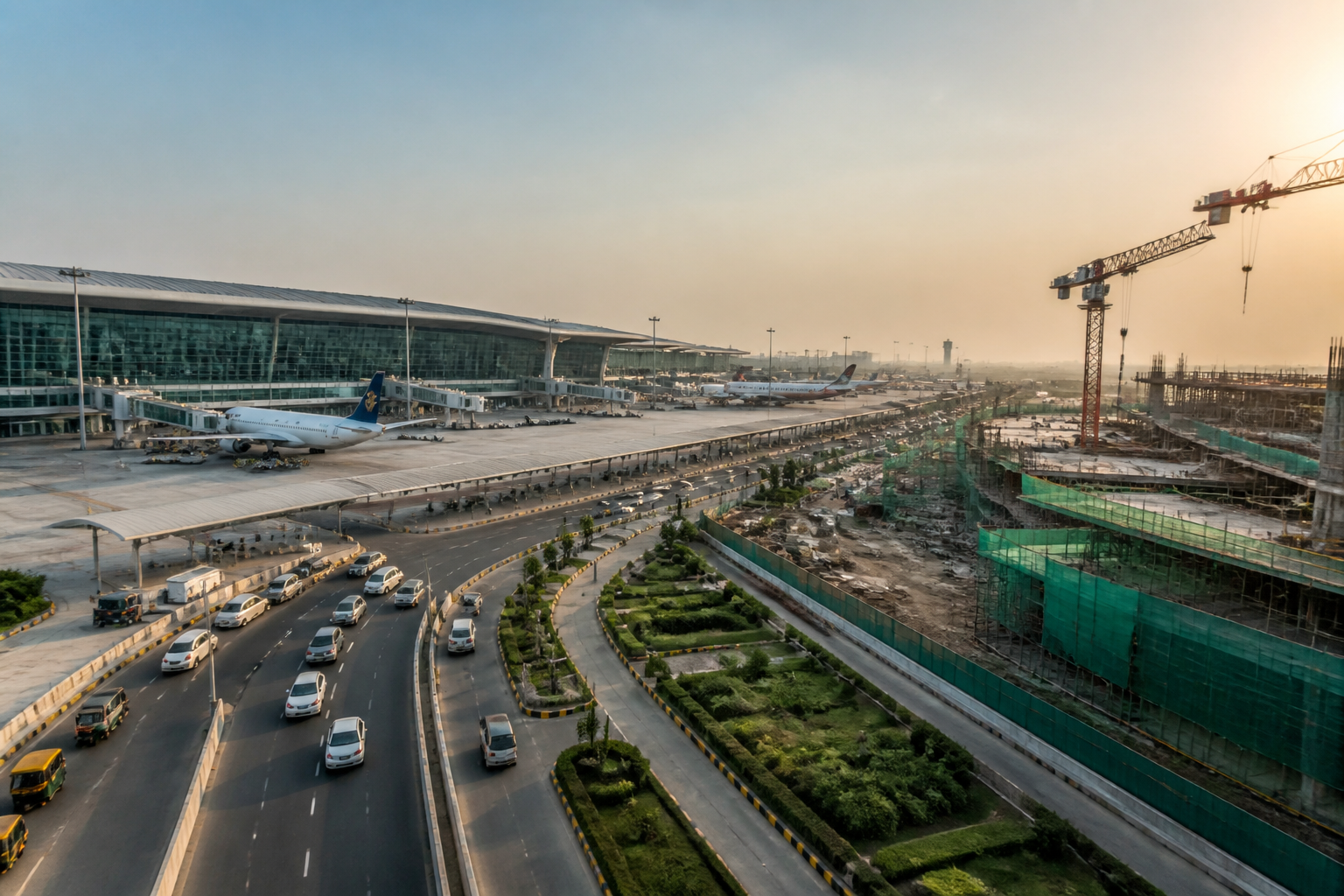
Delhi Airport’s expansion plan is designed to push international capacity sharply higher by 2030, but it also exposes a larger question for the National Capital Region: how should India’s busiest airport and the new Jewar airport divide future passenger demand? The 10-year master plan shared by Delhi International Airport Ltd (DIAL) proposes a new international pier at Terminal 3, limited capacity improvements at Terminal 1 and a possible longer-term replacement for Terminal 2.
The plan, reported by The Times of India, would increase Indira Gandhi International Airport’s overall capacity from 10.4 crore passengers per annum to more than 12.5 crore by early 2030. The most significant change would be at Terminal 3, where a proposed international pier, identified as Pier E, would add capacity for 1.6 crore passengers annually. With that addition, Terminal 3’s capacity would rise from 5 crore to 6.6 crore passengers per annum, including 4.6 crore international passengers and 2 crore domestic passengers.
The numbers show that the proposed expansion is not a uniform enlargement of every terminal. It is primarily an international-capacity intervention. At present, Terminal 3 has capacity for 5 crore passengers annually, of which 3 crore are international and 2 crore are domestic, according to the report. The new pier would therefore add substantially more international handling capacity than domestic capacity. That distinction matters because airports are not simply buildings with larger floor areas. Their effective capacity depends on the ability of check-in halls, security areas, immigration facilities, baggage systems, gates, aprons, aircraft stands and access roads to work together.
DIAL also plans a smaller increase at Terminal 1 through internal changes rather than a structural expansion. Additional check-in and security counters are expected to lift Terminal 1’s capacity from 4 crore to 4.5 crore passengers per annum. Terminal 2, currently assigned capacity of 1.4 crore passengers annually, would continue in its existing form for some years. The report says it could eventually be demolished and replaced by a larger Terminal 4 in the next decade, depending on demand.
This proposed sequencing reveals the institutional logic behind the master plan. The immediate priority is to add capacity where international growth is expected to be strongest, while extracting a limited increase from an existing domestic terminal. A larger terminal replacement is being held for a later phase and tied to demand conditions. That approach can reduce the risk of building expensive capacity too early, but it also means that the airport’s future depends on whether the interim terminals and their supporting systems can absorb traffic until the next major construction cycle begins.
The plan was shared during a stakeholder consultation held on August 16 at a hotel near the airport. DIAL, backed by the GMR Group, is finalising the 10-year master plan in consultation with stakeholders. The document is scheduled to be submitted to the aviation ministry, which will then seek further responses, according to the report. This means the figures currently available describe a plan under institutional review rather than a completed approval or construction schedule.
That distinction is important for understanding what has and has not been decided. The proposed Pier E, the Terminal 1 modifications and the possible Terminal 4 are components of a planning framework. The supplied report does not establish a final construction tender, a confirmed completion date for each package, a detailed project cost or a final operating arrangement between Delhi’s airports. Those details will determine how quickly the announced capacity can become usable capacity.
The international focus also reflects Delhi’s position as India’s largest aviation hub. The present allocation at Terminal 3 gives it 3 crore passengers per annum of international capacity and 2 crore of domestic capacity. Under the proposed plan, international capacity would increase to 4.6 crore passengers per annum while domestic capacity at the terminal would remain at 2 crore. Across the airport, the total would move from 10.4 crore to more than 12.5 crore passengers annually. The report describes this as more than a 50% enhancement in international traffic-handling capacity, while the overall airport increase is smaller because the domestic expansion is marginal in comparison.
The difference between terminal capacity and airport-wide growth is one of the clearest signals in the plan. A new international pier can raise the number of passengers the airport is designed to process, but it does not by itself guarantee a matching increase in flights. Airlines must deploy aircraft, secure slots, serve viable routes and operate within airspace, runway and ground-handling constraints. The supplied material does not provide forecasts for airline schedules, aircraft movements or route additions. It therefore supports a capacity analysis, but not a conclusion about how much traffic will actually materialise.
The plan also sits within a changing airport geography in Delhi-NCR. Jewar airport in Greater Noida has emerged as a secondary airport for the region, but the report says it is struggling to attract flights and passenger footfalls in the shadow of IGIA. This creates a central planning challenge. A second airport can distribute demand, reduce pressure on a dominant hub and create new access points for parts of the region. But distribution does not happen automatically. Airlines, passengers, cargo operators and ground transport providers must all find the second airport operationally and commercially useful.
The contrast between the two airports raises questions about how regional aviation capacity is planned. IGIA already has established airline networks, passenger familiarity and supporting urban connections. Jewar, by contrast, must build its own traffic base. If most demand continues to concentrate at IGIA, expanding the established hub may appear commercially rational in the short term. If Jewar is expected to play a meaningful regional role, however, its performance cannot be measured only by the existence of runway and terminal capacity. It must also be assessed through flight availability, passenger access and the ability of the regional transport system to connect it with population and employment centres.
The institutional responsibility is divided across several layers. DIAL is preparing the airport master plan and consulting stakeholders. The aviation ministry will receive the plan and seek responses before the proposal advances. Airlines will determine how capacity is used through their networks and schedules. Passengers will experience the outcome through the availability of flights, terminal processing times and access arrangements. The report does not specify how these interests will be reconciled, but the approval process makes clear that the expansion is not solely a construction decision.
The numbers also show why phasing matters. The current airport capacity is distributed across three terminals: 4 crore passengers per annum at domestic Terminal 1, 1.4 crore at Terminal 2 and 5 crore at Terminal 3, which serves both domestic and international traffic. The proposed plan adds 1.6 crore of international capacity through Pier E and 50 lakh of capacity at Terminal 1. Together, those changes raise the airport’s planned capacity to more than 12.5 crore passengers annually. The scale of the increase is substantial, but its physical concentration at Terminal 3 means that supporting infrastructure around the international operation will be critical.
The proposed future replacement of Terminal 2 adds another layer. DIAL plans to retain the terminal for some years before demolishing it to make way for a larger Terminal 4, with the timing dependent on demand. This creates a staged model: near-term capacity gains through a new international pier and internal terminal modifications, continued use of Terminal 2 during the interim period, and a potentially larger redevelopment in the next decade. The model is designed to match investment to demand, but it also requires the airport to manage construction and passenger operations over multiple phases.
For the city and the wider region, airport capacity is closely linked to land-side movement. Every additional passenger must reach the terminal, pass through security and immigration, collect baggage where applicable and leave the airport. The supplied report does not provide details on road capacity, public transport connections, parking, curbside management or freight movement. Those omissions do not diminish the importance of the terminal plan; they identify the areas that will need attention as the proposal moves through review. A larger airside and terminal system can only function efficiently if access and interchange systems keep pace.
The larger urban question is therefore not simply whether Delhi needs more airport capacity. It is whether the National Capital Region can organise capacity across two airports without creating avoidable concentration at one hub or underuse at the other. IGIA’s proposed expansion responds to immediate demand and strengthens its role as the region’s dominant international gateway. Jewar’s weaker traffic position shows that physical capacity elsewhere does not automatically produce a balanced airport network.
What the evidence currently confirms is a substantial proposed increase in IGIA’s capacity, led by international expansion at Terminal 3, a smaller Terminal 1 improvement and a possible future replacement for Terminal 2. What remains uncertain is the final form of the master plan, the approval outcome, the construction timetable, the investment required and the division of traffic between IGIA and Jewar. The next important milestone is the plan’s submission to the aviation ministry and the response process that follows.
