


Uttar Pradesh’s Rs 1,051-crore development push across Mathura and Vrindavan is being presented as a transformation of the Braj region, but its deeper significance lies in how a pilgrimage town absorbs infrastructure built for much larger visitor flows. The programme brings together roads, bridges, accommodation, municipal training, public spaces and proposed temple complexes, while also raising a difficult urban question: can connectivity and tourism expand without weakening the historic character that attracts visitors in the first place?
The state announced 229 projects across Mathura and Vrindavan around Krishna Janmashtami. According to the supplied report, 62 projects worth Rs 540 crore have been inaugurated and the foundation stones for another 167 projects valued at more than Rs 437 crore have been laid. A further Rs 72 crore was transferred directly to beneficiaries under various housing schemes. The figures indicate a broad infrastructure push rather than a single flagship project, although the available material does not provide a consolidated implementation schedule for all 229 works.
The most consequential completed or initiated works are connected to movement. A Rs 251-crore four-lane highway is planned to connect the Yamuna Expressway directly with Vrindavan, addressing congestion on narrower access roads used by pilgrims arriving from the expressway. The stretch is to include dedicated lanes and LED lighting. A new two-lane bridge over the Yamuna is intended to reduce pressure on older bridges and pontoons while improving access between rural areas and hospitals and markets in Mathura.
Another project is a Rs 44-crore flyover at the point where the expressway link road meets the Mathura-Vrindavan highway. The intervention targets a junction where regional traffic and pilgrimage traffic converge. In Chhata, an Rs 86-crore, 30-metre master-plan road is intended to divert freight movement away from village lanes and create conditions for commercial development. These projects show how the programme is not limited to temple access: it also seeks to reorganise the movement of goods, residents and visitors across the wider urban region.
The accommodation and civic components are equally important. A 12-storey tourist hostel costing Rs 47 crore is being built within the Nayara Police Lines campus to serve festival demand during Janmashtami, Holi and Radhashtami. Vrindavan is also receiving a Rs 31-crore civic training centre for municipal staff, with a stated focus on cleanliness, smart services and pilgrim management. The inclusion of staff training is significant because visitor pressure is experienced not only on roads but also through waste, sanitation, public information and crowd-handling systems. However, the supplied material does not establish how many additional municipal personnel or operational resources will be available after the centre becomes functional.
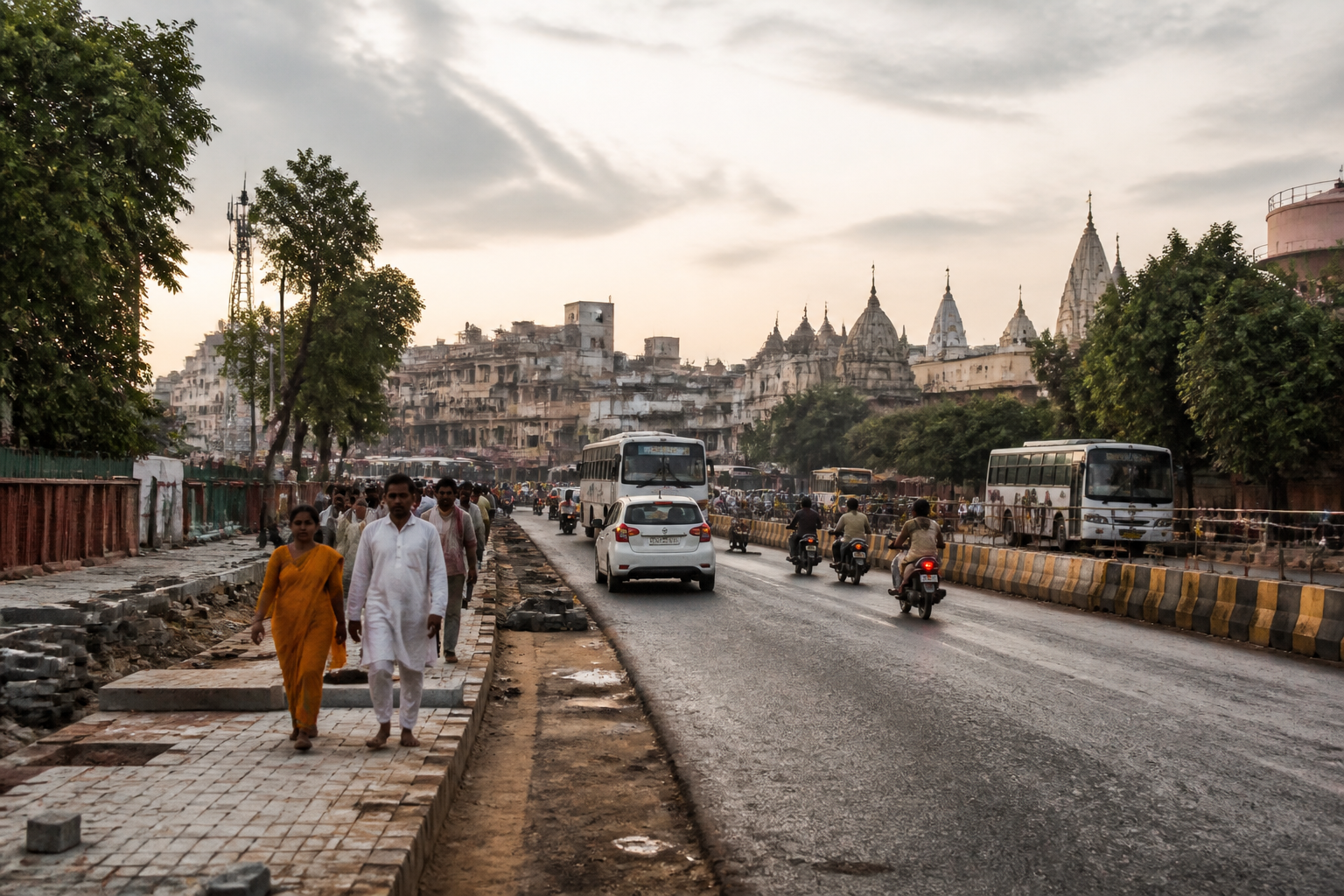
A Rs 35-crore improvement programme on Chhatikara road, the main gateway to Vrindavan from NH-19, includes landscaping, footpaths, cycle tracks and underground wiring. In planning terms, this represents an attempt to redesign the arrival experience and improve the public realm at the same time. Yet gateway beautification and internal city capacity are different tasks. The available information identifies proposed improvements on a major approach road, but does not provide details on pedestrian safety inside Vrindavan’s narrower lanes, parking enforcement, water supply, drainage or waste-processing capacity.
The state has also flagged a ropeway in Vrindavan, mega parking projects, the Raya Urban Node, a Surdas Brajbhasha Academy and Saurabhi Van, described in the report as a 400-acre city forest. These proposals broaden the transformation agenda from transport and visitor accommodation to land development, culture and green infrastructure. Their inclusion in the announcement does not, however, establish their final design, land requirements, funding structure or completion dates. That distinction matters in a region where the announcement of a project can influence expectations before construction begins.
The political and cultural framing of the programme is central to understanding its urban implications. The chief minister has announced plans for grand temple complexes in Mathura-Vrindavan on a scale comparable with those in Ayodhya and Kashi, describing the development as aligned with public faith and the spiritual and cultural importance of the region. This places the infrastructure programme within a larger model of pilgrimage-led urban redevelopment, in which temple investment, visitor facilities and road construction reinforce one another.
Ayodhya is the reference point for this model in the supplied material. The report links the city’s transformation to rising hotel demand and higher land prices near the Ram Mandir, then examines whether similar forces could emerge in Mathura-Vrindavan. The comparison is useful, but it should not be treated as proof of identical outcomes. Ayodhya and Vrindavan have different urban forms, histories, visitor patterns and physical constraints. The report provides no comparable land-price or hotel-occupancy dataset for Mathura-Vrindavan, so the likely real-estate effects remain an expectation rather than an established result.
The infrastructure logic is straightforward. Better access from the Yamuna Expressway can shorten travel friction for visitors from Delhi, Noida and Greater Noida. A stronger road network may support weekend visits, while new accommodation can absorb festival-related demand. The Chhata road could also improve freight movement and create opportunities for retail and warehousing. These are plausible channels through which public infrastructure can affect land use, but the supplied material does not quantify expected visitor growth, additional floor space, hotel rooms, employment or land conversion.
The report also identifies Vrindavan’s emergence as a retirement and long-stay destination. That use places a different burden on the city from short-duration pilgrimage. Long-stay residents require dependable water, sanitation, healthcare access, local mobility, waste management and everyday public services. A city designed primarily for peak festival crowds may not automatically meet those requirements. Conversely, facilities designed only for permanent residents may be inadequate during seasonal surges. The planning challenge is therefore one of managing two overlapping populations: a resident community and a fluctuating pilgrimage economy.
Ankit Aggarwal, director of Devika Group, described the government’s investment as a new phase for the Braj region, pointing to connectivity, civic amenities, tourism and cultural infrastructure. He also said improved services could make Vrindavan more accessible, liveable and suitable for organised development. His comments represent an industry perspective and are relevant to the real-estate implications of the programme, but they do not constitute independent evidence of market performance.
Aggarwal’s caution is more important than the promotional language surrounding the investment. He said Vrindavan differs from a conventional emerging real-estate market because its spiritual and cultural character is its principal asset. In his view, the next phase must address internal connectivity, parking, sanitation, water management, green spaces and heritage conservation. These areas point to the institutional responsibilities that will determine whether regional infrastructure produces a functioning urban system or only a more accessible destination.
The government’s project list shows clear attention to regional connectivity and arrival infrastructure. It is less detailed on the systems that operate continuously after a visitor reaches the city. Roads and flyovers can reduce travel time at selected points, but they do not by themselves resolve congestion in heritage precincts, manage pedestrian flows, protect ghats, maintain public toilets or ensure that new construction respects the existing urban grain. The civic training centre signals recognition of this gap, although its eventual impact will depend on staffing, budgets, operating procedures and coordination between local and state agencies.
The Rs 72-crore transfer under housing schemes introduces another dimension. It suggests that the transformation is not solely about visitors, investors or landmark infrastructure. Residents are also part of the programme’s stated beneficiary base. The supplied report does not identify the number of beneficiaries, the schemes involved, the location of the housing or whether the transfers are linked to new construction, repairs or other forms of support. Without those details, the housing component cannot yet be assessed as a broader affordability or displacement intervention.
The programme’s data profile is therefore uneven. There are clear announced amounts: Rs 1,051 crore across 229 projects, Rs 540 crore for 62 inaugurated projects, more than Rs 437 crore for 167 projects whose foundations were laid, Rs 251 crore for the four-lane highway, Rs 47 crore for the tourist hostel, Rs 86 crore for the Chhata road, Rs 44 crore for the flyover, Rs 35 crore for Chhatikara road and Rs 31 crore for the civic training centre. What is not available in the supplied material are project completion dates, operating costs, land acquisition details, expected capacity, traffic forecasts or performance indicators.
That missing information is important because pilgrimage infrastructure is judged at peak load, not only on ordinary days. A road that performs adequately on a regular weekday may still fail during Janmashtami or Holi. A tourist hostel may add beds without solving last-mile movement. A flyover may remove a bottleneck while shifting congestion to the next junction. Similarly, landscaping and underground wiring can improve a gateway without addressing the service demands generated deeper inside the city. The programme’s urban performance will depend on how these individual investments work together.
The larger question is whether Mathura-Vrindavan is being planned as a network of visitor destinations or as a liveable urban region. The project list contains elements of both approaches: regional roads and bridges, festival accommodation, municipal training, cultural institutions, green space and housing transfers. But the available announcement does not yet reveal a single integrated framework governing land use, heritage protection, transport, utilities, public spaces and tourism capacity.
What the evidence confirms is that the state has committed substantial public money and political attention to the Braj region, with connectivity and pilgrimage infrastructure at the centre of the effort. It also confirms that the programme is being linked to a wider temple-led development model and that industry expects implications for real estate, second homes, long-stay living, hospitality and commercial land. What remains uncertain is how the announced and proposed projects will be sequenced, funded, operated and reconciled with Vrindavan’s historic fabric. The next meaningful indicators will be project completion schedules, detailed land and mobility plans, municipal operating capacity, housing outcomes and safeguards for the city’s heritage and environmental systems.
