


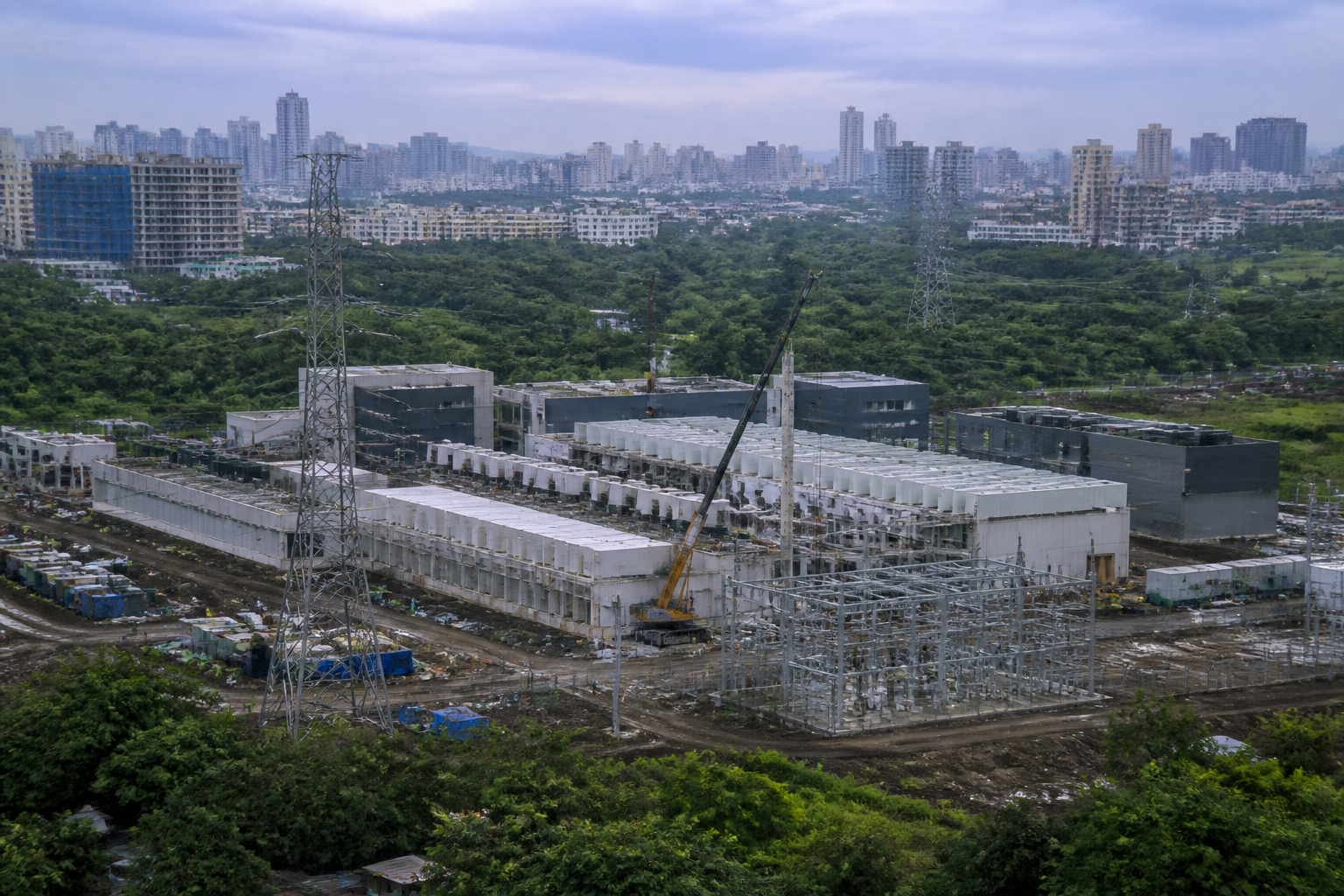
Mumbai is set to retain its position as India’s dominant data-centre market even as new facilities spread to secondary hubs, according to CII-CBRE data cited by the Economic Times. The city’s share of installed data-centre capacity across India’s tier-I markets is estimated to rise from 52% in the first half of 2026 to 68% by 2030. The projection points to a digital-infrastructure build-out that will increasingly shape land demand, power planning, fibre networks and industrial development across Mumbai’s wider metropolitan region.
Mumbai’s installed data-centre capacity is expected to grow 2.1 times, from 0.9 GW in H1 2026 to more than 2 GW by 2030. The expansion is being driven by demand from financial institutions, cloud-service providers, government bodies and defence entities. Artificial intelligence workloads are adding another layer to the requirement, shifting the market beyond conventional hyperscale cloud and colocation facilities towards GPU-focused deployments and captive enterprise capacity.
The forecast is significant because data centres are not ordinary commercial buildings. They are large, power-intensive assets that require reliable electricity, high-capacity fibre connections, cooling systems, physical security and carefully selected sites. Their growth therefore connects the digital economy directly to the physical city. Mumbai’s continuing lead reflects not only its role as a financial centre but also the presence of infrastructure that can support facilities requiring uninterrupted operations.
According to the report, Mumbai’s advantages include power infrastructure, fibre connectivity, limited natural-hazard exposure and subsea cable terminations. These factors help explain why the city remains the preferred location even as developers and operators look for land and power outside the most established urban areas. In data-centre planning, proximity to network infrastructure and dependable electricity can be as important as proximity to customers.
The geography of the expansion is already moving beyond Mumbai’s traditional commercial core. Chandivali and Navi Mumbai are identified as leading areas for capacity growth, particularly along the Thane–Belapur corridor and around Panvel. These locations offer larger land parcels, power availability and connectivity suited to large-format developments. Their growing role shows how digital infrastructure can accelerate the transformation of peripheral industrial and urbanising areas.
This shift also raises a land-use question. Data centres require substantial sites but employ fewer people on a day-to-day basis than many conventional commercial or industrial activities. The supplied report does not provide employment figures or compare job creation across asset classes. It does, however, show that the physical footprint of the digital economy is expanding through facilities whose operational requirements are dominated by power, cooling, security and network resilience.
That distinction matters for metropolitan planning. A data-centre cluster can generate demand for substations, transmission capacity, backup systems, roads, water for cooling and high-redundancy telecommunications. The report identifies power and connectivity as structural advantages, but it does not establish how much additional public infrastructure will be required to accommodate the projected increase from 0.9 GW to more than 2 GW in Mumbai. That gap will be important as the forecast moves from investment intention to construction and operation.
The scale of the investment pipeline is another indicator of the market’s changing character. Anshuman Magazine, Chairman and CEO, India, South-East Asia, Middle East and Africa, at CBRE, said that investment commitments towards data centres stood at around $38 billion in the first half of 2026. He described the level of capital commitment as unusually strong and said artificial-intelligence-linked investment was changing what was being built.
The same statement points to a change in demand. The market is moving beyond hyperscale cloud and colocation towards GPU-focused deployments and direct captive capacity. GPU-intensive facilities can have different technical and energy requirements from facilities designed around more conventional enterprise workloads. This means that the next phase of construction may not simply replicate existing data-centre formats, even when it occurs in the same corridors.
India added 130 MW of new data-centre supply in H1 2026, an 18% year-on-year increase, according to the CII-CBRE data cited in the report. Hyperscale and colocation investments led capital commitments during the period. Domestic operators accounted for 50% of new supply, while operators based in Europe, the Middle East, Africa and the Americas accounted for the remainder.
These figures describe a market that is growing both in volume and in ownership diversity. They also indicate that Mumbai’s dominance is not based on a single type of operator. Domestic companies and international players are participating in the expansion, while joint ventures and structured partnerships are being used to finance artificial-intelligence-ready developments rather than relying only on conventional ownership models.
The financing structure is relevant to the way projects may be delivered. Joint ventures can bring together landowners, infrastructure providers, technology companies and capital partners. Structured partnerships can also distribute the risks associated with large power requirements, changing computing demand and long construction cycles. The report does not identify individual projects or disclose their financing terms, but it describes a market moving towards more specialised and capital-intensive assets.
Secondary hubs will still have a role. Developers are expected to extend into locations offering land, power and policy incentives. This diversification can reduce pressure on the most established markets and provide alternatives where land availability or local infrastructure limits expansion. However, the CII-CBRE assessment indicates that such diversification will not displace Mumbai’s market leadership within the decade.
For the Mumbai region, this creates a planning challenge that is broader than attracting investment. The city and its surrounding authorities will need to manage the relationship between private digital infrastructure and shared urban systems. The relevant questions include how power capacity is allocated, how new facilities connect to transmission networks, how fibre routes are protected, how large developments are integrated into transport and industrial corridors, and how land-use decisions account for facilities that are critical but relatively low in visible public activity.
The report establishes the direction of travel but leaves several implementation questions open. It does not specify the number of facilities expected by 2030, the total land area involved, the water requirements of the projected capacity, the locations of individual projects or the public agencies responsible for coordinating supporting infrastructure. Nor does it quantify the impact on local employment, electricity tariffs, road traffic or municipal revenue.
Those gaps do not weaken the central finding. They show why data-centre expansion should be treated as an urban-infrastructure issue rather than only a real-estate or technology story. Mumbai’s lead is being reinforced by the same network effects that have long supported its financial and communications economies: established connectivity, access to critical infrastructure and a concentration of institutional demand.
The next phase will test whether the metropolitan region can expand capacity without creating hidden constraints in power, land, connectivity and local services. The evidence currently confirms a strong investment pipeline, rapid growth in installed supply and a durable Mumbai advantage. It also indicates that the most consequential decisions will take place beyond the server halls—in power systems, industrial corridors, peripheral land markets and the institutions responsible for coordinating them.
