


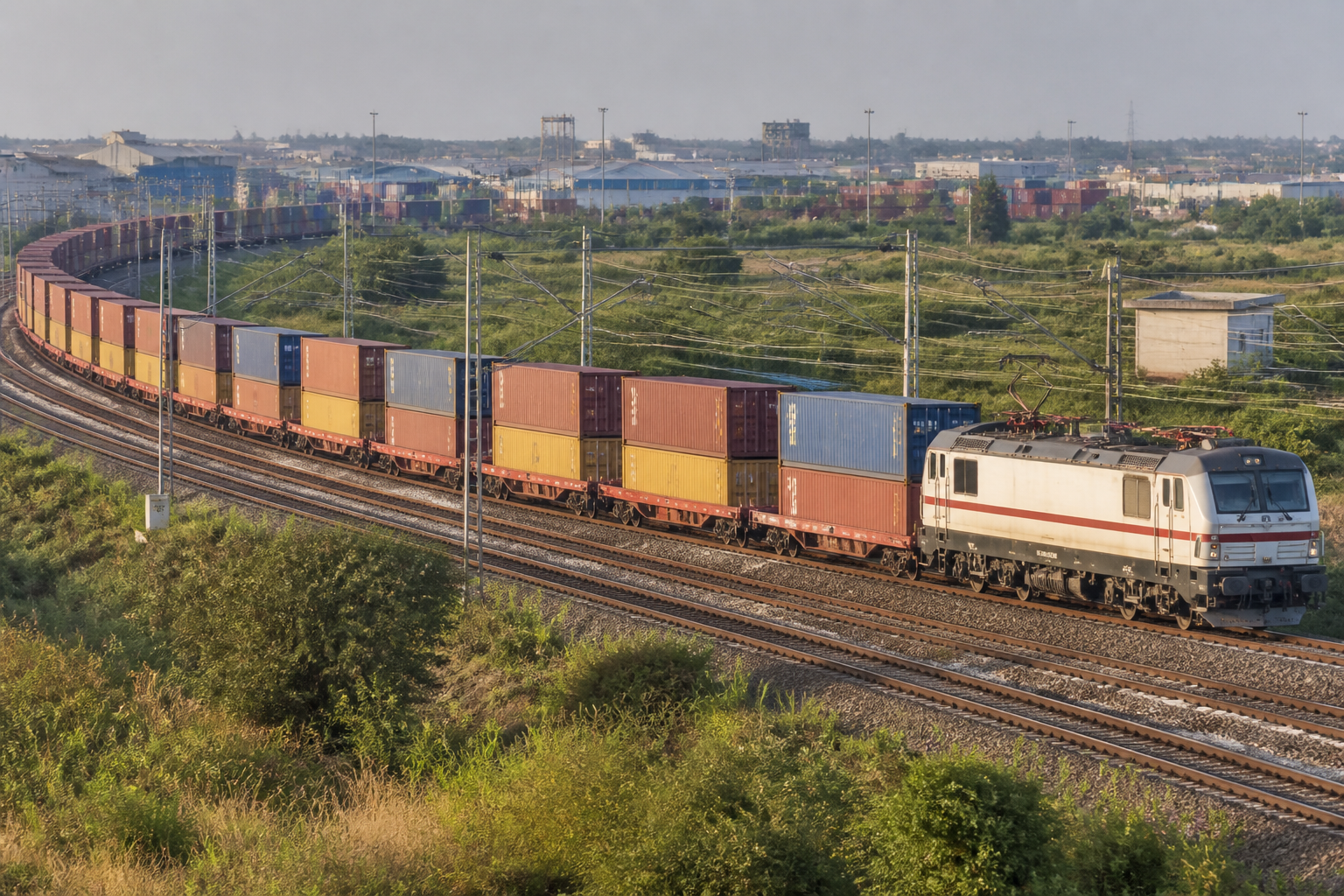
The completion of India’s Dedicated Freight Corridor network marks the transition from construction to utilisation. With the Western Dedicated Freight Corridor now fully operational, the 2,843-km Eastern and Western network gives freight trains dedicated, high-capacity routes across two of the country’s most important economic axes. The immediate change is operational: freight trains no longer have to compete with passenger services for paths on these corridors. The larger question is whether the new capacity can alter the geography and economics of Indian industry.
The network consists of the 1,506-km Western Dedicated Freight Corridor, linking Dadri in Uttar Pradesh with Jawaharlal Nehru Port near Mumbai, and the 1,337-km Eastern corridor, running from Ludhiana in Punjab to Sonnagar in Bihar. Together, the routes pass through manufacturing, agricultural, mineral and consumption belts. The full network was carrying 443 freight trains a day when the final Western sections were inaugurated, according to the supplied report.
The Dedicated Freight Corridors were designed to address a structural constraint in Indian Railways. The country’s busiest routes have traditionally carried passenger and freight trains on the same tracks. As passenger and cargo traffic increased, freight services faced delays and the railway system had limited room to operate longer, heavier trains. Dedicated lines separate the two functions and create infrastructure designed specifically for freight movement.
This distinction matters because the corridors are not simply conventional railway lines with passenger trains removed. They use double tracks, automatic signalling, stronger infrastructure, higher axle-load capability and double-stack train operations. On the Western corridor, high-clearance overhead electrification allows containers to be stacked one above another. The result is greater cargo capacity in a single movement. Indian Railways estimates that the two corridors can handle more than 120 trains in each direction.
The principal economic benefit is therefore a combination of capacity, speed and predictability. The supplied report states that container trains take about 2.44 hours per 100 km on the Dedicated Freight Corridors, compared with 5.25 hours on the conventional network. For coal trains, the corresponding figures are approximately 3.15 hours and 6.48 hours. Faster journeys reduce transit time, but reliability may be equally important for businesses planning production and distribution.
A company carries inventory partly because transport is uncertain. Components may arrive late, retailers may need additional warehouse stock and exporters may move containers to ports well before a vessel’s sailing date to protect against delays. A more predictable rail journey can reduce the need for some of that buffer. The benefit is not limited to the freight bill: it can also affect inventory and working capital. The report’s evidence supports this as an operational implication of more reliable transport, rather than as a quantified saving for individual companies.
The broader logistics-cost picture gives the corridors their national significance. A 2025 assessment by the Department for Promotion of Industry and Internal Trade and the National Council of Applied Economic Research estimated India’s logistics costs at 7.97% of GDP in 2023-24. The assessment placed rail’s logistics cost at about Rs 1.96 per tonne-km, compared with Rs 11.03 for road. The difference does not mean that all cargo can shift to rail. Small and high-value consignments will continue to rely on roads and air, while first- and last-mile movement will require other modes. But for heavy, long-distance cargo, a more competitive rail option can change supply-chain decisions.
The Western corridor is particularly important for the relationship between northern manufacturing centres and western ports. Dadri, already a major inland logistics centre, handled more than 1.7 lakh twenty-foot equivalent units of exports in 2025-26, including garments, food products, tractor parts, tyres, auto components and furniture, according to the supplied report. It also handled more than 1.5 lakh TEUs of imports. A dedicated connection towards Jawaharlal Nehru Port and the Gujarat port system gives inland cargo a high-capacity route to maritime gateways.
That connection could weaken the traditional advantage of locating factories close to ports. A factory in the northern hinterland does not need a seaport at its doorstep if it has dependable rail access to one. For exporters, the value of that connection lies not only in lower cost but also in scheduling. International buyers and shipping networks depend on predictable delivery windows. A container that reaches a port consistently within an expected period is easier to integrate into production and vessel schedules than one whose arrival depends on a congested mixed-traffic railway route.
The possible manufacturing effect extends beyond export logistics. Industrial activity in India has often been drawn towards ports and large metropolitan markets because moving raw materials and finished goods over long distances was expensive or uncertain. The Western corridor connects the northern hinterland to industrial centres and ports in Gujarat and Maharashtra. The Eastern corridor links the industrial north with coal and mineral-producing regions. These connections may support factories located closer to labour, land or raw materials while retaining access to wider markets.
The report identifies logistics parks, freight terminals and industrial corridors as important complements to the rail network. Their significance lies in connecting the main railway asset to the wider urban and industrial system. A freight line alone cannot provide a complete supply chain. Cargo must be collected, stored, processed, transferred and delivered. If terminals, warehouses, roads and industrial clusters do not connect efficiently to the DFCs, part of the time and cost advantage can be lost outside the railway itself.
The Eastern corridor has a distinct role because of its relationship with the mineral and energy economy. Coal, steel, cement, fertiliser and other bulk commodities depend heavily on rail. Larger loads and fewer interruptions can reduce the cost of moving these materials across long distances. The eventual effect may appear in the cost structures of power generation, construction materials and manufacturing rather than in railway revenue alone. A lower cost for transporting an industrial input can be transmitted through several stages of the economy.
Agriculture presents another use case, although the corridors will not resolve the larger causes of food inflation. Food grains, fertiliser and other agricultural commodities already move by rail between production and consumption centres. Faster and more predictable freight can reduce one layer of friction in that chain. The impact will depend on connections to warehouses, cold chains, agricultural markets and road-based distribution. Crop yields, weather, storage capacity and global commodity prices remain separate variables that the freight network cannot control.
The DFCs also create capacity beyond their own tracks. If substantial freight moves onto dedicated routes, space can be released on the conventional railway network for additional passenger services and freight that does not use the corridors. This is a form of capacity creation across two railway systems. A similar possibility exists on highways if rail becomes competitive enough to attract long-distance bulk and container traffic. Fewer trucks on some routes could reduce congestion and the pressure imposed on road infrastructure, although the supplied material does not quantify the likely road-traffic shift.
There is also an emissions dimension. The corridors are electrified, reducing the long-distance freight system’s dependence on diesel. An official Indian Railways assessment estimates that the two DFCs could save about 457 million tonnes of carbon dioxide emissions over 30 years. That estimate depends on actual traffic levels, operating patterns and the extent to which freight shifts from less efficient modes. It is therefore a projection associated with the network’s potential, not a measure of emissions already avoided.
The most important test begins after construction. The completion of the tracks establishes physical capacity, but economic value will depend on utilisation. Ports, inland container depots, warehouses, industrial parks and ordinary railway lines must work as a connected system. A corridor can be technically capable of carrying more trains without automatically generating a proportionate increase in manufacturing, exports or regional development.
There are early indications that businesses are beginning to use the network in new ways. The supplied report cites Amazon’s daily service on the Western DFC, introduced in August, linking logistics operations across Delhi, Ahmedabad and Surat with onward connections towards Pune, Mumbai and Goa. The example is limited, but it illustrates the shift required for the corridors to become more than an alternative route. Businesses must redesign supply chains around dependable dedicated rail services rather than use them only when conventional routes are congested.
This makes the Dedicated Freight Corridors an infrastructure project with effects that extend beyond railway operations. Their performance will be visible in transit times, but also in the location of factories, the movement of bulk materials, port connectivity, warehouse planning and the balance between road and rail. The network addresses a major capacity constraint along key freight axes, but it does not remove the need for efficient terminals, last-mile links and coordinated planning.
The evidence confirms that India now has a dedicated freight backbone across two major economic routes, with materially higher speed and carrying capability than the conventional network. What remains uncertain is the scale and distribution of the benefits once the system reaches sustained utilisation. The developments that deserve monitoring are freight volumes, terminal connectivity, industrial activity around the corridors, port integration, modal shifts and whether the projected logistics and emissions gains become measurable in the wider economy.
