


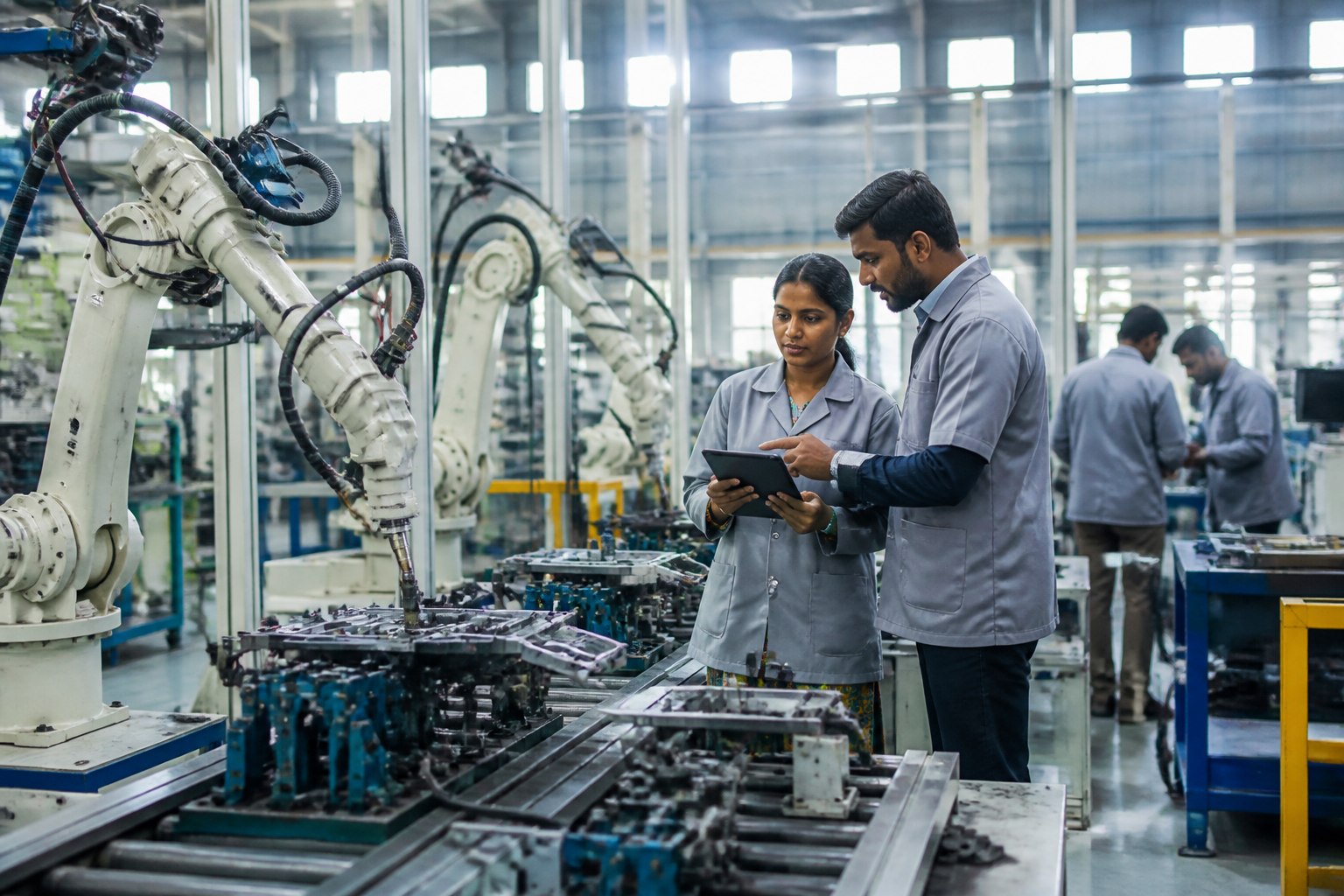
Tamil Nadu’s industrial economy has spent years building strength in automobiles, electronics, engineering, textiles, logistics and energy-related manufacturing. The next technological shift may not be confined to software screens. It could take place on factory floors, inside warehouses, around ports and across the machinery that keeps industrial systems moving.
A report published by Deccan Chronicle has drawn attention to the emerging field of Physical AI and its possible implications for the state. Unlike generative AI, which primarily processes or produces digital information, Physical AI is designed to perceive physical environments, analyse changing conditions and act through machines or autonomous systems. Its development raises a question that extends beyond technology adoption: can Tamil Nadu connect its established manufacturing capabilities with the interdisciplinary expertise needed to build and operate intelligent industrial systems?
The answer is not yet established. The supplied report does not identify confirmed large-scale deployments, investment totals, implementation schedules or a government programme dedicated to Physical AI. What it does show is the breadth of the industrial environment in which the technology could eventually be applied, as well as the institutional and labour challenges that would accompany that transition.
## From digital intelligence to industrial action
Physical AI brings together artificial intelligence, robotics, computer vision, sensors, industrial automation and autonomous systems. Its defining feature is the connection between software-based decision-making and a changing physical environment. A system operating in a factory, warehouse or port cannot rely only on a fixed sequence of instructions. It must respond to equipment conditions, objects, movement, safety constraints and operational priorities as they change in real time.
That distinction matters for a state whose economic geography includes both manufacturing clusters and supporting infrastructure. The report refers to automobile and auto-component manufacturers, electronics companies, engineering industries and logistics operators in and around Chennai. It also points to textile, heavy engineering, renewable energy and manufacturing clusters in other parts of Tamil Nadu. These sectors differ in their processes and workforce structures, but all depend on the performance of physical assets and supply chains.
In factories, the possible applications described in the report include continuous equipment monitoring, abnormality detection, machinery-failure prediction and production optimisation. AI-enabled robots could perform tasks that require real-time decisions rather than simply repeat pre-programmed movements. In warehouses and distribution centres, autonomous systems could assist with inventory movement, while AI could be used to optimise transportation, cargo handling and supply-chain operations.
Ports and other industrial infrastructure could also become testing grounds. The report identifies predictive maintenance, asset monitoring, automated inspection and logistics management as potential applications. These uses are significant because they place the technology within the operational systems of cities and regions, rather than treating it as an isolated corporate software tool.
## The industrial base is an advantage, not a guarantee
Tamil Nadu’s existing manufacturing ecosystem gives it a potential starting advantage. Companies that already operate complex production lines, logistics networks and engineering facilities may have more practical use cases for Physical AI than organisations without access to such environments. The presence of factories, ports, warehouses and technical institutions can create the conditions for experimentation and industrial collaboration.
But an industrial base alone does not automatically create Physical AI capability. The technology requires a connection between research, industrial problems and commercial deployment. Arun Jain, founder of Intellect Design Arena and chief architect of Purple Fabric, said Tamil Nadu had the engineering and technology talent required to participate in the transition, but needed a stronger link between those capabilities and real industrial applications.
This is a different challenge from simply increasing the number of software professionals. Physical systems have to work within operational environments where reliability, maintenance, safety and integration matter. A technically impressive model may have limited value if it cannot connect with machinery, sensors, control systems and established production processes. The report therefore presents adoption as an organisational and engineering challenge as much as an artificial-intelligence challenge.
The same issue applies to the state’s urban-industrial corridors. Their future competitiveness will depend not only on the availability of land, roads, ports or electricity, but also on how efficiently the assets located there can operate together. If intelligent systems are introduced unevenly, the benefits may remain concentrated in a small number of large facilities. If they are linked to broader industrial capabilities, they could influence how factories, logistics centres and infrastructure operators manage routine decisions and maintenance.
## The skills question is wider than AI training
The report’s most important institutional point is that Physical AI requires an interdisciplinary talent ecosystem. K.E. Raghunathan, chairman of the Association of Indian Entrepreneurs, said professionals would need to understand artificial intelligence as well as machines, factories, robotics and the operational environments in which those systems work.
That combination is difficult to produce through narrow training programmes. Physical AI sits at the intersection of artificial intelligence, robotics, electronics, mechanical engineering, computer vision, control systems and industrial operations. Engineering institutions and research centres may therefore need closer links with factories and infrastructure operators if education is to reflect the problems that industrial systems actually face.
The report does not provide details of new courses, research facilities or industry-led training programmes. It does, however, identify a gap between conventional technology education and the practical requirements of intelligent machines. A workforce that understands only software may not be equipped to maintain or safely deploy systems operating in a factory. Conversely, industrial professionals may need new capabilities to interpret data, work with autonomous equipment and supervise systems that make decisions based on real-time conditions.
This skills challenge is also a labour challenge. Raghunathan warned that job losses could become a major concern as industries adopt Physical AI. He argued that governments should place greater emphasis on vocational education so that workers can handle evolving technologies. The concern is especially relevant to small and medium enterprises, which may not have the same financial or technical capacity as large corporations to adopt advanced systems quickly.
The report offers no estimate of potential job losses or of the number of enterprises that could be affected. That absence is important. Automation does not produce a single labour-market outcome across all sectors: its effects depend on which tasks are replaced, which new roles emerge, how quickly firms adopt the technology and whether workers can access retraining. Without those details, the employment impact remains an open question rather than a measurable result.
## Large companies and smaller firms may experience different transitions
The possibility of unequal adoption is one of the clearest urban-economic issues raised by Physical AI. Large corporations are more likely to have the capital, data, engineering teams and operational scale needed to test autonomous systems. Micro, small and medium enterprises may face higher barriers, particularly where production processes are less standardised or where investment returns are difficult to calculate.
That divide could affect industrial clusters, not only individual companies. Manufacturing ecosystems often rely on relationships between large firms, component suppliers, maintenance contractors, transport operators and smaller service businesses. If advanced systems are adopted by only the largest participants, the technological gap could widen across the same supply chain. If smaller firms can access appropriate training, shared infrastructure or affordable industrial tools, the transition could be more broadly distributed. The supplied material does not establish which of these patterns is emerging in Tamil Nadu.
The issue also has a governance dimension. Physical AI operates in public-facing and safety-sensitive environments, including ports, power networks, transport-linked logistics and industrial facilities. The report does not discuss regulatory standards, liability, cybersecurity, data governance or safety certification. Those questions will become more important if autonomous systems move from controlled demonstrations into operational infrastructure. For now, they are part of the policy landscape that remains to be developed or clarified.
## What Tamil Nadu’s next phase would require
The evidence in the report supports a measured conclusion. Tamil Nadu has the industrial breadth and engineering base that could make it an important location for Physical AI applications. Its factories, logistics systems and infrastructure offer potential settings for technologies that monitor equipment, inspect assets, move goods and respond to changing conditions. But the report does not show that this transition has already occurred at scale.
The immediate requirement is therefore not simply more enthusiasm for artificial intelligence. It is a stronger connection between industrial problems, research capability, technical education and deployment. That connection would need to include software specialists, mechanical and electrical engineers, factory managers, vocational institutions and the workers whose tasks may change.
The next evidence to watch is practical: confirmed pilot projects, documented industrial deployments, training initiatives, partnerships between institutions and companies, and measures to support smaller enterprises. Until those details emerge, Physical AI in Tamil Nadu should be understood as an industrial possibility with significant implications, not yet as a completed transformation.
The larger urban question is whether the state’s manufacturing corridors can evolve from places where machines are deployed into systems where machines, infrastructure, workers and data operate as an integrated industrial network. Tamil Nadu’s existing strengths make that question particularly relevant. They do not, by themselves, resolve it.
