


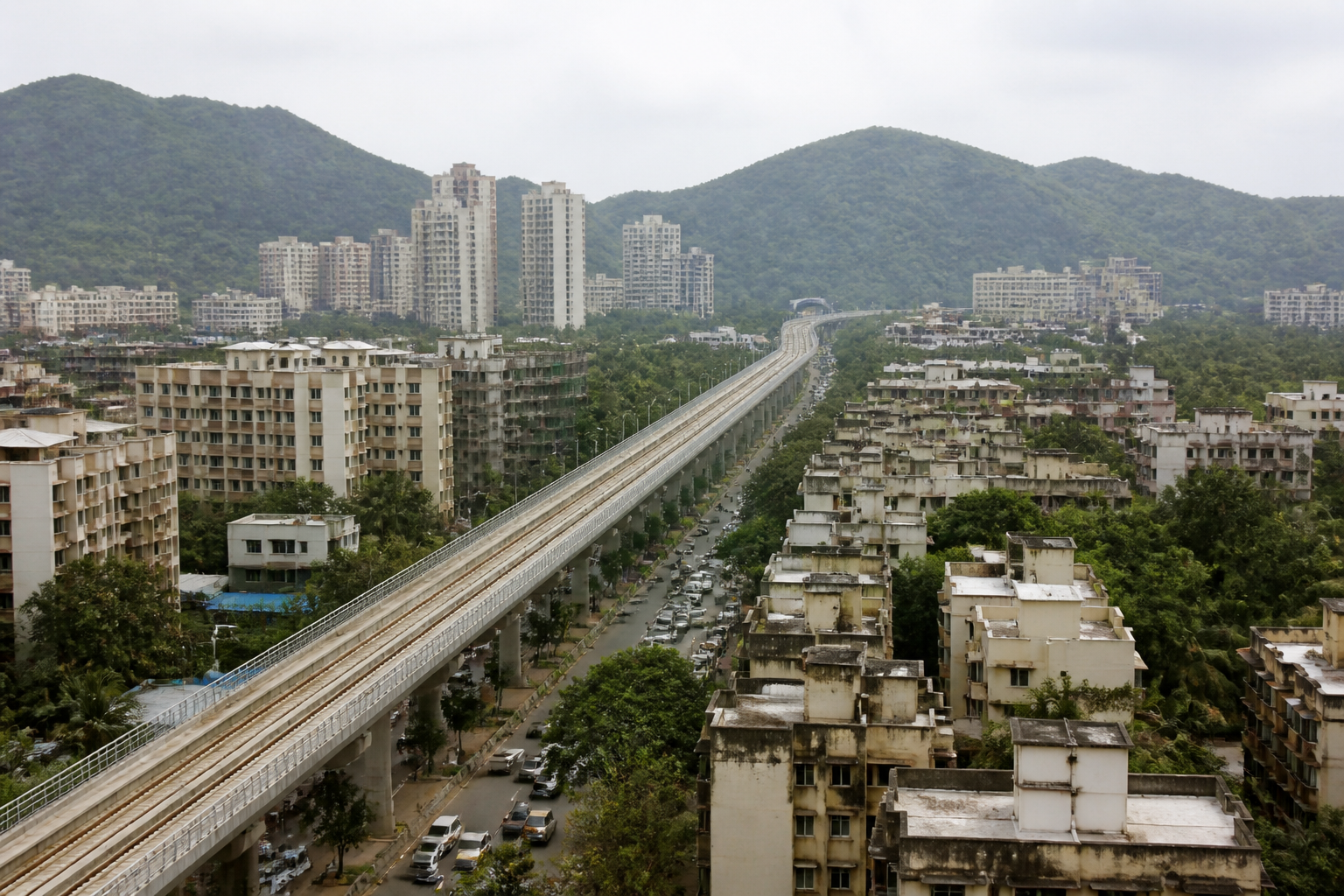
The proposed internal metro project in Thane has moved from a transport-planning proposal into a dispute over displacement, route selection and political accountability. Opposition from residents of Lokmanya Nagar, combined with public disagreement within the Shinde-led Shiv Sena, has exposed a central question for the project: can a new mass-transit corridor be built without leaving the rehabilitation of affected households unresolved?
The proposed alignment is linked to a planned road between Lokmanya Nagar and Upvan. Thane Municipal Corporation’s general body has recently approved a resolution to develop the road identified in the area’s development plan. The metro corridor is also expected to pass along this route. Residents opposing the project claim that several homes could be affected, while the available public discussion has not established how those households would be rehabilitated.
That gap has become the basis of the local campaign against the alignment. Residents have formed the Lokmanya Nagar Bachao Sarvapakshiya Kruti Samiti, or an all-party action committee, to oppose the proposed route. A meeting organised by the committee at Dawalenagar on Sunday was attended by residents and leaders from different political parties. Maharashtra Transport Minister Pratap Sarnaik also attended the meeting and publicly raised objections to the current approach.
Sarnaik’s position, as reported by Loksatta, is not opposition to urban development or public transport in principle. He said development should not result in the displacement and destruction of residents. He argued that alternative routes should be seriously examined so that the ring metro affects the fewest citizens while benefiting the largest number of Thane residents. He also said he would discuss the issue with Deputy Chief Minister Eknath Shinde and seek a positive resolution.
The dispute is significant because the conflict is not simply between supporters and opponents of a metro system. It concerns the sequence in which infrastructure decisions are made. A transport corridor can provide wider mobility benefits, but its social cost depends on the route, the number of affected properties, the quality of rehabilitation and the transparency of the decision-making process. In Lokmanya Nagar, residents say the rehabilitation framework has not been clearly explained even as the road and metro alignment are being advanced.
The available report does not provide the project’s final alignment map, the number of homes expected to be affected, the land-acquisition mechanism, the estimated cost or a rehabilitation timetable. It also does not establish whether a detailed project report has been formally approved or whether the route remains under examination. Those omissions make it difficult to assess the project only through its stated transport objective. Until the affected footprint and rehabilitation commitments are placed in the public domain, the disagreement is likely to remain focused on trust as much as on engineering.
The proposed route also raises a planning question about the relationship between roads and metro infrastructure. According to the report, the Lokmanya Nagar-Upvan road is being developed under the area’s development plan, and the metro route is expected to use the same corridor. This creates a possibility that road development and metro planning are being considered together. However, the report does not clarify whether the road was independently planned before the metro proposal, whether alternative alignments were compared, or how the combined project would affect existing settlements.
Sarnaik has pointed to Upvan as an area with limited habitation and questioned the insistence on taking the alignment through more densely occupied parts of Lokmanya Nagar. His argument places route efficiency alongside the distribution of social costs. A route through a less populated area may reduce immediate displacement, but the evidence supplied in the report does not show whether such an alternative is technically, financially or operationally feasible. That question requires an official comparison of the competing alignments rather than political assertions alone.
The internal disagreement within the Shinde-led Shiv Sena has added another layer to the planning controversy. Sarnaik, who represents the area politically and serves as transport minister, attended the residents’ meeting and criticised the prospect of damaging thousands of families for limited interests. Hanamant Jagdale, the Thane municipal corporation’s house leader and a representative of Lokmanya Nagar, has supported the project. Jagdale said there was no split in the party and that both sides wanted development, but that misunderstandings had contributed to the dispute. He said leaders would meet residents and address those misunderstandings.
Local Shiv Sena office-bearer Santosh Dhamale opposed what he described as development built on the destruction of Lokmanya Nagar. Local corporator Rakesh Shinde also criticised attempts to mobilise support for the ring metro through videos using the deputy chief minister’s image. These statements show that the dispute has become embedded in local political representation, with residents, elected representatives and party leaders presenting competing interpretations of public interest.
The involvement of leaders from different parties is also important. The residents’ committee describes itself as all-party, and the meeting included opposition to the project from across political lines. During an earlier presentation of the internal metro project at the municipal headquarters, Nationalist Congress Party legislator Jitendra Awhad reportedly questioned the rehabilitation process and asked when metro services would reach the Kalwa-Mumbra area. He also alleged that the project could be intended to benefit a builder, although the report provides no evidence establishing that allegation.
That allegation illustrates why formal disclosure will be central to the project’s credibility. Claims about private benefit cannot be treated as established without documentary evidence. At the same time, the absence of publicly stated rehabilitation details can create space for such claims to gain traction. Publishing the route rationale, affected-property assessment, rehabilitation policy, funding structure and implementation responsibilities would allow residents to evaluate the proposal on evidence rather than political statements.
For Thane, the larger urban issue is how to expand public transport in a dense and already-developed municipal area. New infrastructure can improve access and reduce dependence on roads, but corridors passing through established neighbourhoods inevitably create questions about property, resettlement and construction disruption. The project’s public legitimacy will therefore depend not only on whether it promises better connectivity, but also on whether residents can see how its costs will be shared and addressed.
The present evidence confirms that the Lokmanya Nagar alignment faces organised resident opposition, that rehabilitation remains a disputed and insufficiently explained issue, and that senior political figures do not agree on the route. It does not yet establish the final alignment, the scale of displacement, the project’s approval status or the viability of alternatives. The next significant developments will be the outcome of discussions involving Sarnaik and Shinde, the municipal corporation’s clarification of the road and metro plans, and the publication of a detailed rehabilitation and route assessment. Until then, the Thane internal metro debate is less a settled infrastructure decision than a test of whether mobility planning can proceed with transparent social safeguards.
