


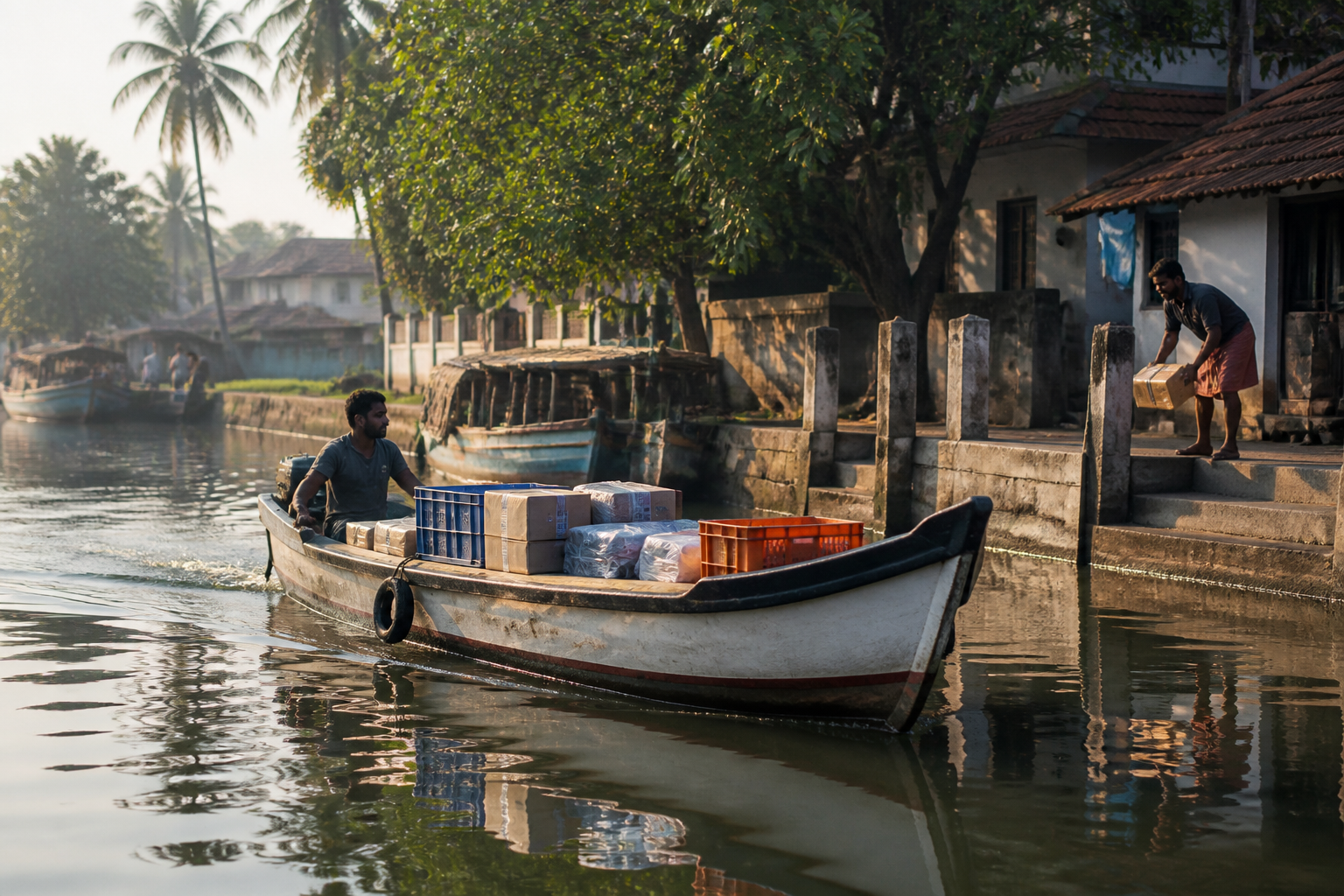
India’s waterways are being discussed not as a replacement for roads, but as a missing layer in the country’s expanding logistics network. The immediate question is not whether inland water transport can carry large volumes of freight. It already does. The more difficult question is whether waterways can help logistics companies reach consumers in riverine, island, backwater and dispersed settlements where conventional road-based delivery becomes expensive or unreliable.
That question has become more important as digital commerce reaches communities beyond major urban centres. The logistics industry is forecast to grow to as much as $281.74 billion by 2026, while rural internet users exceeded 427.7 million during financial year 2025-26, according to the material cited in the report. Those figures point to a widening gap between digital access and physical accessibility. Consumers may be able to place an order online, but the final movement of goods can still be constrained by geography.
India’s rural road connectivity has improved substantially. The report says 99 per cent of eligible habitations have been connected under the first phase of the Pradhan Mantri Gram Sadak Yojana. But a road connection does not automatically create an efficient delivery network. In settlements separated by rivers, canals and backwaters, the last few kilometres may involve ferries, small boats, informal jetties or routes that are inaccessible to conventional delivery vehicles. The challenge is therefore not simply to extend existing logistics infrastructure, but to match the network to local geography.
This is where inland waterways enter the discussion. India has 111 National Waterways covering more than 20,000 kilometres. By March 2026, 32 waterways covering more than 5,100 kilometres were functional, according to the report. Cargo movement through these waterways had exceeded 198 million tonnes by February. Much of the current growth is associated with bulk cargo, which can be moved efficiently in large consignments. Consumer logistics presents a different operational problem, involving smaller shipments, tighter delivery windows and a more complex chain between terminals and individual households.
The government’s stated objective is to increase the share of freight carried on waterways from about 2 per cent to 5 per cent by 2030. The report identifies PM Gati Shakti and the Jalvahak scheme as policy mechanisms that could support that goal. Their relevance to consumer logistics lies in coordination. A waterway by itself is not a delivery system. It requires terminals, aggregation points, road links, digital tracking, local operators and a dependable transfer process between modes.
This distinction matters because inland waterways are most useful where they reduce a specific bottleneck. They can move goods along a river or canal, but they cannot eliminate the final journey from a landing point to a customer’s home. If the terminal is poorly located, lacks storage or is disconnected from local delivery networks, the water leg may simply add another transfer. The potential benefit comes when waterways are integrated into a broader network rather than treated as a standalone alternative to roads.
The Vallam Express initiative in Kerala’s Alappuzha region illustrates how that integration might work at a local level. The initiative serves 14 villages and nearly two lakh residents by combining organised logistics with local boat operators familiar with routes that are difficult to access by road. The example is important because it places local knowledge inside a formal delivery system. Instead of imposing a uniform network on a water-bound geography, it uses existing mobility patterns and adapts them to organised logistics.
That model also challenges the assumption that scale must always depend on standardisation. Abhishek Chakraborty, CEO of DTDC Express, told NDTV that India’s varied geographies, infrastructure and communities require a more adaptive network model. He described the opportunity as a combination of multiple modes, local ecosystems and modern logistics capabilities rather than a single standardised system.
The implication is that logistics performance cannot be measured only by the length of a road network or the number of delivery vehicles. It must also be measured by whether the network can respond to the physical conditions of the market it serves. A boat operator in Alappuzha may be as important to local accessibility as a highway connection is elsewhere. The difference is that this role is often informal or invisible in conventional infrastructure planning.
The urban dimension becomes clearer in the discussion of congestion. Antim Suman, co-founder and chief operating officer of Edgistify, told NDTV that last-mile riders are slowed more often by city traffic than by highways. He argued that inland water transport could move goods upstream and reduce the distance that riders must cover through congested streets. He also said inland water transport can be up to 60 per cent cheaper than road transport, although the supplied material does not establish the conditions or routes to which that comparison applies.
Suman’s larger point concerns the location of logistics infrastructure. Urban water terminals could potentially operate as fulfilment hubs, placing inventory closer to demand before the final delivery begins. In that arrangement, the waterway would not carry a parcel directly to a customer’s doorstep. Instead, it would bring inventory closer to an urban or peri-urban market, shortening the road-based leg and potentially reducing pressure on congested streets.
Such a system would require a change in how terminals are understood. They would need to function not only as points where cargo is loaded and unloaded, but also as nodes for storage, sorting and onward distribution. That raises questions about land availability, neighbourhood access, loading operations, safety, working hours and connections with local roads. The report does not provide evidence on how many such facilities exist or what regulatory framework governs them, leaving the scale of this opportunity uncertain.
The policy architecture is beginning to recognise the need for multimodal coordination. PM Gati Shakti is intended to improve the alignment of infrastructure and logistics planning, while the Jalvahak scheme is cited as a mechanism that could support greater waterborne freight movement. For consumer deliveries, however, policy success will depend on how national targets translate into local operating systems. A target for increasing the freight share of waterways does not by itself guarantee reliable service to households.
Institutional coordination will also be significant. Waterway authorities, local governments, port and terminal operators, road agencies, logistics companies and local boat communities may all have roles in the same delivery chain. If these responsibilities are fragmented, the advantages of one mode can be lost at the transfer point. A functioning multimodal network therefore depends on coordination as much as on physical infrastructure.
The available numbers show both the scale of the opportunity and its limitations. India has more than 20,000 kilometres of National Waterways, but only 32 of the 111 waterways were described as functional by March 2026. Cargo movement had crossed 198 million tonnes by February, yet bulk cargo remains the dominant use described in the report. At the same time, the country has a large and growing base of rural internet users and an expanding logistics market. The infrastructure challenge is to connect these two trends without assuming that digital demand will automatically produce efficient physical access.
The 2 per cent to 5 per cent freight-share target also indicates that waterways remain a relatively small part of the national freight system. Increasing their role will require more than shifting cargo from trucks to barges. It will require identifying routes where water transport has a clear operational advantage, building reliable terminals and ensuring that the final road or boat leg does not erase the gains made upstream.
For cities, this is a question of logistics geography. Online consumption is changing where goods are demanded, while congestion and land constraints affect where goods can be stored and transferred. Water terminals, where feasible, could become part of a distributed fulfilment network. But the evidence supplied here does not establish whether this model is financially viable across different cities or whether existing waterways can support the frequency and reliability expected by digital commerce.
The evidence does establish a narrower conclusion. Waterways are unlikely to replace roads in last-mile logistics, but they can complement them where water is already a practical transport corridor. Their value lies in reducing distance, bypassing geographic barriers, connecting dispersed settlements and moving inventory closer to demand. The next developments to monitor are the expansion of functional waterways, the implementation of multimodal schemes, the creation of suitable terminals and the ability of local logistics ecosystems to connect water transport with dependable doorstep delivery.
