


STL’s FY29 revenue target is also a bet on India’s digital infrastructure build-out
Sterlite Technologies has set a ₹20,000 crore revenue ambition for financial year 2028-29 under its Lakshya growth plan, linking the company’s next phase of expansion to rising demand for optical connectivity, data centres and AI infrastructure. The target is more than four times the company’s reported consolidated revenue from operations of ₹4,745 crore in FY26. This analysis examines what STL’s plan reveals about the changing scale of digital infrastructure demand, the capacity required to support it and the uncertainties that remain around implementation.
The company announced the ambition at an investor meeting held on September 3. STL Managing Director Ankit Agarwal described Lakshya as a plan to transform the scale and position of the business and build it into one of the largest global players in digital connectivity. The company’s stated objective is to build on its existing operations while pursuing stronger economics, deeper customer relationships and a larger role in what it describes as the rapidly expanding digital infrastructure market.
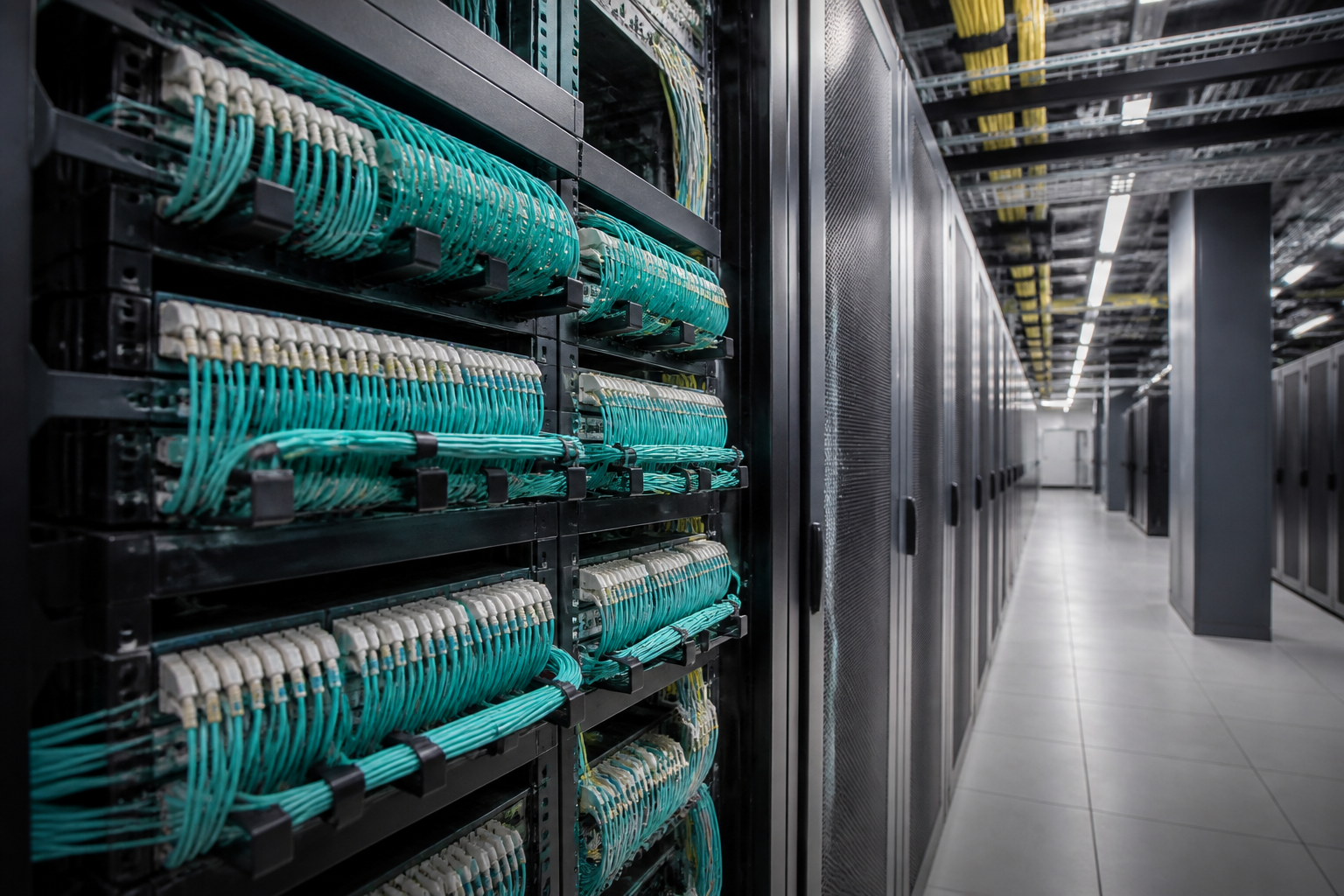
The significance of the announcement lies in the infrastructure behind digital services. Optical fibre is not simply a communications product used by telecom operators. It is a physical layer connecting data centres, networks, cloud infrastructure and other high-capacity digital systems. As more computing moves into large-scale facilities, the demand for fibre within and between those facilities becomes an important part of the infrastructure equation.
STL’s argument is that the volume of optical connectivity required at each location is rising sharply. Agarwal said the company is seeing more places where optical connectivity is needed, as well as substantially more optical content within each location. He linked that increase to the development of AI-led infrastructure, where higher computing intensity requires greater internal connectivity.
According to the figures cited by Agarwal, an AI infrastructure configuration using Hopper technology involves roughly 4,000 fibres per AC. The corresponding figure for Blackwell rises to around 16,000 fibres per AC, while the latest VERA Rubin generation is associated with approximately 64,000 fibres per rack. STL characterised this as a 64-fold increase in fibre content per rack across several generations of infrastructure. The figures were presented by the company during the investor meeting and describe the demand opportunity as STL sees it; the supplied material does not independently establish how widely each configuration is deployed.
This distinction matters because the company’s revenue target depends on converting a broad technology trend into orders, production and sales across specific markets. STL says the opportunity is expanding, but its announcement does not provide a detailed breakdown of how much of the ₹20,000 crore target would come from India, overseas markets, data centres, optical fibre, cables or other parts of the business. The absence of that breakdown makes the target a strategic ambition rather than a fully specified implementation plan.
India is central to the company’s stated opportunity. STL said the country currently has approximately 1.5 gigawatts of data-centre capacity and expects that figure to reach 10 gigawatts by 2030. On the company’s presentation, that would represent an increase of roughly 6.7 times from the current level. The expansion would require not only data-centre buildings and computing equipment but also supporting power and connectivity infrastructure.
STL attributed the expected data-centre growth to what it described as a favourable policy environment, including a tax holiday extending to 2047, and strong power availability across multiple sites in India. The announcement also referred to four submarine cables under commissioning and another three under planning. These cables would form part of the international connectivity system supporting data flows into and out of the country, although the supplied material does not provide their names, landing locations, commissioning dates or capacities.
The data-centre figures therefore connect two different infrastructure questions. The first is capacity: how much computing and storage infrastructure can be established in India. The second is connectivity: how much fibre, cable and network capacity is required to link facilities to one another, to users and to international networks. STL’s strategy is built around the expectation that both will expand together.
The company also said leading hyperscalers are making multibillion-dollar investments in India across cloud, AI and data-centre infrastructure. STL described this as particularly relevant to its business. However, the supplied announcement does not identify the hyperscalers, disclose the value of individual investments or specify which projects have entered construction or procurement. Those details would be necessary to assess how much of the projected demand is committed rather than prospective.
STL’s existing position provides the base from which Lakshya is intended to grow. The company claims approximately 9 per cent of the global optical-fibre market outside China. It also cites a technology portfolio of more than 785 patents and more than 10 advanced manufacturing facilities across key markets. These are company-provided figures, and the material does not identify the methodology used to calculate market share or list the facilities and patents included in those totals.
The manufacturing plan is more concrete in one respect. STL Group Chief Financial Officer Ajay Jhanjhari said the company plans to invest approximately ₹1,000 crore annually over the next three financial years. The stated purpose is to expand fibre and cable capacities by 50 per cent, allowing the company to scale with demand visibility. If implemented as described, the plan would create a defined link between the Lakshya ambition and additional production capacity. The announcement does not specify whether the investment will be funded through internal accruals, borrowing, equity or a combination of sources.
This planned expansion also highlights the difference between market demand and realised revenue. The growth of AI infrastructure and data centres can increase the need for fibre, but suppliers still need orders, customer contracts, manufacturing availability and timely project execution. The material supplied does not include an order book, customer-level commitments, expected margins, regional revenue split or a timetable for reaching the FY29 target. It therefore confirms the direction of STL’s strategy but not the financial pathway to its goal.
From an urban infrastructure perspective, the announcement shows how the built environment is expanding beyond visible assets such as roads, rail lines and buildings. Data centres require physical sites, power and cooling systems, while the networks connecting them depend on fibre routes, cable capacity and international links. The digital layer is consequently tied to land, utilities, industrial facilities and infrastructure planning, even when the resulting services are consumed through screens rather than public spaces.
The policy landscape described by STL combines fiscal support, power availability and international connectivity. The company cited a tax holiday through 2047 and identified power as an important factor in the location of data-centre capacity. It also pointed to submarine cable commissioning and planning as part of India’s connectivity environment. The announcement does not explain which government agencies are responsible for each element, how approvals are coordinated or whether the policy measures apply uniformly across locations.
That institutional detail will matter as capacity grows. A data-centre expansion programme requires coordination across electricity supply, land and buildings, telecommunications, international connectivity and local approvals. Yet the supplied material does not establish how these responsibilities are being managed for the specific capacity increase cited by STL. Nor does it quantify the power, land or network requirements associated with the projected 10 gigawatts of data-centre capacity.
The available numbers nevertheless establish the scale of the company’s ambition. Revenue would rise from ₹4,745 crore in FY26 to a targeted ₹20,000 crore in FY29. STL plans annual investment of about ₹1,000 crore for the next three financial years and says fibre and cable capacity would increase by 50 per cent. At the market level, it cites India’s data-centre capacity rising from approximately 1.5 gigawatts to 10 gigawatts by 2030. At the equipment level, it cites fibre content increasing from roughly 4,000 fibres per AC in one AI infrastructure generation to around 64,000 fibres per rack in the latest generation it referenced.
These figures describe a potential chain of expansion: more computing capacity can require more internal fibre; more facilities can require more interconnection; and more international traffic can require additional submarine cable capacity. But the chain is not automatic. The announcement does not provide evidence on how quickly demand will materialise, how much capacity competitors are adding, or whether STL’s planned manufacturing expansion will be sufficient to capture the opportunity.
The larger urban question is how India will integrate digital infrastructure into its existing physical systems. Data centres and fibre networks are often treated as specialised technology assets, but their growth depends on the same fundamentals that shape other urban and industrial development: reliable power, suitable sites, network access and administrative coordination. STL’s Lakshya plan places those dependencies at the centre of a corporate growth strategy.
What the evidence confirms is that STL is positioning itself for a substantial expansion in optical connectivity, supported by a planned investment programme and a demand thesis centred on data centres and AI. What remains uncertain is the composition of the FY29 revenue target, the status of the demand pipeline and the execution path from announced capacity expansion to realised sales. The next developments to monitor are STL’s annual investments, the reported increase in fibre and cable capacity, details of customer demand and progress in India’s data-centre and submarine-cable pipeline.
