


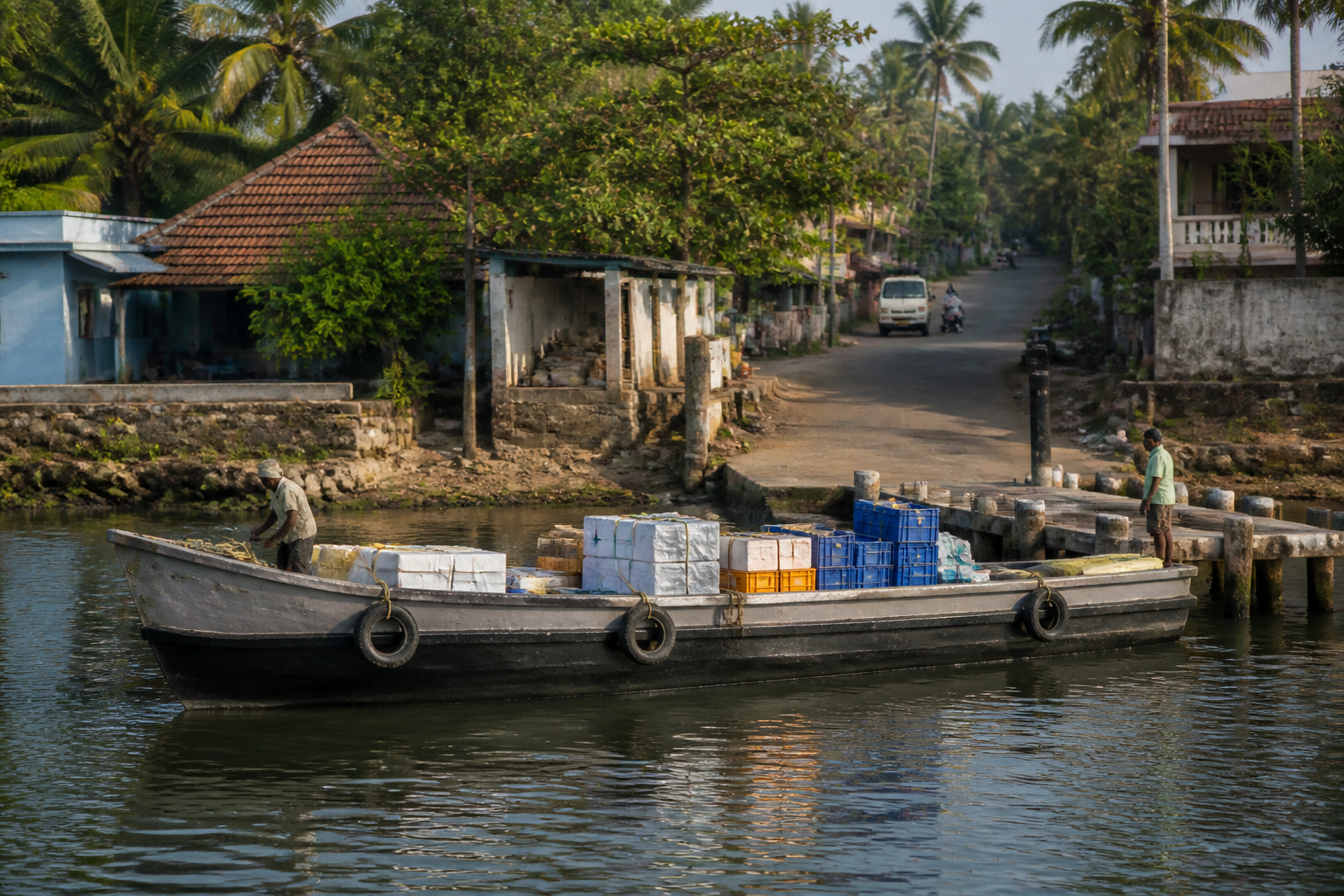
India’s Waterways Could Rewire the Last-Mile Logistics Network
Subheadline: The next phase of e-commerce access may depend less on extending roads than on connecting waterways, terminals, local boat operators and delivery networks.
Standfirst: India’s digital economy is reaching consumers in riverine, island and backwater regions that conventional logistics networks still struggle to serve. The country’s inland waterways are expanding beyond their traditional role in bulk cargo, while government schemes are seeking to raise their share of freight from about 2 per cent to 5 per cent by 2030. The central question is not whether waterways can replace roads. The evidence presented by the Centre, logistics companies and a Kerala initiative points to a narrower but potentially important role: moving goods closer to dispersed communities, reducing the distance that road-based delivery must cover and making local geography part of the logistics design. This analysis examines what that shift would require, where it is already visible and why infrastructure capacity alone does not guarantee accessibility.
India’s e-commerce market has expanded into places where the delivery network remains less developed than consumer demand. Millions of people in riverine, island and backwater settlements can order products online, but the final movement from a logistics hub to the customer can remain costly and operationally difficult. In these locations, the road is not always the most direct or practical route.
That creates a logistical problem distinct from internet access. Rural internet users exceeded 427.7 million during FY 2025-26, while 99 per cent of eligible habitations had been connected under PMGSY-I, according to the material cited in the report. Yet a road connection does not automatically create reliable doorstep delivery. Roads may end before a settlement, become inefficient in areas divided by waterways or require delivery workers to take long, indirect routes.
The implication is important for how India defines connectivity. A village may be connected to a road network and still be poorly connected to a parcel network. The difference lies in the final link between a regional hub, a local aggregation point and the customer. In water-bound geographies, that link may need to include a boat, jetty or water-based fulfilment facility rather than another road extension.
The opportunity is emerging alongside a larger logistics industry. The sector is forecast to grow to as much as $281.74 billion by 2026. But growth in market size does not by itself resolve the problem of access. A larger logistics system can continue to serve dense urban corridors efficiently while leaving dispersed settlements expensive to reach. The challenge is therefore not only scale, but the ability to adapt the network to different physical conditions.
India’s inland waterway network provides one possible layer of that adaptation. Of the 111 National Waterways covering more than 20,000 kilometres, 32 waterways covering over 5,100 kilometres were functional by March 2026, according to the source material. The movement of goods through these waterways exceeded 198 million tonnes by February. Much of this activity involves bulk cargo, but the infrastructure and operating experience could also support a wider range of goods if the connections to local delivery systems are established.
The government’s stated objective is to increase the share of freight moved on waterways from about 2 per cent to 5 per cent by 2030. The report identifies PM Gati Shakti and the Jalvahak scheme as mechanisms that could support this shift. The significance of these programmes, in the context of last-mile logistics, is not simply the volume moved on water. It is whether waterways can be integrated with roads, terminals, warehouses, local operators and digital tracking systems.
A waterway on its own is not a logistics network. It becomes useful to consumer delivery only when cargo can be aggregated, transferred and dispatched with sufficient reliability. That requires physical interfaces between modes. A barge or boat may move goods closer to a settlement, but the parcel still needs to be sorted, handed over and delivered to the recipient. If those transfers are slow or poorly organised, the water route may add another layer rather than reduce the total delivery burden.
This is why the idea of a water terminal serving as a fulfilment hub is central to the argument made by Antim Suman, co-founder and chief operating officer of Edgistify. Suman told NDTV that inland water transport can be up to 60 per cent cheaper than road transport and argued that urban water terminals could bring inventory closer to local demand. The report does not establish that this cost difference applies uniformly across routes or shipment types, but the claim illustrates the potential value of moving some inventory upstream before the final road journey begins.
The proposed model would not eliminate doorstep delivery. Instead, it would change the point at which the road-based delivery begins. If inventory is held closer to customers, riders may travel shorter distances after collecting a parcel. That could reduce the pressure created by congested streets in dense areas and by difficult terrain in dispersed settlements. The benefit would depend on the quality of the terminal, the frequency of water services, the volume of demand and the efficiency of the final handover.
Kerala’s Vallam Express initiative offers a local example of this operating principle. In the Alappuzha region, the initiative serves 14 villages and nearly two lakh residents by combining organised logistics with local boat operators familiar with routes that are inaccessible or inconvenient by road. Its relevance lies in the use of an existing local capability within a more structured delivery system.
That example also challenges the assumption that logistics scale must be built through uniform infrastructure. Abhishek Chakraborty, chief executive officer of DTDC Express, told NDTV that India’s varied geographies and ways of living require networks that can combine multiple modes and local ecosystems. His argument is that consistency for customers does not necessarily require identical infrastructure everywhere. It may instead require the coordination of different forms of infrastructure around a common service standard.
This distinction matters because waterway logistics cannot be assessed only through the length of navigable routes or the tonnage moved. Those are important indicators of capacity, but consumer logistics also depends on frequency, reliability, transfer time, parcel handling, route knowledge and the ability to reach a customer after the water journey ends. The Vallam Express example points to the value of local knowledge, while the government’s freight target points to the scale of the infrastructure challenge.
The policy landscape is therefore broader than a single transport scheme. PM Gati Shakti is relevant because the proposed model depends on coordinating infrastructure rather than developing waterways in isolation. Jalvahak is relevant because it supports the policy objective of increasing cargo movement on inland waterways. Together, the schemes represent an attempt to connect transport modes and make waterways part of a wider freight system.
The available material does not establish how many e-commerce parcels currently move through inland waterways, how many additional terminals would be required or what proportion of last-mile deliveries could shift to water. Those gaps are important. Bulk cargo volumes cannot be directly treated as evidence that parcel logistics is ready to scale. Consumer deliveries have different requirements, including smaller consignments, greater frequency and more precise final destinations.
The data nevertheless establishes a clear imbalance. India has a large and growing digital consumer base, expanding logistics demand and a substantial inland waterway network, but only a portion of that network is described as functional. At the same time, the report shows that road connectivity has not removed the accessibility problem in every geography. The issue is therefore not the absence of infrastructure in absolute terms, but the mismatch between available infrastructure and the routes required by different communities.
That mismatch is likely to be most visible where settlements are dispersed, waterways are already part of daily movement and road-based alternatives are indirect or congested. In such places, a multimodal network may be more practical than attempting to reproduce the same highway-centred logistics model everywhere. The relevant measure is not whether water can carry every parcel, but whether it can remove avoidable distance from the overall journey.
The larger urban question concerns how infrastructure systems are designed around actual patterns of settlement and movement. Roads remain essential for the final delivery leg, and waterways cannot bring parcels directly to most doorsteps. But a logistics system that treats every geography as a road geography may impose unnecessary cost and time on both operators and consumers. The alternative is to connect existing assets—jetties, boats, terminals, warehouses, roads and local delivery networks—through a more coordinated operating model.
The evidence supplied in the report confirms that waterways are becoming more important in India’s freight strategy and that local initiatives are testing their role in consumer logistics. It does not yet establish that inland waterways can transform last-mile delivery at national scale. What it shows is a narrower and more defensible proposition: in water-bound and congested geographies, waterways could improve accessibility when they are integrated with fulfilment, aggregation and doorstep delivery rather than treated as a substitute for roads. The next developments to monitor are the expansion of functional waterways, the implementation of PM Gati Shakti and Jalvahak, and whether models such as Vallam Express can deliver reliable service beyond their initial local contexts.
