


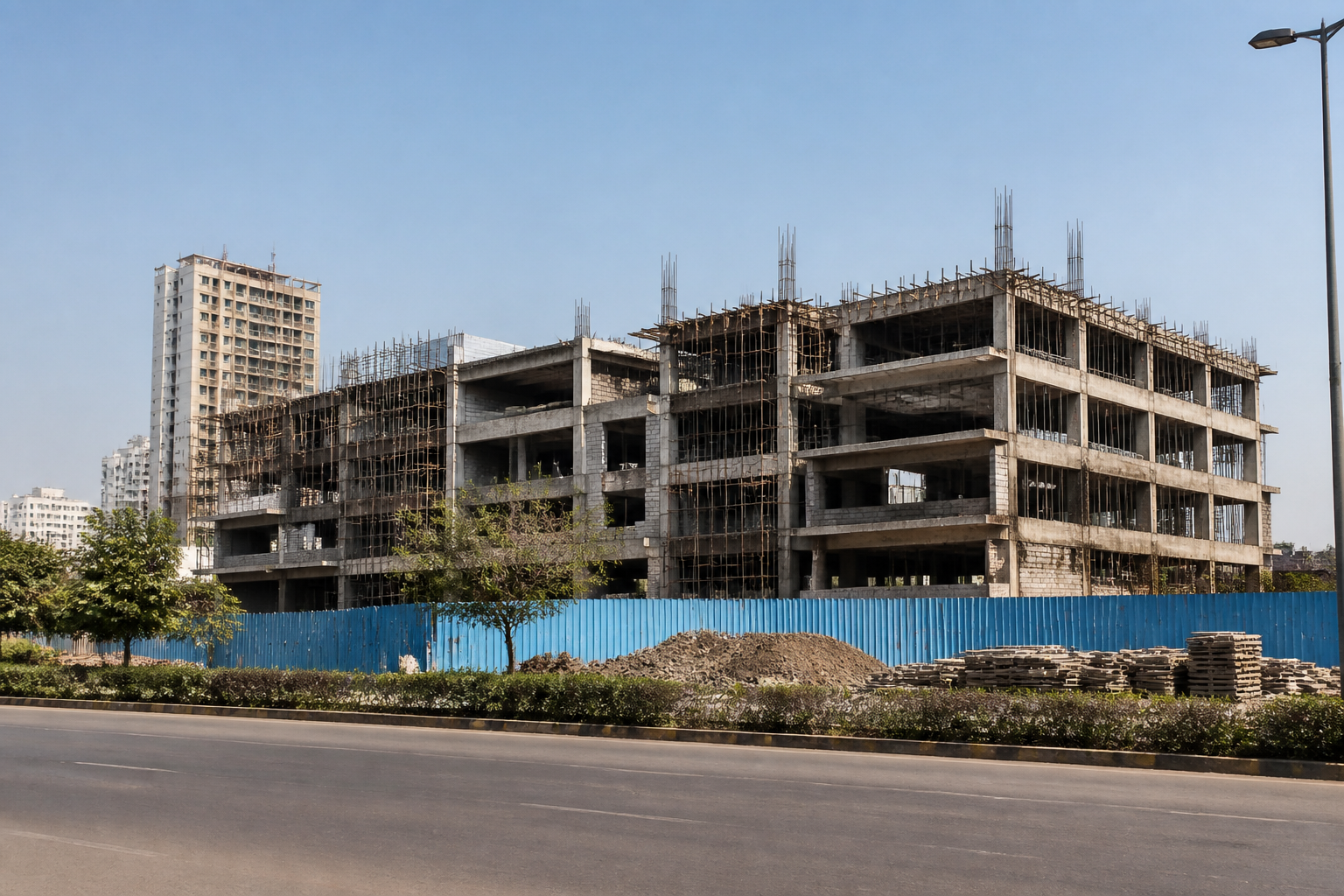
The proposed additional expenditure for Panvel Municipal Corporation’s ‘Swarajya’ headquarters has turned a delayed administrative building into a test of municipal financial control, project planning and accountability. Ahead of the civic body’s general meeting on September 9, the administration is seeking approval for an additional Rs 371.69 crore: Rs 120 crore for construction and Rs 251.55 crore for interiors and related works.
The proposal is significant not only because of its size, but also because the amount now under consideration exceeds the Rs 200 crore provision made under the relevant budget head. The general body is therefore being asked to consider a project whose proposed additional expenditure alone is larger than the current allocation recorded for the headquarters. The available report does not establish whether the full additional amount will be sanctioned, how it will be financed or whether the revised estimate represents the project’s final cost.
The Swarajya headquarters was planned as the new administrative building of Panvel Municipal Corporation. Before construction began, the proposed building was given its name. The corporation had acquired a five-acre plot from the City and Industrial Development Corporation opposite the Karnala Sports Academy for Rs 28 crore. The initial plan estimated Rs 140 crore for construction and Rs 160 crore for interior work.
That original estimate already separated the project into two substantial components: the building itself and its internal fit-out. The revised proposal indicates that both parts have since undergone material changes. The report attributes the delay to various reasons and says that a technical review by the architect, project management consultant and municipal corporation found that several modifications were required in the building design.
The first revised construction package is estimated at Rs 120,13,65,594. It includes additional architectural and building-envelope elements such as glass-fibre-reinforced concrete, stone cladding, a facade system, a dome system, aluminium fins and a fire-resistant paint system. According to the administration’s proposal, these changes are necessary for long-term durability, energy efficiency, ease of maintenance and architectural quality.
Those stated objectives describe the intended value of the revised design, but they do not by themselves answer the central financial questions. The available report does not provide a component-wise comparison between the original and revised designs, nor does it specify when each addition was introduced, who approved the changes or how much of the increased cost is attributable to inflation, design alteration, delayed execution or changes in construction specifications. These details will determine whether the escalation reflects a justified redesign, weaknesses in the original planning process or a combination of both.
The interior works have followed a separate route. A work order for the second phase of interior decoration and related works had earlier been issued to Konkan Railway Corporation Limited. However, the standing committee’s July 28 resolution removed this work from the company. The corporation is now proposing a fresh tender process, with an estimated cost of Rs 251,55,58,931.
The change in the implementing agency matters because it introduces another transition into an already delayed project. A fresh tender can allow the corporation to reconsider scope, competition and pricing, but it can also extend the project schedule if the tendering process, technical evaluation or award takes time. The supplied report does not state whether the earlier work order was cancelled because of performance concerns, a change in scope, administrative reasons or another factor. That explanation is likely to be central to the general body’s discussion.
The project’s financial structure makes the timing of the proposal particularly important. The two revised items are listed under the budget head for the new municipal administrative building, which has a provision of Rs 200 crore. The proposed additional amount of approximately Rs 372 crore is therefore substantially larger than that provision. The report does not clarify whether the corporation intends to revise the budget head, identify new revenue, use other municipal funds or seek approval through another financial mechanism.
This is the point at which a construction proposal becomes a governance question. Municipal buildings are not ordinary private developments. Their costs are ultimately tied to public budgets, and decisions about design, procurement and construction compete with spending on roads, drainage, water supply, waste management, public health and other civic responsibilities. The source material does not quantify those trade-offs in Panvel, but the scale of the proposed escalation makes the budget process itself part of the story.
The project also illustrates the consequences of beginning construction before all design and technical questions have been resolved. The report says that the architect, project management consultant and municipal corporation later identified the need for several modifications. Some changes may be necessary to improve durability, energy performance, maintenance and safety. Yet when such requirements emerge after a project has been planned or construction has begun, they can affect the cost, tender documents, sequencing and contractual responsibilities.
The available evidence does not establish when the technical review took place or whether the revised requirements were included in the original tender documents. It also does not state how much construction has been completed, what amount has already been paid or whether the four-year delay has generated additional claims from contractors or consultants. Without those figures, it is not possible to separate the total proposed escalation into design-related, time-related and procurement-related costs.
The reference to a four-year delay adds another layer to the issue. The report describes construction as proceeding slowly and says that the headquarters has faced delays for various reasons. It also raises questions about whether officials responsible for monitoring the project informed the municipal commissioner in time about the factors that could delay it, and what action the commissioner took if such information was provided.
These are questions of institutional responsibility rather than individual blame. A large public project normally passes through multiple stages: land acquisition, design development, technical scrutiny, administrative approval, tendering, appointment of consultants and contractors, construction supervision and payment certification. Delays or changes at any one stage can affect the next. The supplied report identifies several actors in the process but does not provide the records needed to determine where the primary breakdown occurred.
The September 9 general meeting is consequently more than a vote on a revised estimate. It is the formal setting in which the corporation can place the project’s history, revised scope and financial implications on record. Members can seek clarification on the original estimate, the reasons for design modifications, the status of the earlier work order, the basis of the new interior estimate and the funding plan for the additional expenditure.
The distinction between approval and execution will be important. Even if the general body approves the proposals, the interior works are expected to undergo a new tender process. Approval of an estimated cost does not itself demonstrate that the amount has been spent, that a contractor has been selected or that the building will be completed by a specified date. The report does not provide a revised completion deadline.
The Swarajya headquarters therefore remains an unfinished administrative project with a rapidly expanding financial frame. The evidence currently establishes that Panvel Municipal Corporation is seeking approval for Rs 120 crore in additional construction expenditure and Rs 251.55 crore for a new interior and related works tender, against a budget provision of Rs 200 crore. It does not yet establish the final project cost, the precise causes of the four-year delay, the financing arrangement or the completion schedule.
Those gaps are likely to define the next stage of scrutiny. The immediate milestone is the corporation’s September 9 general meeting, where the proposals and the administration’s explanation for the delay, design revisions and contract changes are expected to come under discussion.
