


Bengaluru | September 8, 2026
Bengaluru has ranked 32nd among India’s million-plus cities in the 2026 Swachh Vayu Sarvekshan, placing it among the bottom 10 performers despite measures under the National Clean Air Programme and clean-fuel schemes. The city scored 152.6 points in the assessment announced by the Union Ministry of Environment, Forest and Climate Change on Monday.
Only seven cities ranked below Bengaluru in the million-plus category. Lucknow topped the list with 198 points, followed by Indore with 197 and Jabalpur with 195. The rankings were released as part of Swachh Vayu Diwas 2026, observed on the International Day of Clean Air for Blue Skies.
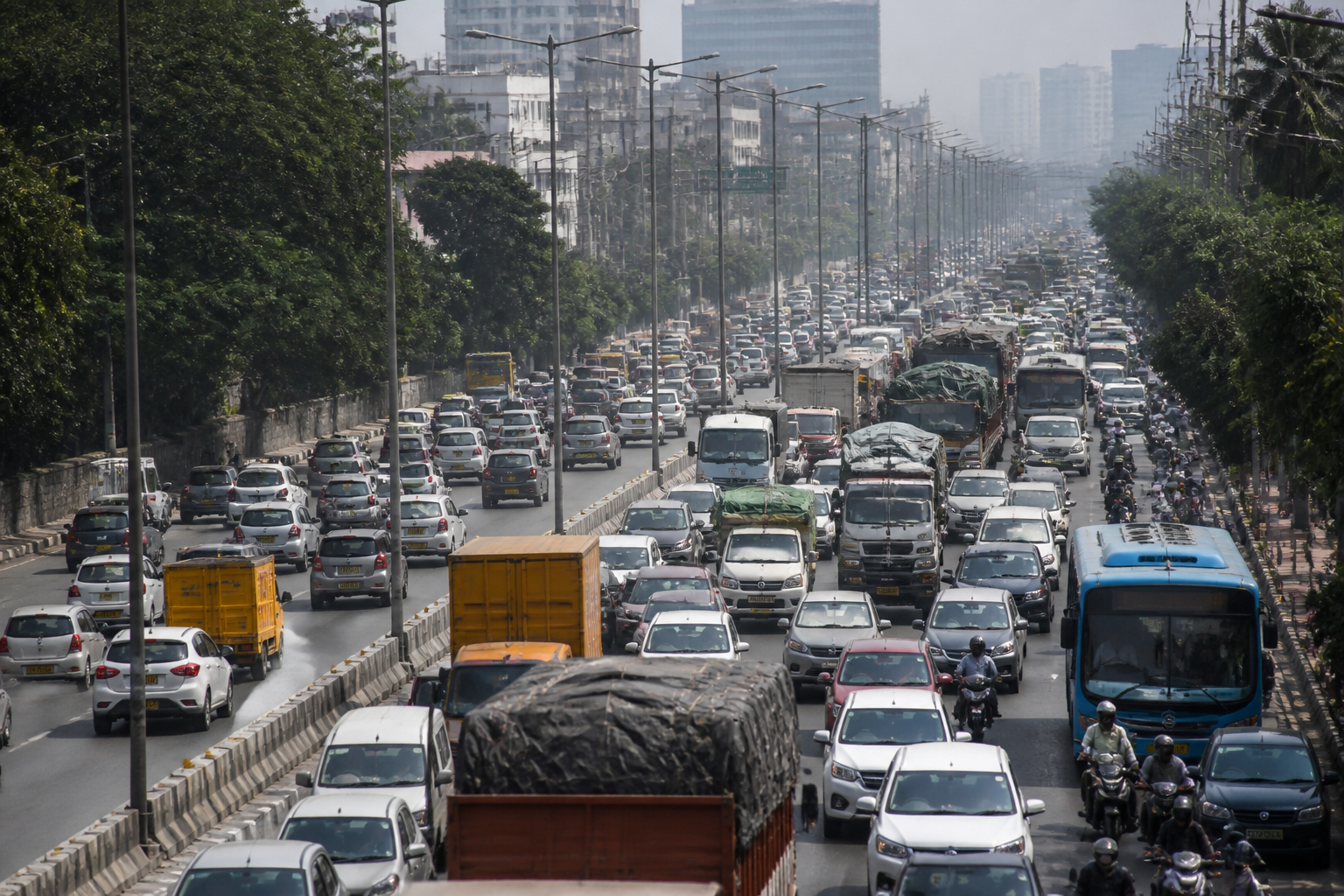
Experts cited traffic congestion, industrial emissions, waste mismanagement and emissions from wood and charcoal burning as key factors affecting Bengaluru’s air quality. Professor Gufran Beig, chair at the National Institute of Advanced Studies, said the city’s slow-moving and congested traffic was a major source of emissions.
“Bengaluru is known for its slow-moving traffic and congestion, which lead to a significant increase in emissions. A traffic mix of slow-moving, low-speed and high-speed vehicles is the biggest issue Bengaluru is facing, and this is impacting the city’s air quality,” Beig said, according to the report.
Air quality experts also pointed to poor road infrastructure, rising emissions from small-scale industries and inadequate waste management. They said emissions from informal settlements, where some residents continue to burn wood and charcoal for cooking, remained a concern despite the coverage of clean-fuel schemes.
Beig said the cost of refilling cooking-gas cylinders meant that some households were not using clean fuel consistently. He also said emissions from small-scale industries in Bengaluru were increasing and remained largely unaccounted for. Road dust, however, was described as a relatively smaller source of pollution in the city compared with the other contributors identified.
The Swachh Vayu Sarvekshan assesses measures taken by cities to control road dust, solid waste, vehicular and industrial emissions, construction and demolition waste, diesel generator sets and emissions from commercial establishments. It also evaluates information, education and communication activities related to clean-air measures.
A total of 130 cities participated in the assessment across three population categories: below three lakh, three lakh to 10 lakh, and above 10 lakh. Cities conducted self-assessments, which were approved by state-level monitoring committees before evaluation by the Central Pollution Control Board. Independent committees subsequently carried out field verification, after which officials selected the 10 best-performing cities.
The 2026 ranking places Bengaluru’s performance below the leading million-plus cities and keeps attention on the implementation of clean-air measures across transport, industry, waste management and household fuel use. The assessment framework will continue to form the basis for evaluating participating cities under the National Clean Air Programme.
