


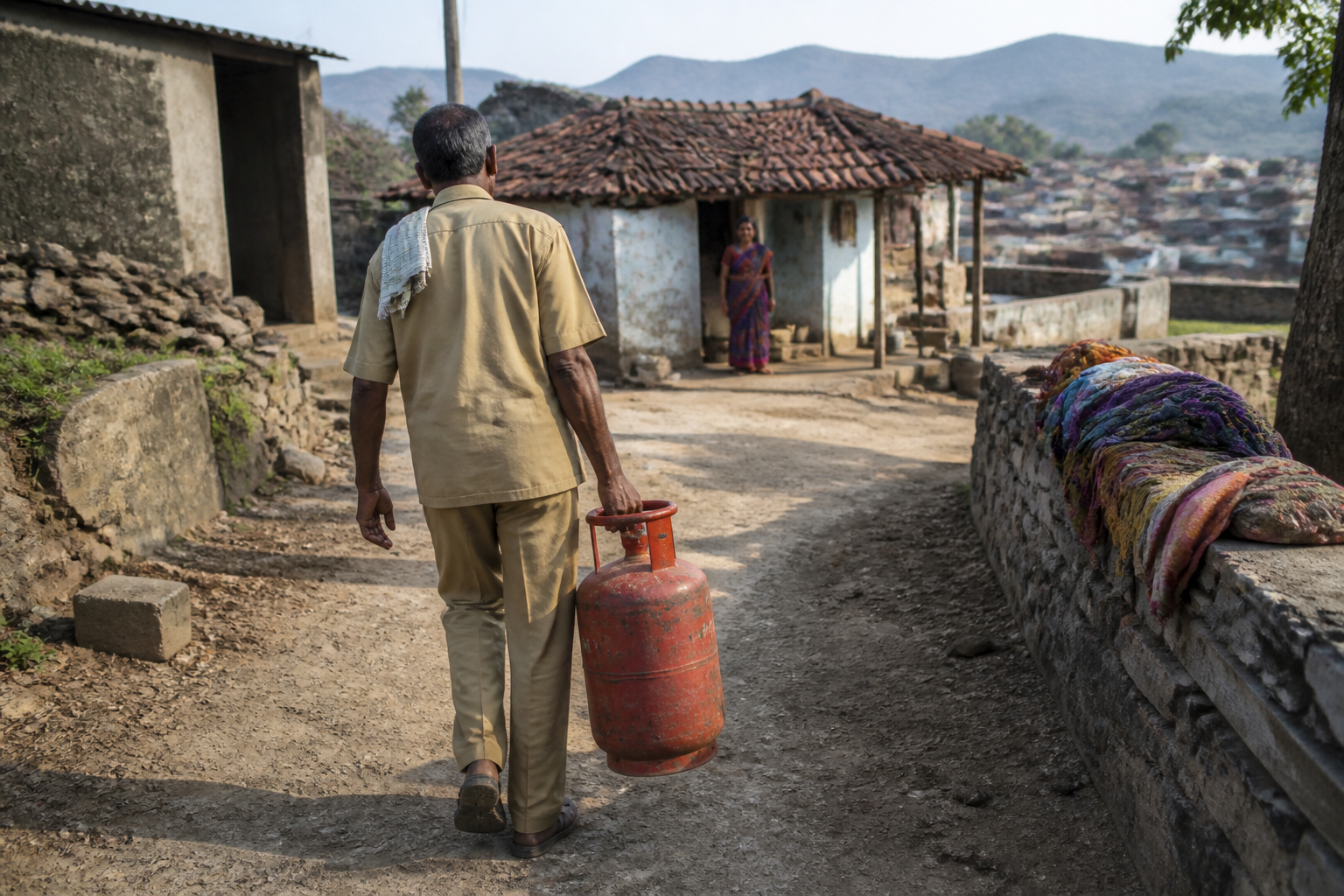
A Council on Energy, Environment and Water analysis finds that LPG connections have not translated into sustained clean-cooking use for many rural households, migrants and residents of urban informal settlements. The gap is shaped not only by the price of a refill, but also by delivery networks, documentation rules and the ability of households to participate in the formal distribution system.
The findings show the limits of measuring clean-cooking progress through connection numbers alone. Among rural households surveyed, 73 per cent had used LPG in the previous 90 days, but only 23 per cent used it exclusively. Half continued to rely on firewood as their primary cooking fuel. Just 47 per cent of rural LPG users received doorstep delivery, leaving households to manage the cost and effort of collecting cylinders.
That distinction between access and regular use is central to the evidence. A household may have an LPG connection but still depend on solid fuels if refills are unaffordable, difficult to obtain or unavailable through a reliable local delivery network. The CEEW studies describe these constraints as a combination of refill affordability and last-mile logistics, rather than as a simple absence of connections.
The delivery problem is especially significant in rural areas, where distance from distributors and transport costs can raise the practical cost of clean cooking. The studies also point to a parallel informal market. Some households buy LPG connections through local shops, roadside dealers or unauthorised sellers, often paying more because formal access is limited or poorly understood.
For households that have to collect cylinders or rely on informal channels, the official retail price does not represent the full cost of using LPG. Time, transport, uncertainty and the need to make a large payment at once all influence whether families continue using the fuel. These factors help explain why recent LPG use can coexist with continued reliance on firewood.
Affordability is a common concern across the categories examined by CEEW. At a price of Rs 400 for a 14.2-kilogram cylinder, at least 80 per cent of respondents said they would switch exclusively to LPG. The median willingness to pay was Rs 500, below the current subsidised Pradhan Mantri Ujjwala Yojana rate of Rs 642 cited in the findings.
The figures suggest that the issue is not simply whether households prefer clean cooking. Many respondents expressed a willingness to use LPG exclusively at a lower price, but the price point required for regular use remains below the cited subsidised rate. In this context, an LPG connection creates the possibility of cleaner cooking without ensuring that households can sustain it over time.
The challenge is also administrative. Migrant workers face difficulties obtaining formal LPG connections because their housing and address circumstances do not fit easily into standard documentation systems. Among migrant LPG users surveyed, 79 per cent lacked a formal connection and fewer than 4 per cent were enrolled in PMUY, despite a 2021 policy provision allowing simplified self-declarations.
The gap between policy eligibility and actual enrolment indicates that formal rules alone do not guarantee access. Migrants may move frequently, live in rented rooms or open spaces, or lack the documents expected by distributors. These conditions make the connection process harder and can push households towards informal purchases even when a formal pathway exists.
The evidence is particularly stark among migrants living in open spaces. Seventy per cent of this group relied entirely on solid fuels, according to the studies. Migrant users who bought LPG informally paid Rs 71 per kilogram, more than 20 per cent above the rates paid by formal users able to afford a complete cylinder.
This premium illustrates how exclusion from the formal system can increase the cost of a basic household service. A family unable to produce the required documentation or pay for a full cylinder may not be paying less for energy; it may be paying more through smaller, informal purchases. The result is a system in which the households with the least secure living arrangements can face both higher prices and greater exposure to polluting fuels.
Urban informal settlements show a different but related pattern. The studies found that 70 per cent of respondents in these settlements reported exclusive LPG use. However, 31 per cent of those without formal connections said they had been rejected because they lacked acceptable address proof. Eleven per cent paid Rs 1,040 informally, compared with a cited retail cost of Rs 803.
These figures show how documentation operates as an infrastructure of access. In informal settlements, the physical presence of a distributor may not be enough if residents cannot establish a recognised address. The result is a barrier created by the interaction between housing informality and service-delivery rules.
The policy implications extend beyond the petroleum sector. Clean cooking depends on the coordination of subsidy design, distributor incentives, payment systems, identity and address documentation, and local delivery networks. The responsibility is therefore distributed across ministries, distributors, local administrations and households, while the consequences are experienced at the kitchen level.
The CEEW recommendations reflect these different barriers. For rural households, the studies call for a higher PMUY subsidy of approximately Rs 200 per cylinder and improved doorstep delivery. For migrants, they propose targeted enrolment drives, additional subsidy and greater awareness of formal connection provisions. For urban poor households, the recommendations include payment innovations such as micro-payments.
The studies also propose smart-meter kiosk pilots and differentiated distributor commissions to expand rural doorstep access. These suggestions treat distribution capacity as part of clean-cooking policy rather than as a separate commercial concern. If distributors do not have an economic reason to serve dispersed or low-volume customers, a connection programme may continue to underperform at the last mile.
The wider urban question is how public policy serves residents whose housing, employment and incomes are not organised around formal permanence. Migrants and informal-settlement residents are often present in cities without holding the documents associated with stable residence. Their exclusion from cooking-fuel systems resembles broader difficulties in accessing water, sanitation, electricity and other networked services.
For rural households, the issue is less about urban informality and more about the cost and reliability of connecting dispersed settlements to formal supply chains. Yet the underlying problem is similar: infrastructure exists, but the service is not consistently affordable or reachable. The clean-cooking transition therefore depends on the quality of the interface between households and the distribution system.
The evidence also complicates the use of a single national measure of success. The number of connections can indicate that a household has entered the formal system, but it cannot show how often the cylinder is refilled, whether the household uses LPG exclusively, or whether it has returned to firewood because of price or availability. The CEEW findings place sustained use at the centre of the assessment.
What the available evidence confirms is that LPG adoption is constrained by three linked conditions: affordability, reliable physical delivery and formal eligibility. Rural households face refill and doorstep-delivery barriers; migrants face documentation, awareness and subsidy gaps; and urban informal-settlement residents face address-proof and payment problems. What remains unclear from the supplied findings is how these barriers vary across states, distributor networks and seasons.
The next phase of clean-cooking policy will therefore be judged less by the number of connections issued than by whether households can refill cylinders regularly and use them as their primary fuel. The CEEW studies place that test on the affordability of each refill, the reliability of last-mile delivery and the ability of mobile and informally housed residents to enter the formal system.
