


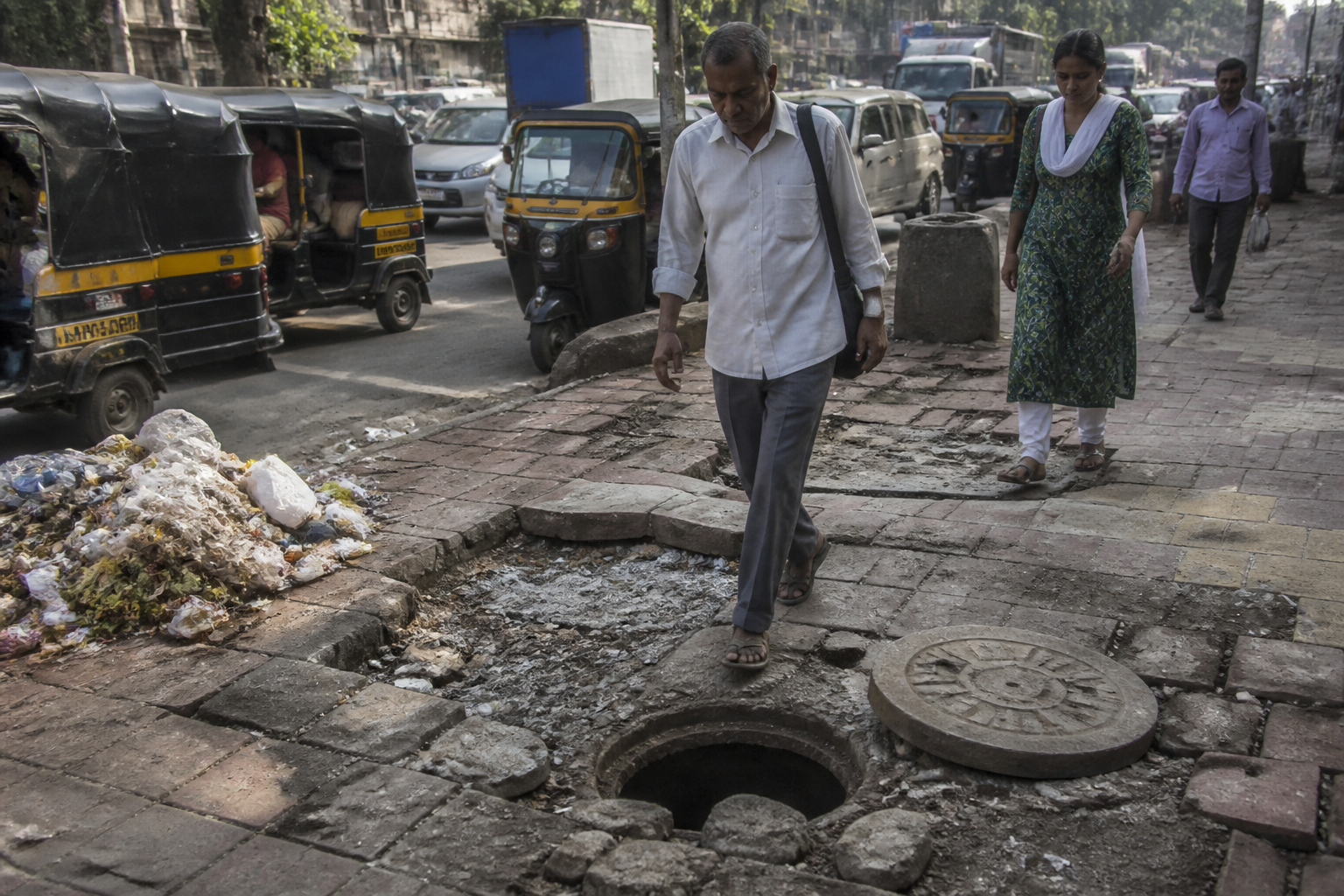
Mumbai’s civic woes are rarely confined to one broken pavement, one garbage pile or one diverted bus route. A recent set of reader complaints published by Mid-Day brings together problems reported in Andheri West, Mulund and Thane: a roofless foot overbridge, roadside waste, broken footpaths, displaced manhole covers, a caved-in road, alleged selective hawker action and a bus route changed after construction near Thane station. Taken separately, these appear to be local grievances. Together, they describe how everyday urban safety depends on several agencies maintaining small but essential parts of the city’s public realm.
The complaints also show why maintenance is a governance issue rather than merely a question of appearance. Pedestrians depend on a continuous surface, functioning drainage, safe crossings, lighting and unobstructed access. When any one of these fails, the burden shifts to residents, schoolchildren, older people, motorists and public transport users. The report does not establish that all the problems share one administrative cause. It does, however, show a repeated pattern: citizens identify hazards, authorities acknowledge individual complaints, and the timing of a permanent resolution remains uncertain.
The most concentrated cluster of complaints came from Yari Road in Andheri West. Residents described heaps of garbage, broken pavements and displaced manhole covers. Another complaint referred to a dangerously caved-in section of the road, with stagnant water and potential risks for pedestrians, school students, parents and motorists. The concerns were presented as continuing conditions rather than isolated incidents, including a roadside location near Pegasus Tower that residents said had become a regular dumping point.
These complaints involve different municipal functions. Waste accumulation requires removal, cleaning and continued collection. A damaged footpath or manhole cover requires inspection and repair. A road cave-in requires identifying the cause of the failure before restoring the surface. The report records a demand for a permanent solution at the dumping site, as well as proper engineering standards and regular inspection for the damaged road. That distinction matters because clearing visible waste or patching a surface may address the immediate symptom without resolving why the problem recurs.
The response attributed to the BMC’s Andheri K-West ward disaster management control room was limited but specific: an official said the complaint would be examined, appropriate action would be taken and the matter would be forwarded to the concerned department. Such a response establishes an administrative route, but not a completion date, repair specification or monitoring arrangement. In the material available, there is no confirmation that the caved-in road, broken pavement or garbage accumulation had been fully resolved.
A second part of the problem concerns the use of public space. One reader questioned action against unauthorised hawkers and vendors, arguing that enforcement should not be selective and that women selling goods on footpaths should not be treated harshly. The concern places two municipal responsibilities in direct proximity: keeping pedestrian routes usable and regulating livelihoods that depend on those same public spaces. The report records a senior civic official saying footpaths were being cleared under the Pedestrian First policy and that ward officials had been instructed to prevent reoccupation through regular inspections. The licence department, the official added, continued to conduct drives.
The response indicates that clearance is being treated as an ongoing process rather than a one-time operation. It also reveals a practical test for the policy: whether cleared footpaths remain accessible after enforcement teams leave. The report does not provide figures on the number of drives, cleared stretches, licensed vendors or repeat encroachments. Without that information, it is not possible to assess the policy’s citywide performance. What can be established is that residents are judging enforcement not only by whether an action occurs, but also by whether it is consistent and whether pedestrian access is maintained afterward.
The complaints extend beyond Mumbai’s municipal boundaries. In Mulund, a newly opened foot overbridge was described as lacking a roof, prompting questions about whether the railway and municipal authorities had considered user comfort and protection from weather during planning. The report does not identify the responsible agency or record an official response on the roof. That gap highlights a recurring feature of infrastructure delivery: opening an asset does not necessarily mean that all elements required for comfortable and usable access have been addressed.
In Thane, a resident of Akashganga Complex in Rabodi said a bus route had been altered during Station Area Traffic Improvement Scheme construction near Thane station. The earlier service had travelled through the Court Naka and Jambli Naka route to Thane station West, while the revised route moved to the east side. According to the complaint, the change reduced the route’s usefulness and made access to rickshaws more difficult. The case shows how construction-related traffic changes can affect connectivity even when the work is intended to improve a station area.
The issue is not simply whether a route diversion is necessary during construction. It is whether the alternative continues to serve the people who depended on the original alignment, and whether residents receive a clear mechanism to request adjustments. The report does not state whether BEST or Thane civic authorities had accepted, rejected or reviewed the request to restore the earlier route. That unresolved status leaves the impact on passengers documented but the institutional response incomplete.
Road maintenance and street lighting add another layer. In response to a complaint about continuing road repair work inside Aarey Milk Colony, an official from the chief executive officer’s office said a proposal had been sent to the Public Works Department for new street lights along the colony’s 26-kilometre road network. The stretch from Aarey Market to the Royal Palms gate would be taken up once the budget was approved. A BMC official separately said road-concentration work across the city had been brought to a safe stage and stopped because of the monsoon. The official said the project had a May 2027 deadline and that work would resume in October 2026.
These details point to the importance of sequencing. Road works, lighting, drainage, footpaths and traffic arrangements do not operate independently for the people using them. If one element is completed later, paused or transferred to another agency, the public may experience the entire corridor as unfinished. The Aarey response supplies a proposed intervention, a funding condition and a timeline, but it does not confirm when the lighting installation will begin or how the road will be maintained while the proposal awaits budget approval.
The broader evidence in the report is therefore administrative rather than statistical. It contains no citywide count of broken pavements, no data on garbage complaints, no performance measure for footpath inspections and no comparison of bus connectivity before and after the Thane construction diversion. That absence limits the conclusions that can be drawn. The complaints should not be presented as a quantified measure of Mumbai’s entire civic condition. They are, however, a useful record of how residents encounter the city at street level and how responsibility is distributed among the BMC, BEST, railway authorities, the PWD, Aarey officials and local enforcement agencies.
The pattern also exposes the difference between response and resolution. Officials have acknowledged several complaints, described existing policies or referred matters to other departments. In one case, a footpath repair and cleaning instruction was issued to a bus depot manager and the local BMC office. In another, a street-light proposal was sent to the PWD. These actions show that complaints can enter formal administrative channels. They do not by themselves demonstrate that the underlying problem has been corrected, inspected after repair or prevented from returning.
For citizens, that distinction is central. A cleaned roadside that becomes a dumping site again, a cleared footpath that is reoccupied, a repaired road that caves in again or a diverted bus route that remains unsuitable all create the impression that the city is responding episodically rather than managing assets continuously. The supplied material does not establish why each problem occurred or whether departments failed to coordinate. It does show that many complaints sit at the boundaries between agencies, budgets and operational responsibilities.
Mumbai’s civic maintenance challenge, as reflected in this set of complaints, is therefore less about a single defective asset than about the chain connecting reporting, ownership, inspection, repair and follow-up. The immediate questions are practical: who is responsible, what action has been authorised, when will it be completed and how will residents know that the issue has been closed? The next developments to monitor are the response to the Yari Road hazards, any decision on the Mulund foot overbridge roof, the review of the Thane bus route, the proposed Aarey lighting work and the resumption of road-concentration work in October 2026.
