


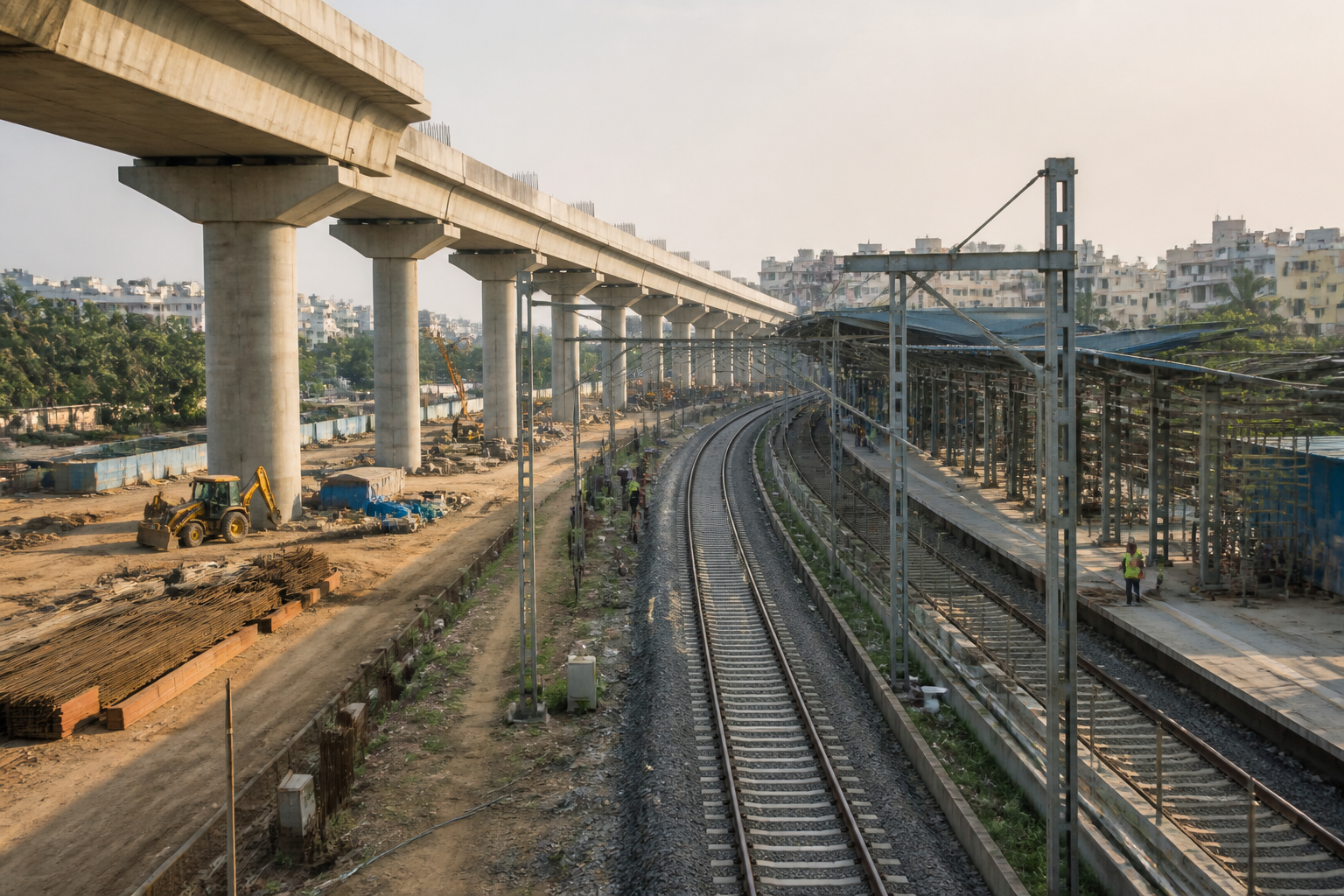
Bengaluru’s suburban rail project has moved from prolonged construction delays into a more active phase, with work under way on the Mallige and Kanaka corridors and a stated expectation that trains could begin operating between Chikkabanavara and Yeshwanthpur by 2028. But the project’s next challenge may not be construction alone. The timing of train deliveries, signalling trials and unfinished land acquisition could determine whether completed civil works translate into passenger services.
The update, reported by Vijay Karnataka on September 6, describes renewed activity across the two corridors after Larsen & Toubro withdrew from an earlier contract, causing parts of the project to stall. K-RIDE, the Karnataka Rail Infrastructure Development Company, has since taken forward construction involving stations, elevated sections, ground-level tracks, bridges, drainage works and retaining structures. The report says the two corridors together will have 30 stations.
That progress matters because Bengaluru’s suburban rail plan is intended to use the city’s wider railway network to serve areas beyond the reach of the existing metro system. Yet the project is not moving as one uniform construction package. Different sections are at different stages, contracts have changed hands, and some land requirements remain unresolved. The result is a delivery problem in which the first usable service could depend on the readiness of a relatively short section rather than the completion of the entire network.
The clearest near-term target is on the 27-kilometre Mallige corridor, which links Baiyappanahalli and Chikkabanavara. According to the report, K-RIDE expects suburban rail services to begin on the roughly seven-kilometre section between Chikkabanavara and Yeshwanthpur in 2028. The corridor is planned to include 12 stations at Benniganahalli, Kasturi Nagar, Sevanagar, Banaswadi, Nagavara, Kanakanagar, Hebbal, Mattikere, Yeshwanthpur, Shettihalli, Mนadarahalli and Chikkabanavara.
The reported cost of construction for the Mallige corridor is ₹1,025.77 crore. Station works have been divided into two packages, with Cementation India and NCC identified as the contractors. A separate ₹106.29-crore package covers 5.80 kilometres of ground-level and elevated route between Yeshwanthpur and Chikkabanavara. Work between Benniganahalli, Banaswadi and Hebbal is also being continued after the earlier contractor left unfinished sections.
The physical works in these sections include small and large bridges, drainage infrastructure and retaining walls. K-RIDE’s stated target is to complete them within two years. A double-decker structure between Yeshwanthpur and Mattikere has been awarded to Cementation India, with a work order expected shortly. At Soladevanahalli, a tender has been issued for a depot on 26 acres, at a reported cost of ₹200 crore.
The Kanaka corridor is larger and more dispersed. It is planned to extend for 46 kilometres between Heelalige and Rajanukunte. The report says station construction has been divided into two packages, with ground-level stations planned at Heelalige, Singena Agrahara, Huskur, Ambedkar Nagar, Carmelaram, Bellandur, Doddanekkundi, Kaggadasapura, Channasandra, Horamavu, Thanisandra, Jakkur, Muddanahalli and Rajanukunte. Elevated stations are being built at Marathahalli, Hennur, Hegde Nagar and Yelahanka.
This distribution reveals the complexity of building suburban rail through a city where railway alignments, roads, existing neighbourhoods and fast-growing employment districts intersect. A corridor may be described as one project, but its construction depends on multiple structures and interfaces: stations, bridges, elevated sections, ground-level track, depots, drainage and access arrangements. Delays in any one of these can affect the ability to operate a complete service.
Land acquisition is another part of the sequencing problem. K-RIDE has completed the land acquisition required for the two corridors and their stations, according to the report. Land needed for flyovers and railway overbridges remains to be acquired. That distinction is important. Completing land acquisition for the main alignment and stations does not necessarily mean that every supporting structure required for safe and continuous operations is ready to build.
The project’s future corridors are at an earlier stage. K-RIDE plans to take up the 41-kilometre Sampige corridor connecting KSR Bengaluru with Devanahalli through Kempegowda International Airport after giving priority to the current C-2 and C-4 routes. The 35.5-kilometre Parijata corridor between Kengeri and Whitefield is expected to follow. Indian Railways has approved the Sampige and Parijata corridors, while a joint survey for land acquisition is under way. The report says acquisition under the Karnataka Industrial Areas Development Board Act is expected to begin after the survey, with the statutory notification process likely to take about a year.
This means the suburban rail programme is advancing on two tracks: construction on selected corridors and preparation for future alignments. For the first phase, however, the key question is whether civil construction and railway systems will be synchronised closely enough to support passenger operations.
The reported contract for train supply creates a specific risk. The supplier is expected to begin deliveries within 18 months, but the report cites concern that delivery could take more than two years. That possibility raises the prospect of a mismatch between infrastructure and operations: stations and routes could be substantially complete while trains are still unavailable.
Transport expert Rajkumar Dugar compared this risk with the experience of Bengaluru’s Yellow Line, where infrastructure completion was followed by a wait for trains. He also pointed to the use of European-style signalling on the suburban rail project. Beyond the physical delivery of rolling stock, the system would require testing, trial operations and resolution of technical issues before regular passenger services could begin. The report does not establish that these delays will occur, but it identifies them as risks that could affect the 2028 expectation.
K-RIDE Managing Director Laxman Singh said several processes remain pending but described the progress of recent months as evidence that the project is moving in the right direction and at the required pace. He attributed the work to coordination among the state government, the Railway Ministry and partner institutions.
That coordination will be central because the project involves more than a conventional construction contract. K-RIDE must align state-level decisions, railway land and infrastructure, civil contractors, rolling-stock supply, signalling systems and statutory land procedures. The earlier withdrawal of a contractor shows how a change in one part of the delivery structure can affect progress elsewhere.
The evidence currently supports a cautious description of the project: construction has accelerated, several station and route packages are active, and K-RIDE has identified a 2028 operating expectation for the Chikkabanavara-Yeshwanthpur section. It does not yet establish that the section will open by that date. The remaining land acquisition, completion of unfinished works, depot construction, train delivery, signalling and trial operations all have to be coordinated.
For Bengaluru, the larger urban question is therefore not only whether suburban rail lines are being built, but whether the network can be delivered as an operating system. A track without trains, a station without access, or a completed civil package awaiting signalling approval would not provide the mobility benefit promised by the project. The coming milestones will be the issue of pending work orders, completion of the remaining land acquisition, progress on the Soladevanahalli depot, rolling-stock delivery and the start of system testing.
The current update confirms movement, but it also shows why the project’s schedule must be judged against operational readiness rather than construction activity alone. The 2028 target for Chikkabanavara-Yeshwanthpur will become more credible as these linked components reach completion in sequence.
