


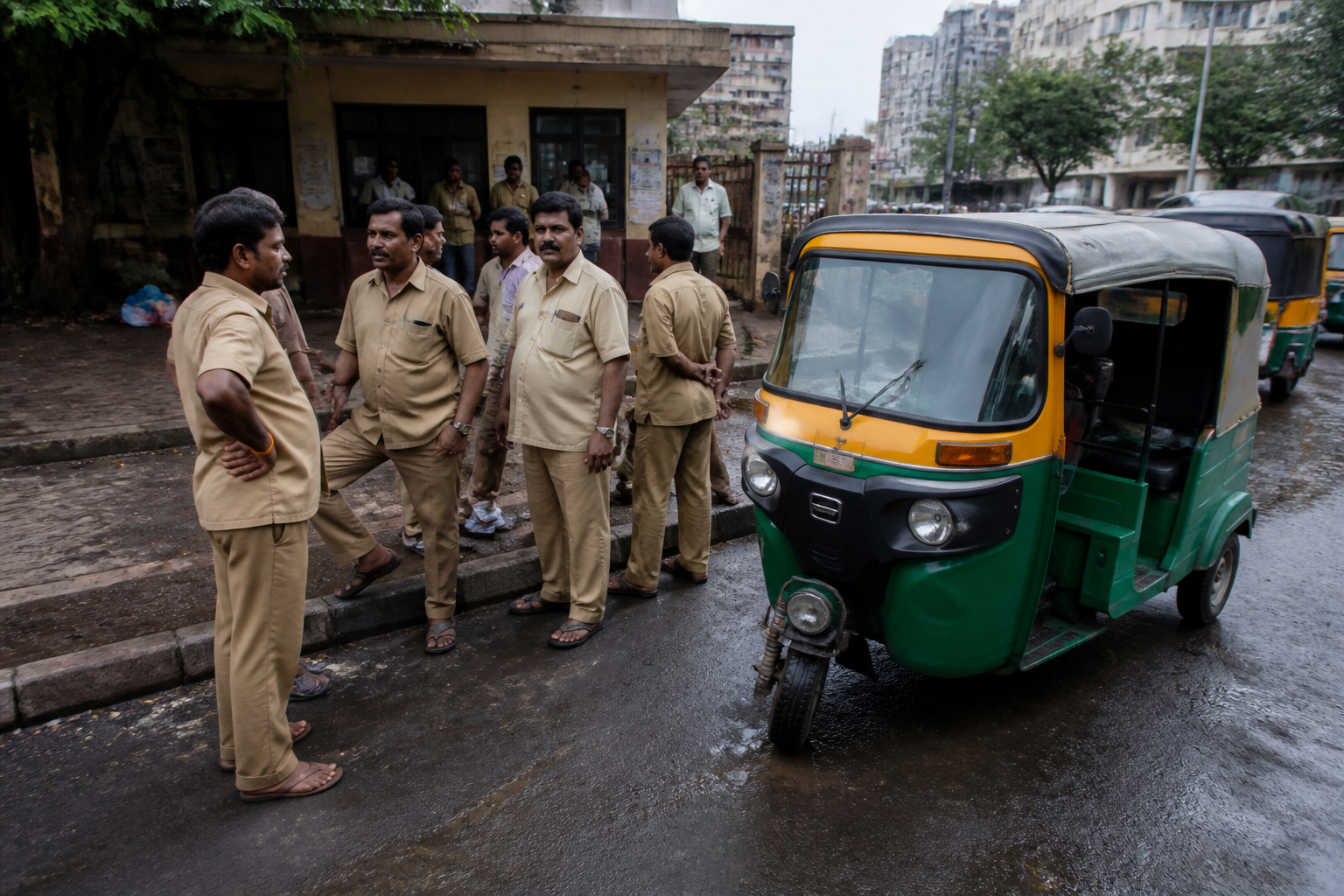
A government-announced honourarium of ₹10,000 for 251 autorickshaw drivers in the Kalyan regional transport area appears modest when viewed as a one-time payment. Its larger significance lies elsewhere: the scheme recognises a longstanding gap in the social-security architecture for transport workers who spend decades providing an essential urban service but generally do not receive a formal retirement benefit.
The benefit was announced for members of the Dharmaveer Anand Dighe Maharashtra Passenger Transport Drivers Welfare Board who have completed 65 years of age. According to information provided by Kalyan Regional Transport Officer Ashutosh Barkul, the amount will be deposited directly into the beneficiaries’ bank accounts. A cheque for the honourarium for 251 drivers was handed to Barkul by Deputy Chief Minister Eknath Shinde and Transport Minister Pratap Sarnaik at an event held at Gadkari Rangayatan auditorium in Thane.
The announcement covers drivers registered in the Kalyan Regional Transport Office area, identified by the vehicle registration series MH-05. That area includes Kalyan, Dombivli, Ulhasnagar, Ambernath and Shahapur. The benefit therefore connects a state welfare decision with a transport workforce spread across a large and rapidly urbanising part of the Mumbai Metropolitan Region. The supplied report does not specify when each beneficiary will receive the money, but it states that the transfer is intended to take place directly through bank accounts.
The immediate numbers are limited but significant. There are 251 eligible drivers in the current announcement, while the welfare board has 5,800 members in the Kalyan regional transport area. The local transport office has reportedly recorded the highest membership enrolment in the state and has been described as ranking second in Maharashtra on the broader measure of membership performance. These figures indicate that the scheme’s potential reach is considerably larger than the first group receiving the payment.
At the same time, membership should not be confused with eligibility. The announced payment applies to members who have reached 65, while the report does not state how many of the 5,800 members meet that age criterion or how many may qualify under other welfare provisions. It also does not provide the total financial allocation for the current round, the process used to verify beneficiaries, or a schedule for future payments. Those details will determine whether the announcement functions as a recurring support mechanism or remains a limited one-time intervention.
The policy responds to a structural problem in the autorickshaw economy. Drivers operate in a sector where work is closely tied to the vehicle, the permit, daily demand and the driver’s physical ability to remain on the road. The report states that many drivers find it difficult to continue passenger transport after reaching an advanced age. Unlike employees in formal establishments, they do not generally have a conventional government-backed retirement safety net linked to their years of service.
That distinction matters for urban policy. Autorickshaws are not only private income-generating assets; they are part of the everyday mobility system in cities and towns. They connect residential areas to railway stations, bus routes, markets, schools and employment centres. Yet the economic security of the people operating this last-mile network is often treated separately from the functioning of the transport system itself. The welfare board places the driver inside the policy frame rather than treating the vehicle only as a permit or compliance issue.
The demand for such a board did not originate solely with the latest announcement. The report says that several transport organisations had sought a welfare mechanism for four to five years. Those mentioned include the Konkan Division Rickshaw-Taxi Federation, the Kalyan Rickshaw Drivers and Owners Association, the Dombivli Rickshaw Drivers Union, the Lalbavta Rickshaw Organisation and other driver groups. Their demand, as described in the report, was that drivers should have financial support in old age after providing passenger services for much of their working lives.
This history suggests that the ₹10,000 payment is the visible outcome of a longer process of negotiation between transport organisations and the state. It also shows why implementation is as important as the announcement. A welfare board can provide a framework, but the practical value for drivers will depend on registration, eligibility verification, predictable disbursal and the ability of workers to access the benefit without excessive administrative hurdles.
The institutional arrangement described in the report is spread across several levels. The welfare board is a state-level initiative associated with the transport department. The Kalyan Regional Transport Office is responsible for the local membership base and for processing the current group of beneficiaries. Senior political and ministerial representatives have provided public backing, while local driver organisations have acted as advocates for the scheme. This division of responsibilities creates both reach and accountability questions.
The regional transport office is positioned as the interface between the state programme and drivers in five localities. Its role is not limited to vehicle regulation in this account; it also includes identifying members and transmitting welfare benefits. That broadens the public-service expectations placed on the office. For beneficiaries, the quality of the scheme will be experienced through the local registration and payment process rather than through the announcement made at a public function.
The current data also reveals a gap in what is publicly known. The report identifies the number of beneficiaries, the age threshold and the size of the membership base, but it does not establish the board’s total budget, the frequency of the honourarium, the number of eligible drivers across Maharashtra or whether the benefit is indexed, renewable or linked to any other support. Without those details, the long-term financial protection offered by the programme cannot yet be assessed.
The distinction between an honourarium and a pension is especially important. The reported ₹10,000 payment is described as a “sanman nidhi”, or honour fund, rather than as a monthly retirement income. That language points to recognition and immediate assistance, but it does not by itself establish continuing income security. For a driver who can no longer work, a single transfer may provide short-term relief without replacing earnings or covering recurring household expenses.
This does not reduce the value of the payment. Direct transfer into bank accounts can reduce dependence on intermediaries and create a clearer record of disbursal. It can also help the administration track whether announced benefits reach the intended recipients. But the source material does not state whether all 251 drivers have completed the necessary documentation, whether bank-account validation has been completed or when the transfers will appear. These are implementation milestones that will determine the announcement’s practical effect.
The Kalyan area’s large membership base adds another layer to the policy question. If 5,800 people have enrolled in the welfare board locally, the state has an established contact network through which future schemes could be delivered. That network could make it easier to identify older drivers and communicate eligibility requirements. It could also expose the limits of a programme if enrolment is high but the number of actual benefits remains small or irregular.
The report presents the local office’s membership performance as a major achievement, including the claim that it has the highest registration in the state and ranks second on a broader performance measure. Those claims are attributed to the event context, but the supplied material does not provide comparative figures from other regional transport offices. They therefore indicate the importance assigned to enrolment, rather than independently establishing the scale of the state-wide difference.
For urban governance, the case raises a broader question: should the people who operate essential but largely informal mobility services be covered by dedicated social-protection systems? The current initiative answers in the affirmative, at least for autorickshaw drivers who join the welfare board and meet the age requirement. Its design, however, leaves open how far that protection extends across the working life of a driver and how it will respond to risks before old age.
The announcement also illustrates the limits of judging transport policy only through infrastructure, fares or regulation. A city’s mobility system depends on workers whose incomes are affected by passenger demand, operating costs, vehicle ownership arrangements and the ability to continue working. A welfare intervention directed at drivers may therefore have consequences beyond the beneficiaries themselves, although the supplied report does not provide evidence to measure those wider effects.
The immediate next step is the transfer of the ₹10,000 benefit to the bank accounts of the 251 eligible members. Further scrutiny will need to establish whether the deposits are completed, how many additional members may qualify, and whether the welfare board publishes a regular framework for assistance. Until those details emerge, the Kalyan announcement confirms the creation and use of a targeted support mechanism, but not yet the scale of retirement security it can provide for the region’s autorickshaw workforce.
