


Subheadline: Roads, frontier connectivity and civilian activity are becoming central to India’s response to China’s expanding infrastructure footprint, according to officials and experts speaking in Pune.
Standfirst: A public discussion in Pune has placed Arunachal Pradesh’s border infrastructure at the centre of the India-China strategic debate. Governor Kaiwalya Trivikram Parnaik said India had built about 4,000 kilometres of roads in the state since 2015 and was developing projects such as the Frontier Highway to improve access to remote border areas. The claims, reported by Loksatta, come alongside warnings from speakers at the China Conference 2026 about China’s infrastructure and surveillance capabilities. The larger issue is not only military mobility. It is whether roads, communications, tourism and services can create a durable civilian presence in a difficult and contested landscape. The available material establishes the claims made at the conference, but does not provide project-level data on costs, completion status, traffic, environmental impact or civilian outcomes. Those gaps are important to understanding what border connectivity is delivering on the ground.
The immediate trigger for the discussion was the opening of the China Conference 2026 in Pune, organised by the Pune International Centre and the Centre for China Analysis and Strategy. Arunachal Pradesh Governor Kaiwalya Trivikram Parnaik told the gathering that China’s expansionist approach made infrastructure in the border state a strategic necessity. He said India was responding through a network of roads and projects intended to improve access to frontier areas.
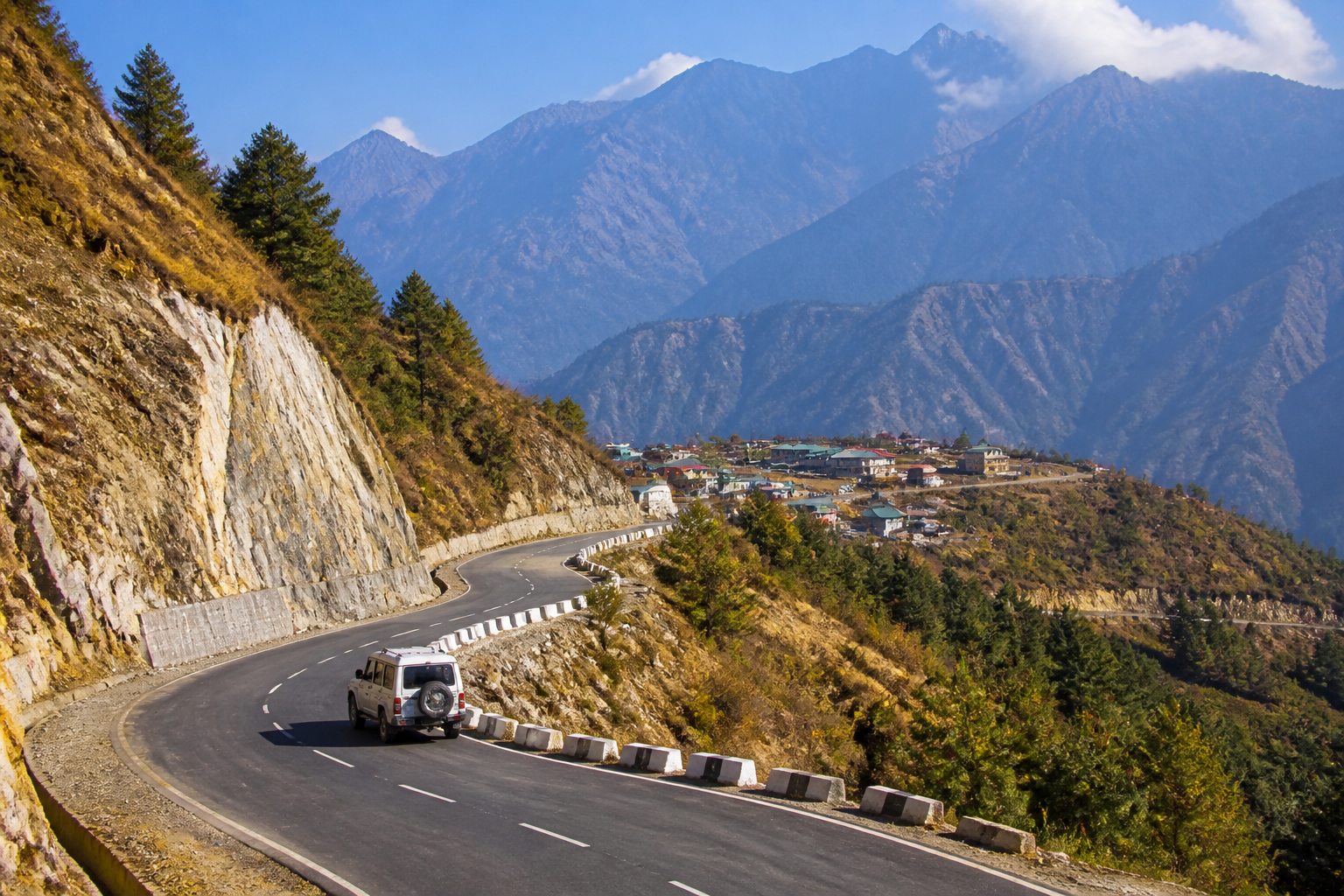
Parnaik’s central claim was that around 4,000 kilometres of roads had been constructed in Arunachal Pradesh since 2015. He also referred to the Frontier Highway, describing it as a project that would make movement by the armed forces easier along the border. According to the account, the governor said roads had connected border villages that previously had limited transport access.
The source material does not provide a list of the roads included in the 4,000-kilometre figure, nor does it distinguish between newly built roads, upgraded roads and roads constructed under different agencies or programmes. It also does not establish the current completion status, alignment, cost or construction timetable of the Frontier Highway. These details matter because a road’s strategic value depends not only on its length but also on its all-weather reliability, bridges, maintenance, links to settlements and connection with logistics bases.
Even with those limitations, the remarks point to a clear change in the way border roads are being discussed. They are no longer presented only as transport facilities for isolated communities. They are also treated as instruments of state presence, military logistics and territorial administration. In Arunachal Pradesh, where terrain and distance make service delivery difficult, the same road may support civilian movement, emergency access, tourism, local trade and defence operations.
That overlap creates a distinctive infrastructure challenge. A road designed primarily for military movement may follow a different logic from one planned around everyday civilian demand. A civilian road network, by contrast, requires dependable access to markets, schools, health facilities and administrative centres. The available report does not show how these objectives are being balanced in individual projects. It does, however, indicate that the governor wants infrastructure development to be paired with activities such as mountaineering and tourism.
This emphasis on civilian activity is significant because the border question is also a question of settlement and visibility. Parnaik argued that India needed to make its presence in the region more visible while responding to Chinese claims over parts of Arunachal Pradesh. Promoting tourism and mountaineering, in this framing, is not simply an economic measure. It is linked to whether remote areas remain connected to the wider state and whether civilian movement reinforces administrative presence.
The report also places India’s road-building effort within a wider comparison with China’s infrastructure development in Tibet. Parnaik said China had expanded roads, railways and other infrastructure in Tibet, increasing the ability to move troops rapidly and maintain larger deployments near the border. He further referred to Chinese capabilities in cyber, electronic, information and satellite-based surveillance.
These statements were made by a serving governor with a military background and were reported by Loksatta. The supplied material does not include an independent assessment of the surveillance capabilities described, or comparative data on the road and rail networks on either side of the border. It therefore supports an analysis of the policy emphasis, but not a definitive measurement of the relative infrastructure advantage between India and China.
The institutional landscape is also important. Border infrastructure in a state such as Arunachal Pradesh involves more than one policy objective and, potentially, multiple public authorities. Roads must serve security requirements while also supporting villages, local economies and access to public services. The source does not identify the agencies responsible for the projects mentioned at the conference, their funding structure or the approval and monitoring arrangements. Without that information, it is difficult to assess whether the announced infrastructure push represents a coordinated network or a collection of separate works.
The comments by Pune International Centre chairman Vijay Kelkar broadened the policy frame. Kelkar said India-China relations should be examined through economic, strategic, technological, diplomatic and social perspectives rather than through a single lens. Applied to infrastructure, that means a border road cannot be assessed only by its defence utility. It should also be examined for its effect on local livelihoods, ecological pressures, public spending, access to services and the movement of people and goods.
The report provides one specific historical marker: the governor contrasted the present road network with a period before 2015 when roads and connectivity in Arunachal Pradesh were described as highly limited. It does not provide a year-by-year construction trend, baseline road length, travel-time data or indicators of improved service access. As a result, the 4,000-kilometre figure is an important claim in the discussion, but not by itself a complete account of infrastructure performance.
The same caution applies to the Frontier Highway. A highway along or near a sensitive border can reduce travel time and improve logistical access, but its impact depends on whether construction is continuous, whether difficult stretches remain vulnerable to weather disruption and whether villages are linked to the main corridor. The supplied report does not answer these questions. It records the strategic expectation attached to the project rather than its measured outcomes.
The conference discussion also connected infrastructure to China’s wider regional influence. Parnaik referred to Chinese economic and infrastructure projects in Pakistan, Bangladesh, Sri Lanka, Nepal and Myanmar, and argued that lending for infrastructure could create economic and strategic dependencies. Those remarks extend the debate beyond Arunachal Pradesh, but the supplied material does not include country-level project data, debt figures or independent assessments of the claims. They are best understood as the speaker’s strategic interpretation rather than established evidence presented in the report.
Other speakers at the event focused on China’s political and military decision-making. Jaydev Ranade said Chinese President Xi Jinping was likely to retain control in the coming political cycle, while former Army chief General Manoj Pande said India needed stronger coordination among the three services, closer border surveillance and better intelligence. These observations reinforce the conference’s emphasis on preparedness, but they do not alter the central infrastructure question: how should India convert physical connectivity into reliable, sustained access in a remote border state?
For urban and infrastructure policy, Arunachal Pradesh offers a difficult test case. The region is not an ordinary road-building environment. Mountain terrain, dispersed settlements and security sensitivities raise construction and maintenance challenges that do not appear in the headline kilometre count. A project may be strategically important while remaining expensive to operate and difficult for civilians to use. The report does not provide evidence on these trade-offs, but its focus on roads, villages and tourism makes them unavoidable questions for future evaluation.
What the available evidence confirms is narrower but still consequential. At a public conference in Pune, Arunachal Pradesh’s governor presented road construction and the Frontier Highway as central components of India’s response to China’s border posture. He also linked connectivity with tourism, mountaineering and a stronger civilian presence. The discussion therefore treats infrastructure as both a security asset and an instrument of regional development.
What remains uncertain is the performance of the network itself: how much of the reported 4,000 kilometres is operational, where the Frontier Highway stands, how projects are funded, what ecological and social safeguards apply, and whether residents have experienced measurable improvements in access. Those are the next facts required to move the debate from strategic assertion to infrastructure assessment. Future reporting should monitor project milestones, agency-level disclosures, construction progress and the effect of new connectivity on border communities.
