


Volkswagen’s agreement with German trade unions to remove 50,000 jobs has been presented as a compromise. Its deeper significance is less settled. The deal may preserve the company’s co-determination system by forcing management and workers to negotiate, or it may mark the point at which that system begins to give way under the pressure of global competition, high domestic costs and technological disruption.
The agreement, reached on September 3, opens the way for Volkswagen to close four factories in Germany between 2031 and 2034, or convert them to alternative uses. It would reduce the company’s annual production capacity by 500,000 vehicles. The proposed job losses come on top of an equivalent number of positions eliminated under a 2024 agreement.
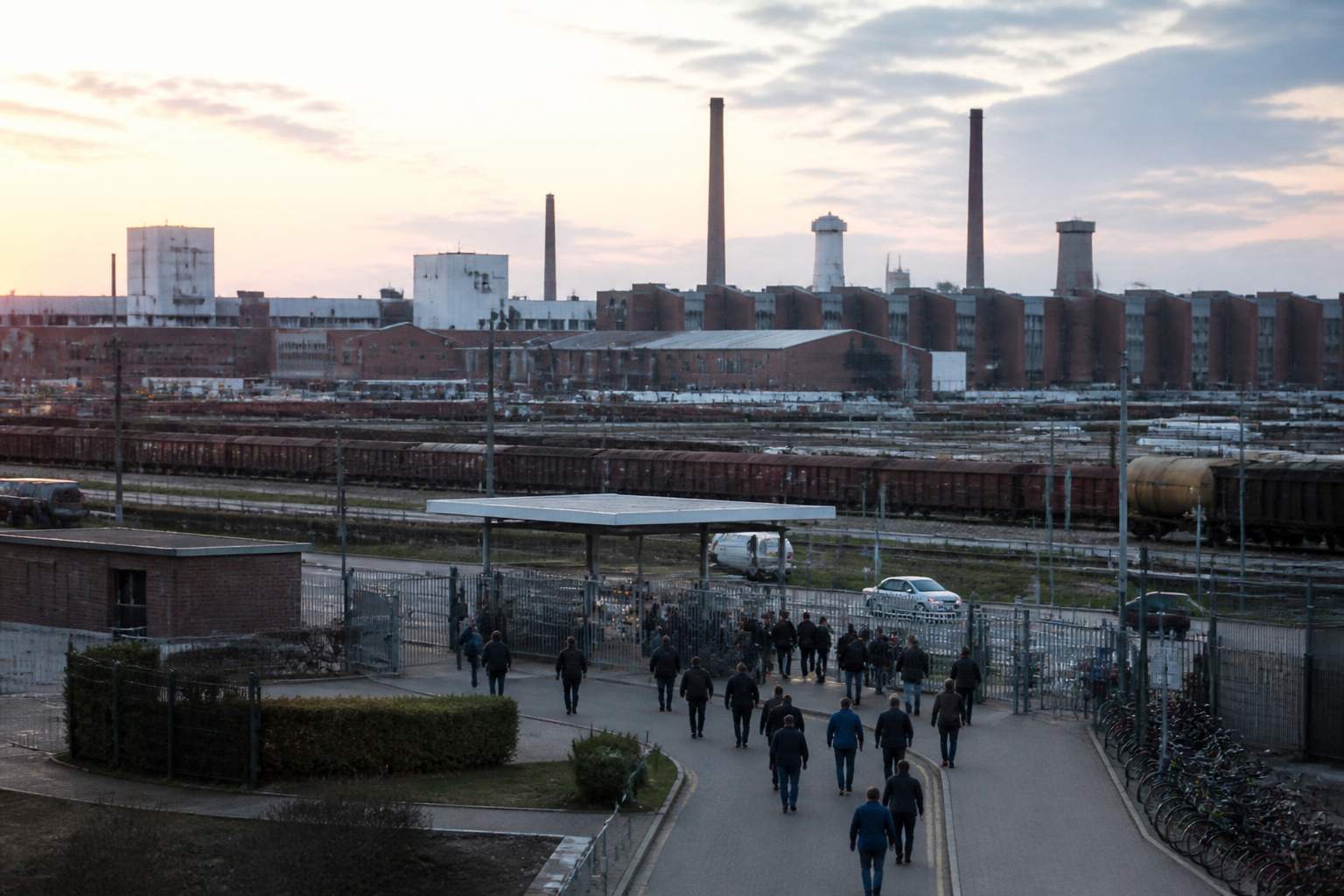
For cities and industrial regions, the consequences of such decisions extend well beyond a company’s payroll. Large factories support supplier networks, transport systems, commercial districts and local tax bases. When production contracts, the effects can move through the wider urban economy even if plant closures are spread over several years.
The agreement also exposes the institutional structure that made the negotiations unusually consequential. Volkswagen’s 20-member supervisory board includes 10 employee representatives and two members appointed by Lower Saxony, the company’s home state. Lower Saxony owns a 20% voting stake and, under the Volkswagen Act of 1960, can veto decisions it opposes.
Both the state and employee representatives have historically sought to preserve jobs in Germany. Management, by contrast, has increasingly argued that the cost of maintaining domestic production has become incompatible with the company’s competitive position. The resulting conflict is not simply between a business and its workforce. It is also a contest over who should determine the future of an industrial company whose operations are embedded in regional economies and public institutions.
Volkswagen’s management appears to have secured the latest concessions only after threatening to bypass the supervisory board and appeal directly to shareholders. According to the supplied report, this was a step the company had never previously taken. The possibility of phasing out the SEAT brand may also have increased pressure on employee representatives, although the report presents that possibility as a rumour rather than a confirmed plan.
That escalation matters because co-determination has long been regarded as a defining feature of Germany’s industrial relations model. Workers do not merely negotiate wages and employment conditions; they have a formal role in strategic decisions through board representation. At Volkswagen, that structure has helped protect employment but has also made it more difficult for management to close plants, relocate production or reduce capacity quickly.
The company’s current difficulties have accumulated over time. Volkswagen once competed with Toyota for global industry leadership, when scale was prioritised over profitability. As other European manufacturers shifted production towards lower-cost countries in eastern Europe, Volkswagen’s unions resisted comparable moves. The supplied report says they were understood to have insisted that every job created abroad be matched by one in Germany.
That strategy helped preserve industrial employment, but it also left Volkswagen with expensive factories and a high-cost workforce. Since 2019, annual vehicle sales have fallen by about two million to roughly nine million in 2025. The decline has coincided with stronger competition from Chinese carmakers in China and other international markets.
The challenge is not limited to labour costs. Volkswagen’s transition to electric vehicles and software-defined cars has produced uneven results. Its electric vehicles are improving, but earlier models received a limited market response. Investments in internal software development have delivered little, and Volkswagen now relies on Rivian, a United States-based start-up, and Xpeng, a Chinese company, for elements of its software capability.
The company’s software-defined vehicle platform is described as years behind comparable efforts by Chinese manufacturers. That weakness has direct commercial consequences in China, where Volkswagen’s sales continue to decline. Electric vehicles account for only a small part of its business in the country, even though electrified cars represent roughly three-fifths of the Chinese market.
The new agreement therefore gives Volkswagen time, but not necessarily a solution. The company plans to simplify its vehicle range and reduce capital investment and research-and-development spending by more than previously planned. It is targeting an operating margin of 9% in 2030, compared with less than 4% now.
Those targets reveal the tension at the centre of the deal. Reducing capacity and employment may improve the company’s cost structure, but cutting investment and research spending could make it harder to compete in electric vehicles and software. A factory closure can address excess capacity; it cannot by itself repair weak products, delayed platforms or declining market share.
The response from employee representatives indicates that the agreement has not resolved the dispute. Daniela Cavallo, head of Volkswagen’s works council, said: “We’ve given up on no plant and, contrary to media reports, no plant closure has been approved.” Her statement suggests that the interpretation of the agreement remains contested, particularly over whether the four facilities will definitely close or might be assigned alternative uses.
That distinction is important for affected regions. A plant closure, a production reduction and a conversion to another use have different implications for employment, land, infrastructure and municipal finances. The supplied material does not identify the four factories or establish which alternative uses are being considered. It therefore confirms the scale and direction of the plan without resolving its local impact.
Volkswagen’s earlier experience illustrates the difficulty of implementation. In December 2024, the company withdrew a plan to close three German factories after workers went on strike. The latest agreement may reduce the immediate risk of industrial conflict, but the underlying disagreement over employment, investment and competitiveness remains.
For Germany’s industrial cities, the issue is larger than the future of one automaker. The Volkswagen case demonstrates how an employment-centred model can come under pressure when production systems change faster than institutions can adapt. It also shows why factory decisions are urban decisions: industrial sites are connected to housing, commuting patterns, supplier districts, public revenues and the economic identity of entire regions.
The agreement confirms that Volkswagen’s management has gained leverage, including the option of going directly to shareholders if negotiations fail. It does not confirm that co-determination has ended, nor that the four factories will close. What happens next will depend on the implementation of the Future Plan 2030, the treatment of the affected plants and whether Volkswagen can use the time created by the agreement to improve its products, software and profitability.
