


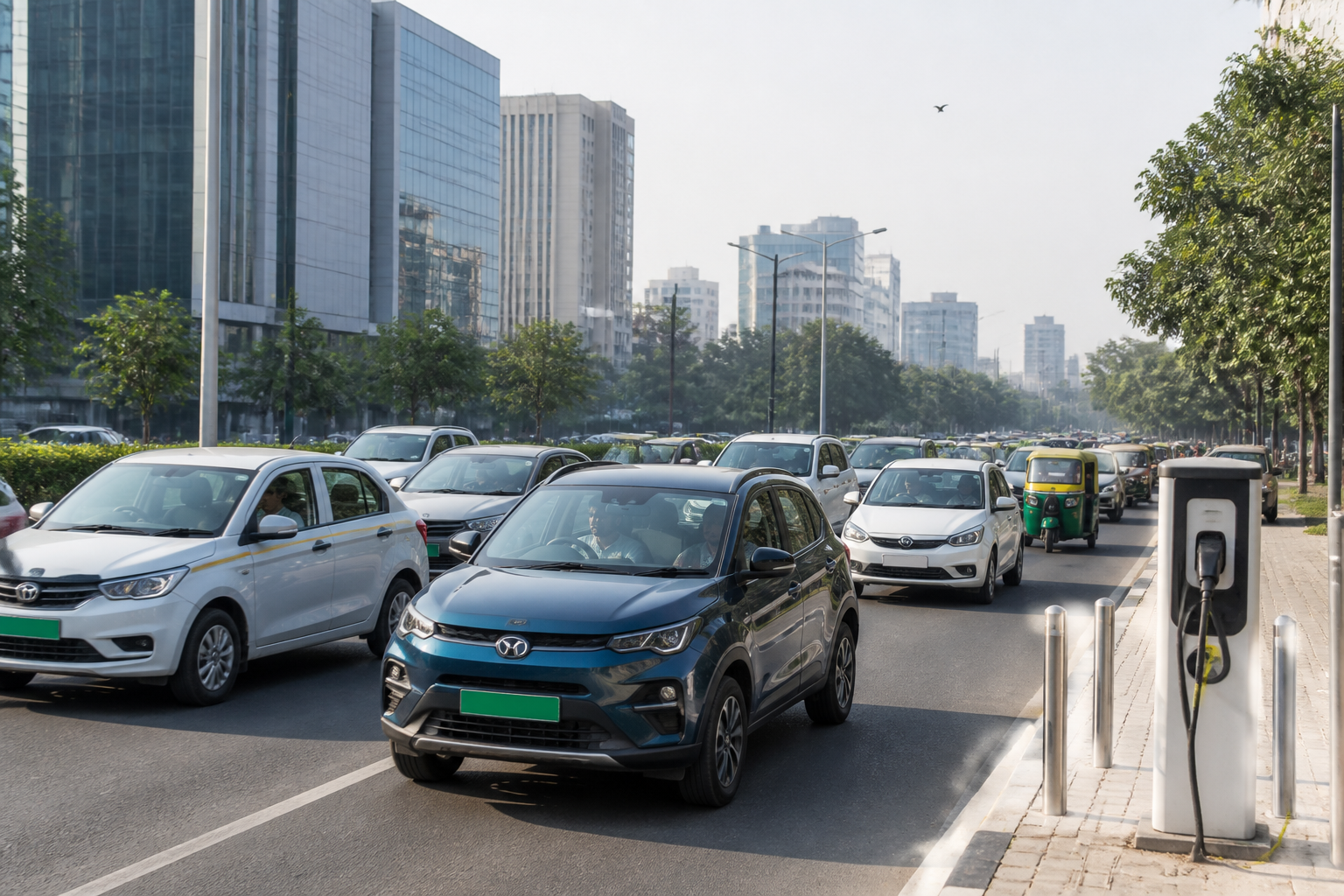
The reported rise of electric cars in India is part of a wider change in how the country’s passenger-vehicle market is being divided among fuel and powertrain options. In August 2026, CNG, hybrid and electric vehicles together accounted for 42 per cent of passenger-vehicle sales, exceeding petrol’s 41 per cent share for the first time, according to an Equirus Securities report cited by The Hindu BusinessLine.
That crossover is significant because it does not describe a simple transition from petrol to electric vehicles. The August figures show a more complex market in which CNG, hybrids and EVs are gaining ground together, while petrol’s share has fallen. The data also points to different reasons behind the shift, including the expansion of electric-car offerings, buyer hesitation around the E20 transition and the continuing role of CNG in the passenger-vehicle market.
The reported fuel mix must be read as a market snapshot rather than evidence that India’s passenger-vehicle fleet has already been transformed. The figures concern August retail sales, and the report does not establish how quickly the same pattern will spread across all vehicle categories, regions or income groups. Still, the direction of the change offers an important indicator for cities, manufacturers and policymakers because vehicle demand is increasingly being distributed across several alternatives to conventional petrol vehicles.
The broader passenger-vehicle market also expanded during the month. Retail sales grew 16 per cent year on year in August 2026, according to the report, with improved affordability following GST rate cuts identified as a supporting factor. Within that growing market, petrol’s share declined to 41 per cent from 46 per cent a year earlier. CNG’s share rose to 25 per cent from 21 per cent over the same period.
Electric vehicles recorded the fastest growth among the specific figures provided. Electric-car sales rose 52 per cent year on year to 30,700 units in August. EV penetration reached 7.7 per cent, compared with 5.9 per cent in August 2025. The August level was, however, below the 8.1 per cent recorded in July 2026, indicating that the monthly trajectory was not a straight upward line even as the annual comparison remained strong.
This distinction matters for interpreting the market. A year-on-year increase suggests that electric vehicles are gaining a larger foothold than they held a year earlier. The month-on-month decline from July to August, meanwhile, shows that adoption can fluctuate. The supplied report does not identify the precise causes of that monthly movement, so it would be premature to treat one month’s easing as either a reversal or a permanent slowdown.
The report attributes part of the movement towards CNG, hybrids and EVs to buyer hesitation around the E20 transition. E20 refers to petrol blended with 20 per cent ethanol. The material supplied does not provide a detailed breakdown of consumer concerns, vehicle compatibility or the geographical distribution of that hesitation. It does, however, present the transition as one factor that may have encouraged some buyers to consider alternatives to petrol.
CNG’s performance is particularly important in this mixed transition. Its share reached a record 25 per cent in August, up from 21 per cent a year earlier. That increase means CNG, rather than electric vehicles alone, accounted for a substantial part of the decline in petrol’s market share. The numbers therefore complicate any description of India’s cleaner-fuel shift as an exclusively electric story.
For urban transport systems, the distinction between powertrains has practical consequences. CNG vehicles, hybrids and EVs do not place the same demands on infrastructure or operate in the same way. Electric cars require charging access and grid-connected supply. CNG vehicles depend on refuelling networks. Hybrids combine different propulsion systems. The supplied figures do not measure the availability or reliability of any of these systems, but the changing sales mix indicates that demand for them is expanding at the same time.
The company-level data shows how competition is developing within the electric-car segment. Tata Motors accounted for around 43 per cent of electric-vehicle sales in August, its highest share since December 2025, compared with around 42 per cent in July 2026 and 41 per cent in August 2025. The report attributes the recovery to Tata Motors’ broad EV portfolio and the recent launch of the Tiago EV.
JSW MG Motor’s share, by contrast, declined to around 15 per cent in August from 28 per cent in August 2025, amid increasing competition, according to the report. Mahindra & Mahindra’s share eased to around 21 per cent in August from 23 per cent in July. Maruti Suzuki, following its entry into the electric-vehicle segment, captured around 5 per cent of the EV market.
These figures indicate that electric-vehicle adoption is being accompanied by a reordering of market positions. The expansion of the overall EV market does not guarantee that every early entrant will maintain its share. As more manufacturers introduce electric models, competition can redistribute sales even while total demand grows. The supplied material does not provide model-level sales totals for each company, so the share figures should not be interpreted as a complete measure of brand performance or profitability.
The regional data adds another layer to the transition. Delhi recorded the country’s highest electric-car penetration in August at about 19 per cent. The report cautioned that this figure was inflated by fleet registrations. After excluding registrations linked to a VinFast-supplied taxi fleet, Equirus Securities estimated underlying penetration at approximately 12-14 per cent, still above the national level of 7.7 per cent.
Delhi’s example shows why headline adoption rates require closer examination. Fleet registrations can materially affect a city’s monthly penetration, particularly when a large number of vehicles are registered for taxi or commercial use. The adjusted estimate remains higher than the national figure, but the difference between 19 per cent and 12-14 per cent demonstrates how the composition of registrations can shape the apparent pace of urban electrification.
It also suggests that electric-vehicle adoption cannot be understood only through national averages. A city with substantial fleet purchases may show a different market pattern from one driven mainly by private households. The supplied report does not provide comparable adjusted figures for other cities, nor does it explain whether Delhi’s position reflects charging access, fleet economics, policy conditions, consumer preferences or the specific registration event. Those questions remain open.
The policy landscape behind the August shift is visible in the factors cited by the report but is not fully detailed in the supplied material. GST rate cuts are associated with improved affordability across the passenger-vehicle market. The E20 transition appears as a source of buyer hesitation. Beyond these points, the input does not specify the tax structure, subsidy arrangements, charging policies, fuel standards or state-level measures affecting the reported sales.
That limitation is important because vehicle adoption is shaped by more than showroom prices. The August data shows what buyers registered, but not the full cost of ownership, access to refuelling or charging, financing conditions, operating patterns or resale expectations. Without those details, the figures can establish a market shift but cannot by themselves explain the complete policy or economic mechanism behind it.
The data nevertheless establishes several clear trends. Petrol’s share fell five percentage points in a year, from 46 per cent to 41 per cent. CNG gained four percentage points, from 21 per cent to 25 per cent. EV penetration rose 1.8 percentage points year on year, from 5.9 per cent to 7.7 per cent. Electric-car sales increased 52 per cent year on year to 30,700 units. At the same time, EV penetration fell from 8.1 per cent in July to 7.7 per cent in August.
Taken together, these figures describe a market moving away from petrol through multiple channels. CNG currently represents the largest non-petrol share among the alternatives identified, while EVs are growing rapidly from a smaller base. Hybrids are included in the combined 42 per cent figure, but the supplied report does not provide their separate share. That missing breakdown prevents a more precise assessment of how much of the shift came from hybrid vehicles compared with CNG and EVs.
For vehicle manufacturers, the figures point to a market in which product breadth may matter. Tata Motors’ reported recovery in EV share is linked to its wider electric portfolio and the Tiago EV launch. Maruti Suzuki’s 5 per cent share follows its entry into the segment. These developments suggest that the competitive structure is changing as established manufacturers add electric models, although the supplied material does not provide enough information to assess whether product range, pricing, availability or brand preference was the decisive factor.
For cities, the central issue is coordination. A larger share of CNG, hybrid and electric vehicles changes the infrastructure requirements associated with urban mobility, but the data does not show whether public systems are expanding at the same pace as sales. The Delhi figures make the question especially visible: a high apparent penetration rate can be influenced by fleet registrations, while the underlying rate can still exceed the national average.
The evidence therefore confirms a broadening transition rather than a completed one. In August 2026, alternatives to petrol crossed the 40 per cent threshold collectively, while electric vehicles reached 7.7 per cent penetration nationally. The market is not moving along a single path from petrol to EVs; it is absorbing CNG, hybrids and electric cars at different speeds and for different reasons.
What remains uncertain is whether the August pattern will persist, how much of the change is driven by temporary affordability or registration effects, and how the balance among CNG, hybrids and EVs will evolve. Future monthly sales data, a fuller breakdown of hybrid and fleet registrations, and evidence on charging and refuelling infrastructure will be needed to establish whether this is the beginning of a durable market restructuring or a strong but uneven phase in India’s passenger-vehicle transition.
