


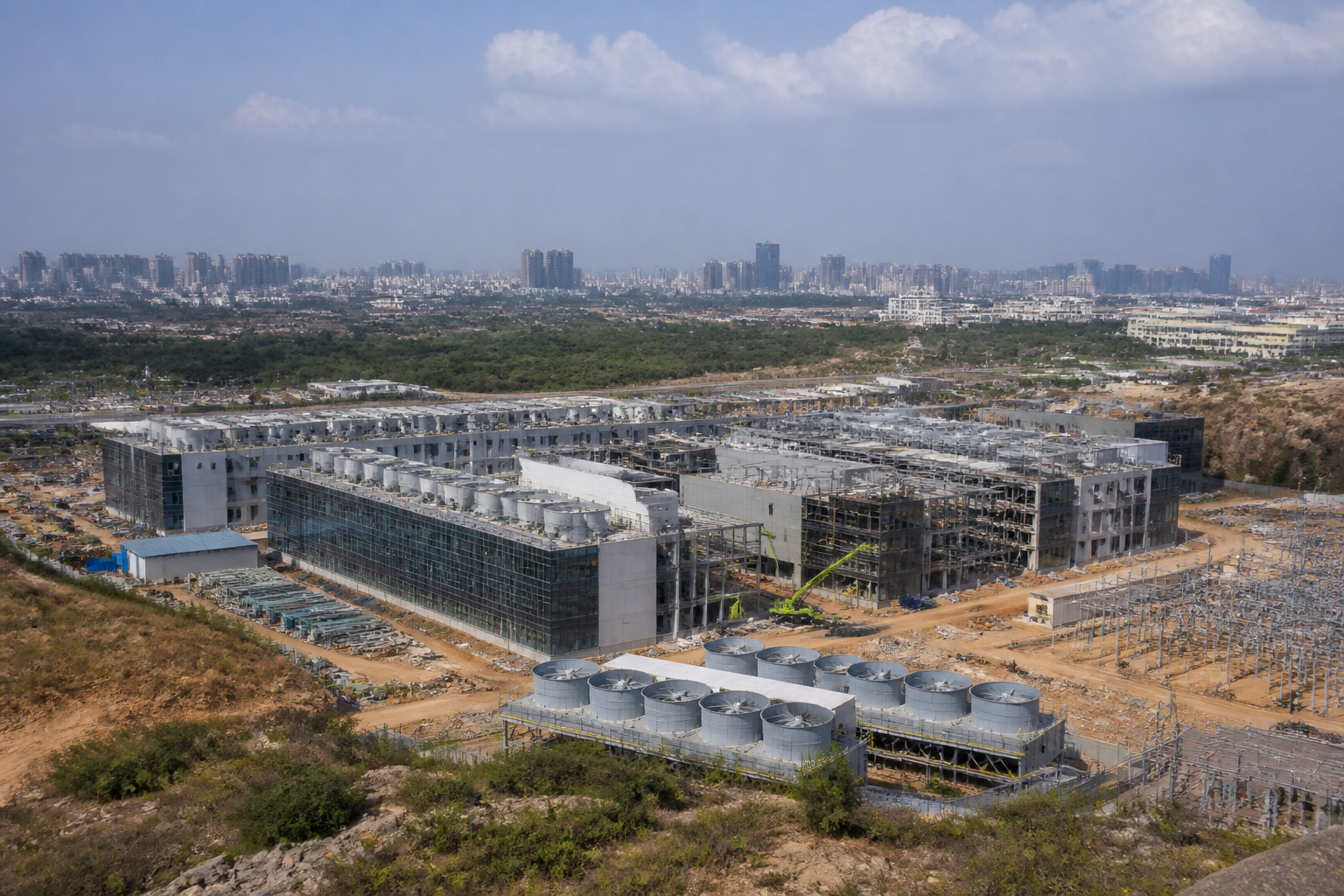
A proposed 1 GW AI data centre campus in Hyderabad is being presented as a major technology investment. Its larger significance, however, lies in the urban systems required to support artificial-intelligence computing: large power blocks, high-density cooling, water management, specialist construction and a workforce capable of operating complex digital infrastructure.
HyperVault, the data centre subsidiary of Tata Consultancy Services, has secured 264 acres in Hyderabad for a campus that could eventually reach up to 1 GW of capacity. HyperVault and its partners are expected to invest up to ₹70,000 crore in developing and managing the infrastructure. The project was announced on September 5, with construction planned in phases according to customer demand and technology requirements.
The announcement does not establish that the full 1 GW capacity will be built immediately. Nor does it provide a detailed construction schedule, power procurement plan, water balance, financing timetable or approval map. Those unresolved details are important because an AI data centre is not simply a large building filled with servers. It is an infrastructure system whose viability depends on the reliability and expansion of several city and regional networks at the same time.
HyperVault says the campus will be purpose-built for frontier AI companies and hyperscalers, with high-density GPU deployments supporting AI training, inference and advanced computing workloads. The company also says the campus will use larger power blocks, liquid cooling and faster deployment models. These requirements distinguish AI-oriented facilities from conventional office-led technology development, where the primary urban concerns are usually land, transport and commercial floor space.
For Hyderabad, the proposed campus adds a new dimension to the city’s long association with information technology. TCS Chief Executive Officer and Managing Director K Krithivasan said the project would advance the company’s “Infrastructure-to-Intelligence strategy” by combining AI-ready infrastructure with its cloud, engineering, enterprise transformation and AI capabilities. He identified Hyderabad’s scale, talent and ecosystem as reasons for selecting the city.
The state government has described the decision as a significant endorsement of Telangana’s infrastructure and technology ambitions. Chief Minister A Revanth Reddy called the project “historic” and said access to AI models and computing capacity was becoming a form of public infrastructure. IT and Industries Minister D Sridhar Babu said discussions began after a conversation between the chief minister and Tata Sons Chairman N Chandrasekaran in Davos in January, followed by negotiations involving state officials, HyperVault and TCS.
These statements establish the political and corporate importance attached to the project, but they do not yet answer the practical questions that will determine its urban footprint. The source material does not specify the campus location within Hyderabad, the power substation arrangements, the source of water, the road and logistics plan, or the regulatory approvals required before construction can proceed. It also does not quantify the number of jobs, beyond describing them as several thousand direct and indirect positions.
The first major question is electricity. A 1 GW data centre campus would require substantial, dependable and continuous power capacity once fully built. The project’s final electricity demand may not be identical to its stated IT load, and the announcement does not disclose the phasing assumptions behind the figure. Even so, the proposed scale indicates that the campus will need power planning that extends beyond an individual plot and into the wider grid, substations, transmission links and backup systems serving the development.
This is where the project becomes an urban-planning issue rather than only a corporate investment story. The campus will depend on infrastructure that is often invisible to residents but essential to the functioning of the city. Any expansion of power supply must be coordinated with other industrial, residential and commercial demand. The announcement does not say how that coordination will be managed, whether new transmission infrastructure is required, or how the project will fit into Telangana’s wider electricity planning.
Cooling is the second major system challenge. HyperVault has said the campus will use liquid cooling for higher-density computing. That approach is associated in the announcement with AI infrastructure capable of handling larger computing loads, but no technical details have been provided about the cooling configuration, water consumption, heat rejection or operating standards. The company has committed to water-neutral design principles, yet the report does not define how water neutrality will be measured or achieved.
That gap matters in a city where large developments compete for reliable utilities. A water-neutral claim can refer to different combinations of efficiency, recycling, replenishment or offsetting, depending on the project’s accounting framework. Until HyperVault or the authorities publish the design parameters, the statement should be treated as a stated principle rather than a demonstrated performance outcome. The same applies to the proposed use of green energy: the announcement does not identify the source, contracting model or share of electricity expected to come from renewable generation.
The campus also points to a shift in the construction and engineering requirements of digital infrastructure. HyperVault expects the project to catalyse activity across power, cooling, networking, construction, engineering and operations. That could create demand for specialised contractors and technical workers in addition to the employees directly engaged by the data centre. But the announcement provides no breakdown of job categories, construction duration, local hiring commitments or training arrangements.
The employment question is therefore more complex than the headline figure suggested by a large investment. Data centres are capital-intensive facilities, and the balance between construction employment, specialist technical roles and long-term operational jobs will depend on the final design and degree of automation. The supplied material confirms that several thousand direct and indirect jobs are expected, but it does not establish how many will be permanent, how many will be created during construction, or how benefits will be distributed across the region.
The project is also part of a broader corporate strategy. TCS announced its entry into the data centre segment last year through the formation of HyperVault. Private equity investor TPG is investing $1 billion in the business, according to the report. That funding relationship suggests that the Hyderabad campus is intended to be part of a larger infrastructure platform rather than a standalone facility. However, the available information does not specify how the TPG investment will be allocated between this campus and other activities, or what portion of the ₹70,000-crore investment will come from TCS, HyperVault, partners or customers.
The phased development model may reduce the risk of building the entire campus before demand is secured. HyperVault says construction will proceed in line with customer demand and technology requirements. This is significant because AI computing demand can require rapid changes in server density, cooling systems and network architecture. A phased approach could allow the campus to adapt as those requirements evolve, but it also means the announced maximum capacity should not be read as an immediately available facility.
For government, the project creates an institutional coordination task. Telangana’s industries and infrastructure agencies will need to work with the company on land, utilities, environmental requirements, construction permissions and connectivity. The report confirms government support and a rapid partnership process, but it does not identify the full list of agencies involved or the milestones that will govern implementation. The next stage will therefore be measured less by the announcement itself than by the publication of approvals, construction schedules and utility commitments.
Hyderabad’s selection reflects the combination of factors cited by the company: land at a scale of 264 acres, an existing technology ecosystem, access to talent and the ability to support a large infrastructure build-out. The announcement does not compare Hyderabad with alternative locations or provide a formal site-selection assessment. What it does show is that competition for AI infrastructure is increasingly tied to the capacity of cities to assemble land, power, water, networks and institutional support as one package.
That package raises a larger question for Indian cities. If AI computing becomes a critical economic and public infrastructure layer, cities will have to accommodate facilities whose land requirements and utility demands are different from those of conventional technology campuses. Planning systems will need to account for the physical consequences of digital growth: substations, cooling, water recycling, freight access, construction logistics, network resilience and emergency operations.
The Hyderabad project is not yet evidence that all of those systems are in place. It is evidence that a major technology company and the Telangana government believe the city can support them at scale. The project’s significance will become clearer as HyperVault discloses the campus location, phased capacity, power and water arrangements, construction timeline, approvals and employment plan. Until then, the proposed 1 GW campus is best understood as a large infrastructure commitment whose success will depend on the urban systems beyond its boundary.
