


Subheadline: One reported crash in Varthur links road-surface failure to injury, hospital costs and renewed questions over how Bengaluru’s road budgets are tracked.
Standfirst: Aishani Khanna’s reported accident in Varthur is not, on the evidence currently available, proof of a citywide pattern or of responsibility by any particular agency. It is, however, a clear account of how an apparently ordinary road defect can become a serious household cost. Khanna says she fractured her ankle after her two-wheeler struck a pothole while she was travelling to work in the rain on August 20. She was hospitalised for almost five days, underwent surgery and reported a bill of Rs 1.97 lakh. Her account, and the political response that followed, raise a larger question about Bengaluru’s road governance: whether expenditure on repairs can be connected to visible, durable improvements on the ground. The material supplied for this analysis does not establish the exact road, the responsible agency, the repair history or the total number of comparable incidents. It does show why those records matter.
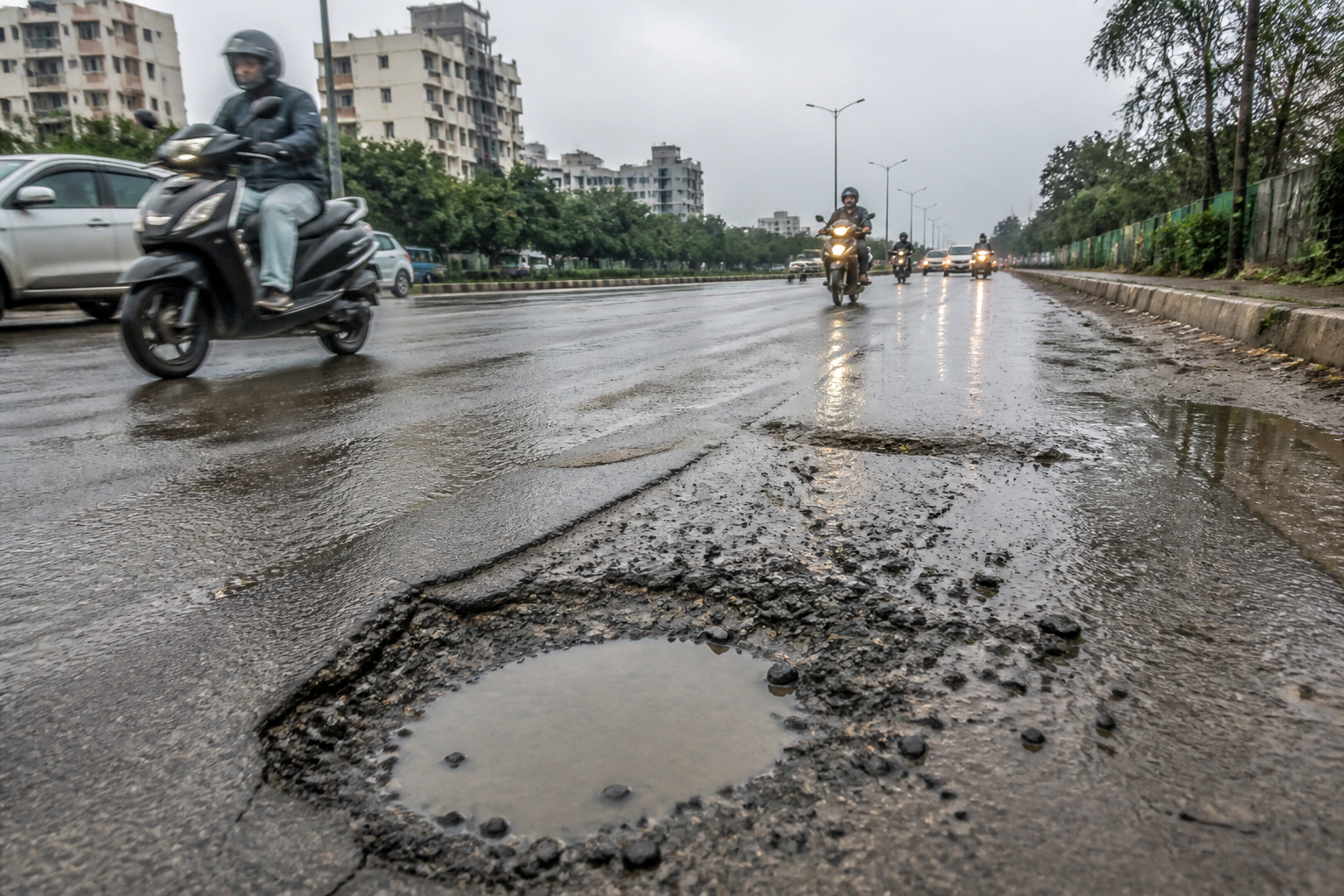
A pothole is usually treated as a small engineering defect. For a person travelling on a two-wheeler, particularly during rain or in poor visibility, it can become a safety hazard within seconds. Khanna, a resident of Varthur, told mediapersons that she was travelling to work around noon on August 20 when her vehicle hit a pothole. She said she fell and the two-wheeler landed on her, causing an ankle fracture and other injuries.
Her account is the central evidence available in the report. It establishes that she suffered injuries, was admitted to hospital for nearly five days and underwent surgery. She also said that another surgery could be required depending on her recovery. The hospital bill, according to her, had reached Rs 1.97 lakh. These details describe the personal consequences of a road failure, but they do not by themselves establish legal liability or prove which authority was responsible for the stretch.
That distinction is important. Urban roads are managed through multiple institutional arrangements, and responsibility can depend on the road’s classification, location, maintenance contract and administrative jurisdiction. The source material refers to the Bengaluru East City Corporation in Khanna’s criticism, but it does not provide an official response from that body, an inspection report, a police record, an engineering assessment or a court finding. The analysis therefore cannot determine whether the pothole resulted from inadequate maintenance, drainage failure, utility work, construction damage, weather-related deterioration or another cause.
What the report does establish is that Khanna describes the roads in her area as having remained in poor condition for nearly ten years. That is an allegation from a resident, not an independently verified measurement of road quality. Even so, the claim points to a governance problem that is broader than the repair of one depression in the carriageway. If a road defect remains visible for an extended period, the relevant public question is not only why it formed, but also whether it was reported, inspected, recorded, prioritised and repaired.
Those steps are the missing chain in the available account. A functioning road-maintenance system should be able to show when a defect was identified, which agency received the complaint, whether the location was inspected, what repair was ordered, who carried it out and whether the work was later checked. Without such records, residents are left with the visible condition of the road and authorities are left with broad claims of expenditure. The gap between those two forms of evidence is where accountability becomes difficult.
The political response has widened that gap into a debate over public spending. Tejasvi Surya, who highlighted the incident on X, said the state government had claimed to spend nearly Rs 5,500 crore on Bengaluru’s roads over the last few years. He also referred to Minister Krishna Byre Gowda’s announcement of another Rs 8,000 crore for fixing the city’s roads. Surya demanded that details of the works undertaken and an account of the earlier spending be made public, describing this as a need for a White Paper.
The supplied report does not include the government documents supporting the Rs 5,500-crore figure, the terms or scope of the proposed Rs 8,000-crore allocation, or a response from the state government to the demand. Those numbers should therefore be treated as attributed political claims and announcements, not as independently verified measures of completed roadwork. The difference matters because an allocation, a sanctioned project, a tender, an awarded contract, a completed repair and a road that remains serviceable are separate stages of public expenditure.
This is also why the question of road quality cannot be answered only by adding up budgets. A large spending figure may cover resurfacing, stormwater works, junction improvements, utility coordination, emergency repairs or other categories. The source material does not specify the composition of either amount. Nor does it identify how much was spent in Varthur, which roads were repaired there, how long those repairs lasted or whether the reported pothole had previously been recorded.
For citizens, however, the distinction between categories of expenditure is less visible than the condition of the road beneath them. A commuter encounters a surface, a drain, a junction and a traffic environment. When a crash occurs, the immediate cost is borne by the individual through treatment, lost time, mobility restrictions and psychological distress. Khanna described the mental trauma of the incident and said she continued to recall how it happened. The source does not provide information about insurance coverage, lost income, compensation or any formal claim against an authority.
The case also highlights why road safety in Bengaluru cannot be separated from weather and travel conditions. Khanna said it was raining when the accident occurred. Rain can reduce visibility and conceal the depth or edge of a pothole, but the available evidence does not establish whether drainage or water accumulation contributed to this particular crash. That question would require a site inspection and information about the road’s condition at the time.
The institutional issue is therefore one of traceability. Public authorities need to connect a road budget to a location and a measurable outcome. Residents need accessible information about planned works, completion dates, contractors, maintenance guarantees and complaint status. Elected representatives need to distinguish between funds announced and works delivered. Without that information, every new road allocation risks being judged against the same visible defects that prompted the earlier spending.
The available evidence does not show how common pothole-related injuries are in Bengaluru, how many complaints were made in Varthur, or whether road conditions have improved or deteriorated over time. It also does not establish whether the reported accident led to an official inspection or repair. Those are not minor omissions. They determine whether the incident is treated as an isolated failure, a recurring maintenance problem or evidence of a wider breakdown in road administration.
For now, the confirmed public record is narrower: one resident has described a crash in Varthur, serious injuries, surgery, a five-day hospitalisation and a Rs 1.97 lakh bill; a public representative has used the incident to question earlier and proposed road spending; and the report does not include a response from the relevant civic or state authorities. The next meaningful development would be the publication of work-wise spending records, an official assessment of the road and a clear account of the authority responsible for its maintenance. Until those records are available, Bengaluru’s road debate remains caught between announced expenditure and the everyday evidence of the street.
