


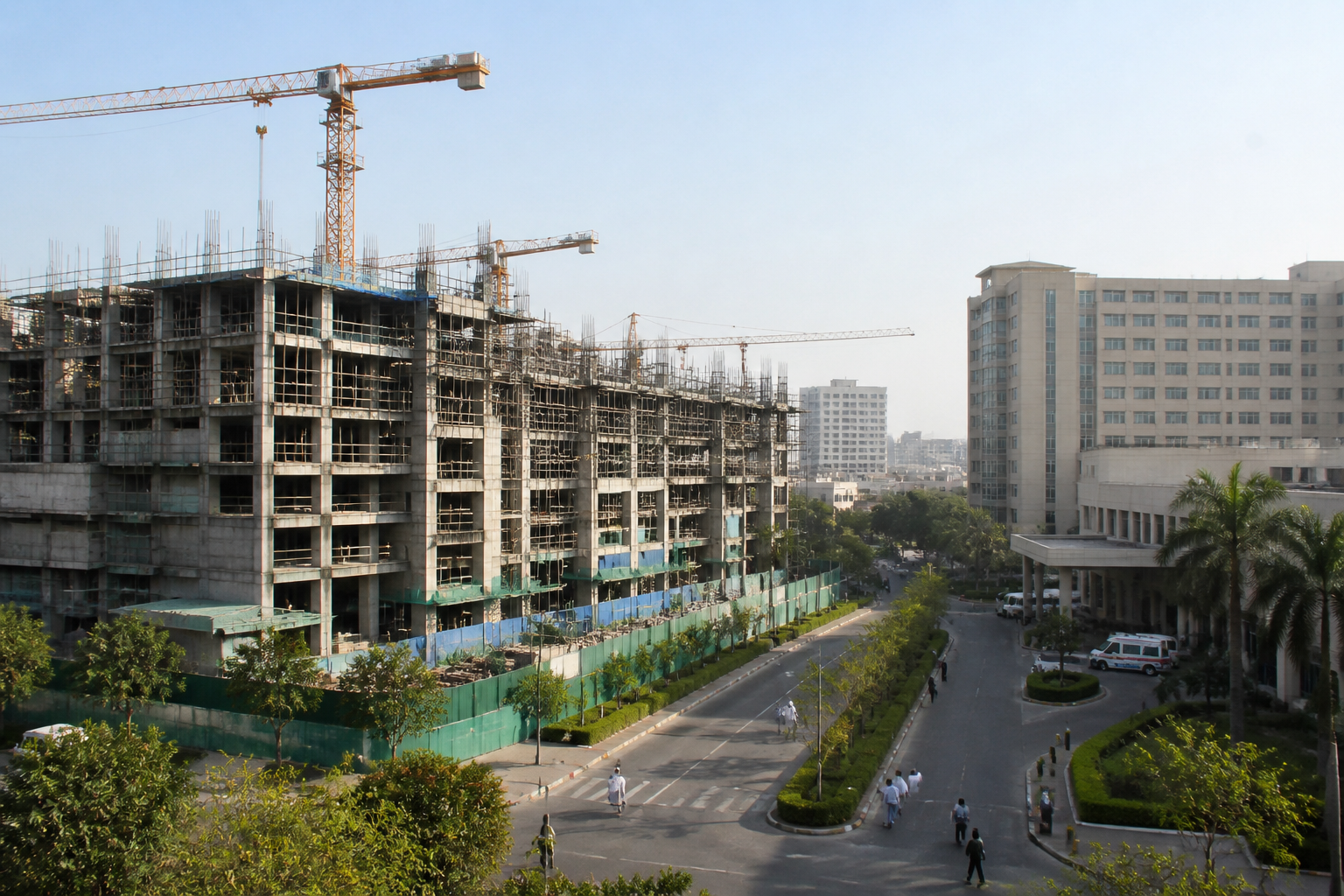
Manipal Hospitals plans to add 2,426 beds by 2030, with about 80 per cent of that capacity built through greenfield projects. The plan marks a shift for a hospital chain whose capacity expanded rapidly through acquisitions between FY21 and FY26. It also places the economics of new healthcare construction at the centre of the company’s next phase of growth.
The expansion comes after Manipal Health Enterprises added 5,548 beds through the acquisitions of Columbia Asia, Vikram Hospitals, AMRI, Medica Synergie and Sahyadri Hospitals. The Sahyadri transaction, completed in stages beginning in October 2025, added 10 hospitals and 1,606 licensed beds in Maharashtra. Manipal paid about ₹5,255 crore during FY26 for a stake of nearly 90 per cent and committed another ₹574 crore for a further tranche.
That acquisition-led expansion increased the company’s operating scale quickly. Its operational beds rose 20.2 per cent to 6,227 in FY26 from 5,179 a year earlier. Consolidated revenue from operations increased 25.4 per cent to ₹10,335.75 crore, while earnings before interest, tax, depreciation and amortisation rose 22.1 per cent to ₹2,644 crore. Yet the same expansion also increased borrowing, depreciation and tax costs, showing why the next phase of capacity creation cannot be understood only through the number of beds added.
The planned pipeline consists of around 1,943 greenfield beds and 483 brownfield beds. Greenfield hospitals are built from scratch, while brownfield projects add or expand capacity at existing facilities. The distinction matters because new hospitals require land, construction, equipment, technology, information technology systems and interiors before they begin generating operating revenue. Brownfield expansion can use an existing institutional and physical base, but its scope may be limited by the capacity and layout of current sites.
According to an earlier interview with Business Standard, Manipal Hospitals managing director and chief executive officer Dilip Jose said a greenfield hospital of about 250 beds typically requires ₹380 crore-₹390 crore, excluding land and building costs. Spending on medical equipment, technology, information technology and interiors is about ₹1.5 crore per bed, he said. Applying that equipment and fit-out benchmark to the planned 1,943 greenfield beds produces an indicative investment of about ₹2,915 crore, also excluding land and building costs.
This calculation is not a company-issued project cost for the entire pipeline. It is an indication of the capital intensity involved in creating new hospital capacity. The actual cost will depend on location, land prices, building specifications, project phasing, equipment mix, clinical specialities and the timing of construction. The supplied company figures nevertheless show that a greenfield strategy requires substantial expenditure well before a facility reaches maturity.
## From acquisitions to new urban capacity
The geographic focus of the plan is concentrated in markets where Manipal already has a presence, including Karnataka, Maharashtra, Goa and eastern India. The company is also evaluating acquisitions in these markets and in Delhi-NCR, Telangana, Kerala, Andhra Pradesh and Chhattisgarh. The Mumbai-Pune corridor has been identified as a key growth opportunity, while acquisitions are being considered to consolidate the company’s position in Delhi-NCR.
This approach combines two different forms of healthcare expansion. Acquisitions provide access to operating hospitals, existing patient relationships, licensed beds and established locations. Greenfield projects, by contrast, allow a hospital chain to choose its site and design its clinical capacity, but they take longer to build and require upfront capital. Manipal’s pipeline indicates that acquisitions are not being abandoned; rather, new construction is becoming a larger part of the capacity strategy.
For cities, the location of that capacity is as important as the aggregate number of beds. A hospital’s usefulness depends on where it is placed relative to residential growth, transport corridors, existing medical facilities and the catchment area it can serve. The company’s focus on the Mumbai-Pune corridor and its established presence across several states suggests that expansion decisions are being made through regional networks rather than as isolated projects. The supplied material does not specify the sites, construction schedules or specialty mix of the proposed greenfield hospitals, so the urban distribution of the future beds remains uncertain.
The plan also reveals how private healthcare capacity is assessed internally. Manipal generally begins assessing additional capacity when a hospital approaches 70 per cent occupancy. That threshold allows time for construction before an existing facility becomes constrained. In FY26, however, occupancy across the company’s hospitals stood at 64.5 per cent, down from 67.1 per cent in the previous year, even as operational beds increased by more than a fifth.
The lower occupancy rate alongside a larger bed base complicates a simple demand narrative. The company added capacity faster than the occupancy ratio increased, at least during the reported year. This could reflect the integration of acquired hospitals, the time needed for newer capacity to build patient volumes or differences between facilities and markets. The supplied report does not establish which explanation is dominant. What it does show is that new beds do not immediately translate into fully utilised capacity.
## The financial cost of physical expansion
Manipal’s FY26 results demonstrate the tension between scale and returns. Average revenue per occupied bed rose 8.8 per cent to ₹68,900 per day from ₹63,300. Inpatient volumes increased 19.9 per cent to 527,227, while outpatient volumes rose 16.2 per cent to 5.48 million. Cardiac sciences, oncology, neurosciences, gastro sciences, orthopaedics and renal sciences together contributed 64.3 per cent of gross inpatient revenue, up from 62.6 per cent in FY25. Oncology recorded the strongest growth among these specialties.
These operating indicators improved even as reported profit declined. Profit after tax fell 15.3 per cent to ₹916.59 crore from ₹1,081.67 crore. Finance costs increased 68.9 per cent to ₹864.29 crore, primarily because of higher borrowings, including non-convertible debentures raised for acquisitions and expansion. Depreciation and amortisation increased 34.1 per cent to ₹679.55 crore as the asset base expanded following the Sahyadri acquisition. Tax expense rose to ₹261.51 crore from ₹160.64 crore.
The result was a higher-debt, lower-return balance sheet despite growth in revenue and operating earnings. Net debt, including lease liabilities, rose to 3.7 times earnings before interest, tax, depreciation and amortisation in FY26 from two times in FY25. Return on capital employed declined to 22 per cent from 27 per cent. EBITDA margin also narrowed to 25.6 per cent from 26.3 per cent.
That financial backdrop is central to understanding the greenfield decision. Building hospitals from scratch could reduce dependence on acquisition opportunities and give the company greater control over location and design. But it also adds construction expenditure and future depreciation before the new assets have reached their expected utilisation levels. The company will therefore have to balance the need to create capacity against the cost of carrying that capacity during the ramp-up period.
The planned pipeline follows a year in which Manipal took on significant acquisition-related obligations. The Sahyadri deal expanded the company’s Maharashtra presence, but it also contributed to the rise in debt and finance costs. The transition from acquiring existing hospitals to building new ones does not remove those obligations. Instead, it adds a second capital requirement to a balance sheet already carrying the effects of rapid inorganic growth.
## What the capacity numbers show
The numerical relationship between existing and planned capacity is significant. Manipal had 6,227 operational beds in FY26, while its identified expansion pipeline contains 2,426 additional beds. The pipeline is therefore equivalent to roughly 39 per cent of the reported operational bed base. Of the planned additions, 1,943 are greenfield beds and 483 are brownfield beds.
The company has not provided in the supplied material a year-by-year schedule for commissioning those beds. The stated horizon is 2030, but the pace of construction, approvals, commissioning and occupancy will determine how quickly the capacity becomes operationally meaningful. Without project-level timelines, the pipeline should be read as an identified expansion ambition rather than as a set of beds immediately available to patients.
The occupancy data also provides a measure of the absorption challenge. At 64.5 per cent occupancy, the existing network was below the company’s stated 70 per cent threshold for assessing additional capacity. That does not invalidate the expansion plan, because the company may be planning for future demand, regional gaps or the time required to build a hospital. But it does mean that the financial performance of the new facilities will depend on how quickly patient volumes develop in each market.
At the same time, the rise in inpatient and outpatient volumes indicates that demand across the network was expanding in FY26. The increase in average revenue per occupied bed and the larger contribution from major specialties point to a business that is handling more patients and generating more revenue from occupied capacity. The evidence therefore presents two conditions simultaneously: demand is growing, but capacity growth and capital spending are advancing faster than some performance measures.
The company’s public listing adds another layer to this expansion strategy. Manipal’s ₹9,275.21-crore initial public offering comprised a fresh issue of ₹8,000 crore and an offer for sale of ₹1,275.21 crore. Its shares listed at ₹652 on the National Stock Exchange, a 10.5 per cent premium to the issue price of ₹590, and closed at ₹725.20 on September 4, up about 11.2 per cent from the listing price and 22.9 per cent from the issue price. The market response is part of the company’s post-listing context, but it does not establish how the greenfield programme will be financed or executed.
## The larger urban healthcare question
Hospital expansion is an urban infrastructure decision as much as a corporate growth decision. New facilities require land, road access, utility connections, workforce, medical equipment and links to referral networks. Their placement can influence where specialised care is available and how patients move across a metropolitan region. Yet the supplied material does not identify the specific sites or assess their relationship with existing public or private hospitals.
The Manipal plan illustrates a broader institutional choice within private healthcare: whether to acquire established capacity or create new capacity in selected urban and regional markets. Acquisitions can accelerate scale but may increase borrowing and integration demands. Greenfield projects provide greater control over the physical asset but require longer lead times and expose the operator to construction and utilisation risk. The company’s reported results show that both growth models carry significant financial consequences.
The evidence confirms three features of the transition. First, Manipal is moving from a period dominated by acquisitions toward a pipeline in which greenfield beds account for 80.1 per cent of planned additions. Second, the proposed construction is capital intensive, with an indicative equipment and fit-out requirement of about ₹2,915 crore for the greenfield beds before land and building costs. Third, the plan is being pursued while debt, depreciation and finance costs are already weighing on profitability.
What remains uncertain is how the 2,426 beds will be distributed, when individual projects will open, how they will be financed and how quickly they will reach sustainable occupancy. Those are the developments that will determine whether the greenfield strategy becomes a durable expansion of urban healthcare capacity or an extended period of capital deployment before returns materialise.
