


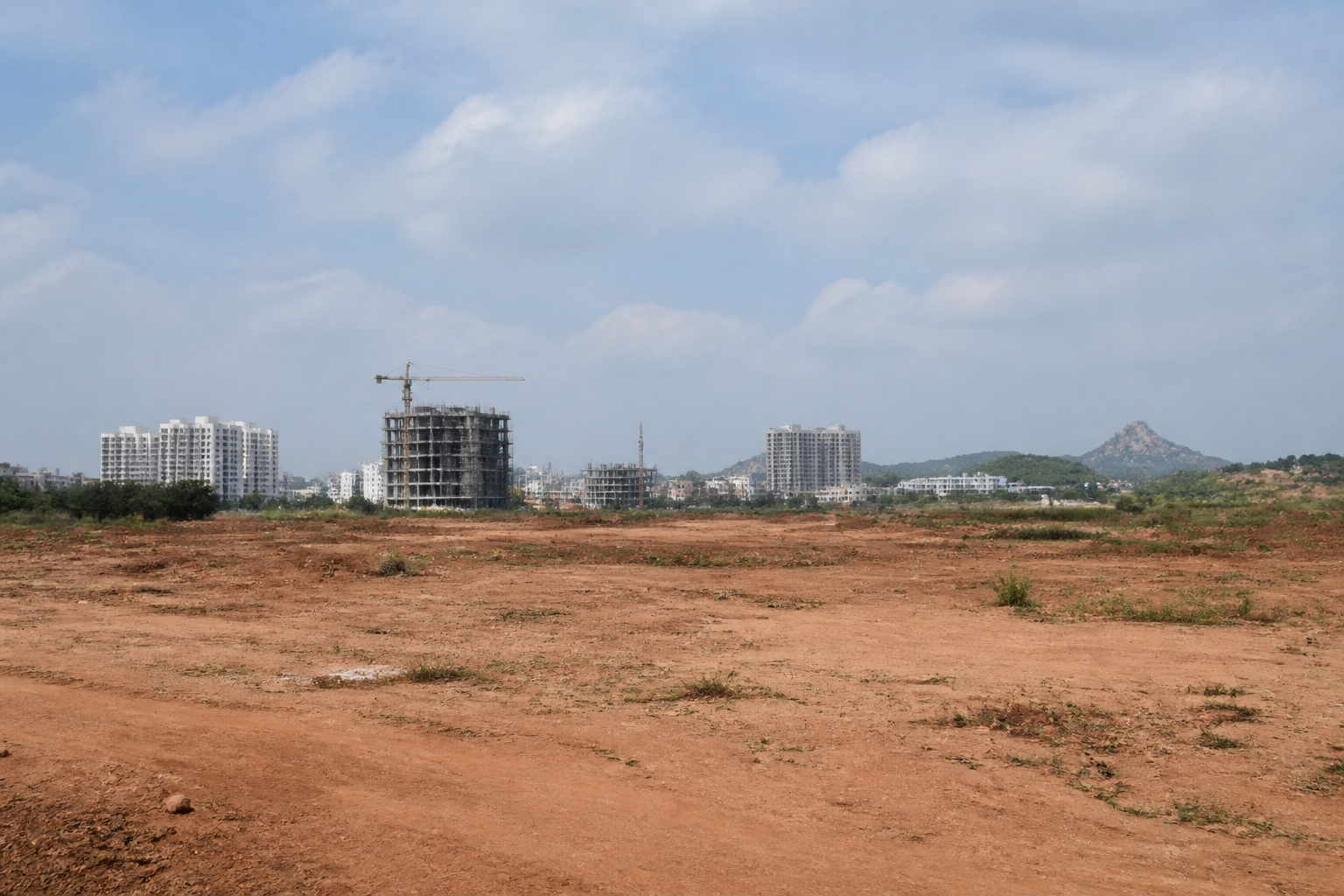
Bengaluru’s proposed international cricket stadium has moved closer to construction after the Karnataka Housing Board awarded a ₹990.16-crore contract to J Kumar Infraprojects Ltd. But the project’s next phase will depend on more than the conclusion of the tender process. Land acquisition, environmental approvals and the formal issue of a work order remain central to whether the proposed 80,000-seat facility can proceed on schedule.
The stadium is planned across 75 acres in Suryanagar Phase 4, in Anekal taluk, on the southern edge of the Bengaluru metropolitan region. The Karnataka Housing Board has estimated the overall project cost at ₹1,241 crore. Of that amount, ₹943.46 crore was identified as the estimated cost of the stadium’s infrastructure works when tenders were invited on April 8, according to the report by Vijay Karnataka.
Only two major infrastructure companies participated in the tender process. J Kumar Infraprojects submitted a bid of ₹1,127.90 crore, while NCC Ltd submitted a bid of ₹1,225.55 crore. The contract was ultimately awarded to J Kumar Infraprojects at a reduced value of ₹990.16 crore, making it the lowest bidder in the process.
The award, however, does not mean that construction has begun. The Karnataka Housing Board has not yet issued the work order. The project is being executed through an engineering, procurement and construction model, under which the selected contractor will be responsible for planning, design, infrastructure engineering, procurement and construction. The contractor will also be responsible for obtaining environmental approval, according to statements attributed to Housing Board officials.
That arrangement places the project at a point where contractual formalities and regulatory clearances must be completed before physical work can start. The Housing Board official quoted in the report said an agreement with the contractor must first be finalised, followed by approvals from the board and the state government. The official said the work order would be issued after these processes are completed.
The proposed stadium is being presented as a major sports infrastructure asset for Karnataka. With a planned capacity of approximately 80,000 seats, it would rank behind Ahmedabad’s Narendra Modi Stadium in capacity if completed as described. The foundation stone was laid on May 23 by former chief minister Siddaramaiah, according to the report.
The project’s financing model is different from a conventional state-funded capital project. The report says the state government is not providing a separate grant for the stadium. Instead, the Karnataka Housing Board plans to meet the cost through resources generated from the sale of its properties, including residential sites and houses. This means the project is tied to the board’s ability to mobilise funds from its own assets rather than relying on a dedicated budgetary allocation.
That financing structure also makes the project a housing-board infrastructure initiative rather than simply a sports department development. The Housing Board is using land and financial resources associated with its broader property portfolio to support a large public-facing facility. The available material does not establish the detailed cash-flow plan, payment schedule or financial safeguards for the stadium. Those details will be important in assessing how the project’s construction costs will be managed over time.
The more immediate complication concerns land. The stadium requires 75 acres. Of this, 53 acres and 14 guntas have reportedly been allocated from 401 acres and 31 guntas already acquired by the Housing Board in Indlawadi village, Anekal taluk. The adjudicated value for that land has been fixed at ₹95,52,328 per acre.
The report says that, under a 2020 government order and a 50:50 arrangement, landowners will receive developed sites as well as an advance payment of ₹20 lakh per acre. The remaining 21 acres and 26 guntas required for the stadium are being pursued through a fresh acquisition process in Indlawadi village. A preliminary notification has been issued under Section 11(1) of the land acquisition law, and the process of issuing a final notification under Section 15(3) is reportedly under way.
This means that the project has a tendered contractor but does not yet have the entire stated land requirement secured through a completed process. In infrastructure projects, the distinction matters. A tender award identifies the agency selected to undertake the work, while construction requires access to the site, a legally usable project area, approved designs, financial arrangements and regulatory permissions. The report indicates that several of these steps remain incomplete.
The land question has acquired greater significance because the High Court has reportedly quashed the acquisition of 1,938.13 acres obtained by the Karnataka Housing Board for the Suryanagar Phase 4 housing project. The report links that order to concerns regarding the project’s location within the 268.96-square-kilometre eco-sensitive zone of Bannerghatta National Park.
According to the report, the court order followed concerns that the acquisition process had not adequately considered scientific studies, environmental impact assessment and social and ecological factors identified by the Central Empowered Committee. The source material does not reproduce the court order or set out its complete legal reasoning, so the precise scope of the judgment and its application to the stadium site require examination of the primary documents.
The Housing Board official quoted by Vijay Karnataka said the court order would not affect the entire housing project area and that construction of the stadium would begin within two months. The official also said the project had been given three years for completion. These statements establish the board’s current position, but they do not by themselves resolve the legal and regulatory questions surrounding the land still required for the stadium or the environmental approvals to be obtained.
This is the central tension in the project. The stadium is being advanced as a time-bound infrastructure development, yet its site forms part of a larger landscape where land acquisition and ecological scrutiny have already become legally contested. The proposed facility may occupy only 75 acres, but its implementation cannot be separated entirely from the planning and environmental history of the wider Suryanagar Phase 4 area.
The project also illustrates how large urban facilities are assembled at the metropolitan edge. A stadium of this scale is not only a building. It requires a legally secure site, road access, utilities, parking and crowd-management systems. The supplied report provides details about the land area, tender value, capacity and approval process, but it does not specify the planned road network, public transport connections, parking capacity, water supply, sewage arrangements or emergency-access strategy.
Those missing details are significant because an 80,000-seat venue would create concentrated demand on event days. The available material does not state how many events are expected, how spectators would travel, or which agency would be responsible for managing transport and public services around the venue. These questions should form part of subsequent scrutiny, particularly because the site is located in Anekal taluk rather than in Bengaluru’s established central sports precinct.
The project’s governance structure is also important. The Housing Board is simultaneously the land-owning and implementing institution described in the report, while the selected contractor is responsible for the engineering and procurement package. The state government must approve the agreement before the work order is issued. Environmental approval is to be obtained by the contractor. This creates a chain of institutional responsibilities that will need to be tracked as the project moves from tender award to execution.
At present, the evidence confirms four developments: the stadium has a planned capacity of about 80,000 seats; a ₹990.16-crore construction contract has been awarded to J Kumar Infraprojects; 75 acres have been identified for the facility, with part of the remaining land still under acquisition; and construction has not begun because the work order and related approvals are pending.
What remains uncertain is equally important. The supplied report does not establish when the final land acquisition notification will be issued, whether all environmental permissions will be granted, when the contract agreement will receive board and government approval, or whether the stated three-year completion period will begin immediately after the work order. It also does not provide the final project design, construction schedule, funding milestones or the legal documents governing the site.
The next phase will therefore determine whether the tender award becomes a functioning public asset or remains an incomplete administrative milestone. The Karnataka Housing Board’s agreement with the contractor, government approval, environmental clearance, final land acquisition steps and issue of the work order are the immediate developments to monitor. Only after those conditions are met will construction of Bengaluru’s proposed international cricket stadium formally begin.
