


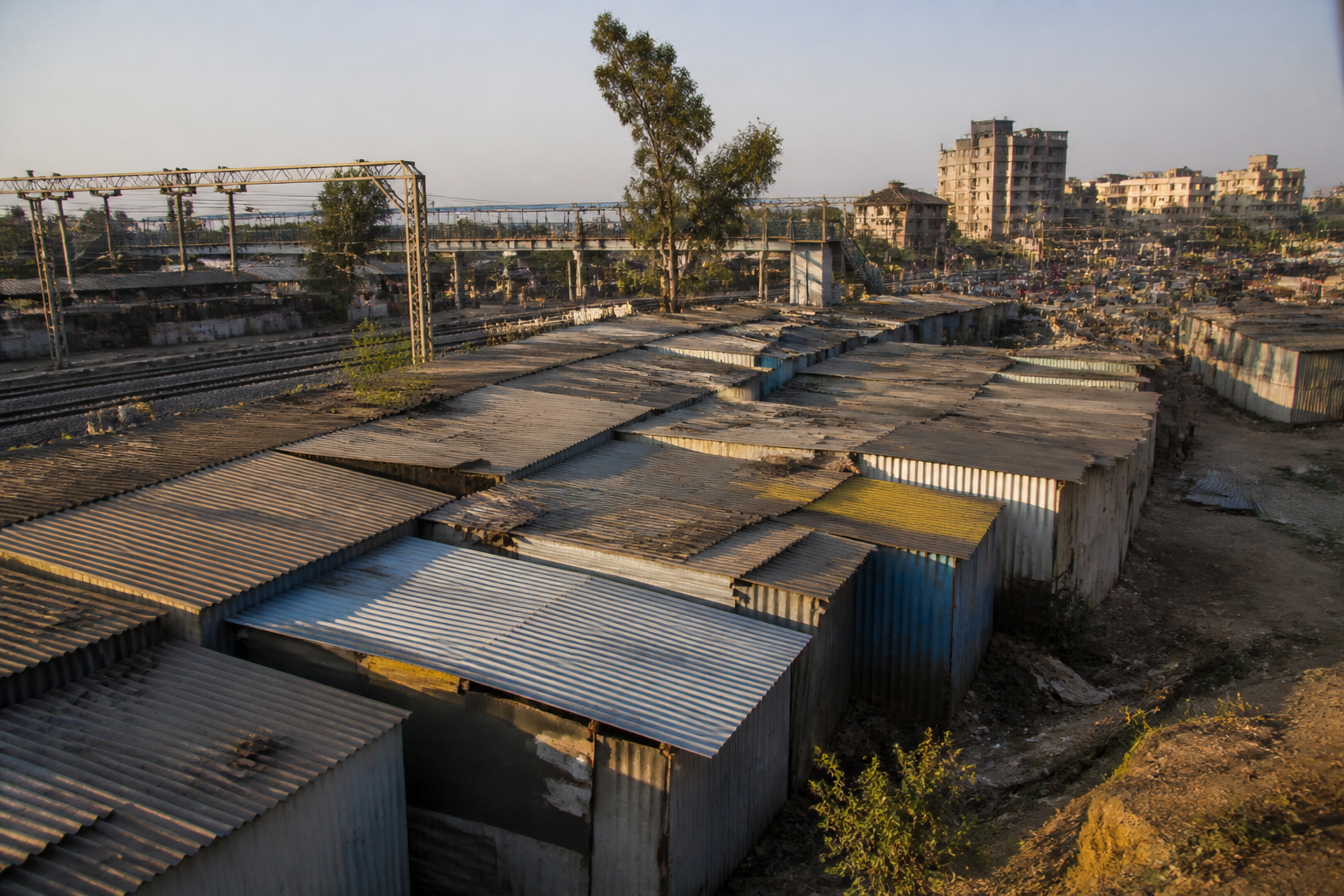
The Bombay High Court’s refusal to grant interim relief to the developer of 54 commercial sheds near Boisar railway station has moved the dispute from a question of temporary legal protection to a test of administrative enforcement. The sheds, located on a strategically placed plot within Boisar gram panchayat limits, have been held unauthorised by the Palghar tehsildar, the district court and, at the interim stage, the High Court.
The immediate legal position is relatively clear. The High Court has declined to protect the construction while the challenge proceeds, leaving the Palghar administration free to act on the tehsildar’s order of February 3, 2026. Yet the physical action has not followed the sequence of adverse orders. The tehsildar has told Loksatta that the administration is waiting for police security and other manpower before proceeding.
That gap between an order and its execution is the central urban issue in the Boisar illegal construction case. The dispute is not only about 54 sheet-metal structures. It concerns which authority can permit construction, whether a local no-objection certificate can be treated as development approval, and what happens when enforcement is delayed even after multiple courts refuse interim protection.
According to the report, the property lies in Group No. 100 and was purchased on June 22, 2023. The property records included old house numbers 460 to 462. On October 7, 2024, the Boisar gram panchayat issued a no-objection certificate connected with construction at the site. The structures subsequently erected were described as 54 commercial sheet sheds, each reportedly measuring six metres by three metres. The report also refers to construction over an area recorded as 21.25 square metres in the tehsildar’s order, although it does not explain how that figure relates to the 54 sheds.
The administrative objection was that the construction had not received permission from the competent authority, identified in the report as the Palghar district collector. The tehsildar issued a notice on July 17, 2025, asking the parties to explain the construction. In response, the developers sought regularisation within the framework of law. The tehsildar did not accept that position and, on February 3, 2026, ordered that the unauthorised structures be removed within seven days. The order warned that the administration would carry out the removal if the parties did not act themselves.
The dispute then moved through successive layers of litigation. The developers challenged the tehsildar’s order before the lower civil court and sought temporary protection. That request was rejected. An appeal before the Palghar district and sessions court was also dismissed, leaving the tehsildar’s decision in place. The parties subsequently approached the Bombay High Court through Writ Petition No. 9692 of 2026.
The High Court challenge reportedly questioned the tehsildar’s jurisdiction and sought protection for the structures. A single bench of Justice N. J. Jamadar rejected the petition and declined an oral request from the petitioners’ lawyers to extend interim relief. The court also referred to Supreme Court rulings while observing, according to the report, that construction raised in disregard of regulatory requirements cannot be accepted and that courts should not show excessive sympathy in such cases.
The court’s refusal to continue interim protection is important, but it should not be confused with a complete account of the site’s regulatory status. The available report establishes the orders and the refusal of temporary relief. It does not reproduce the full High Court judgment, the planning regulations applicable to the parcel, the exact land-use classification or any final determination on every issue raised in the writ petition. Those details would be required to assess the broader legal consequences of the case.
The dispute highlights a recurring administrative distinction in urban development: a local body’s no-objection certificate is not necessarily the same as permission from the planning or land-use authority competent to approve construction. In this case, the report says the gram panchayat did not possess planning authority for the work in question. The alleged reliance on its NOC therefore became a central part of the dispute, while the revenue administration treated the absence of approval from the competent authority as decisive for enforcement.
This distinction matters especially in fast-growing settlements around railway stations and industrial corridors. Such locations create strong commercial incentives to use land intensively and quickly. Small sheds can be presented as temporary or low-impact structures, but a large cluster of commercial units can change traffic patterns, servicing requirements, pedestrian movement and the demand for water, sanitation, electricity and waste collection. The report does not provide evidence on the sheds’ occupancy or operations, so the direct effects on tenants and customers remain unclear. It does, however, place the structures near a railway station, making the location relevant to the management of public access and surrounding land use.
The case also shows how enforcement can become fragmented. The gram panchayat was involved at the local level through the reported NOC. The tehsildar acted under the revenue administration. The district court considered the challenge to that action, and the High Court reviewed the subsequent petition. Each institution dealt with a different part of the dispute, but the responsibility for physical removal remains with the administration, which says it needs police protection and manpower.
That requirement is not unusual in contested demolition or eviction operations. Officials may need security, equipment, personnel, notice procedures and coordination across departments. However, the longer an order remains unimplemented, the greater the possibility that commercial activity, occupation or third-party interests will become embedded at the site. The report does not state whether the sheds are occupied, rented or operating, nor does it provide a revised enforcement date. These are significant gaps in understanding the current situation.
The legal chronology also underlines the cost of delayed clarity. The notice was issued in July 2025, the removal order followed in February 2026, and the matter then passed through the lower court, the district court and the High Court. At each stage, the applicants sought protection and, according to the report, were unsuccessful. The case therefore illustrates how an apparently local construction dispute can remain unresolved on the ground even after the principal interim remedies have failed.
For Palghar’s expanding urban settlements, the larger question is whether construction control is being exercised before structures are built or only after disputes reach the courts. Preventive scrutiny of permissions, land records and development authority jurisdiction can reduce the need for later enforcement. Once commercial structures are established, authorities must manage not only the legality of the building but also the practical consequences for occupants, nearby residents, access routes and public services. The supplied report does not establish whether such preventive checks were attempted or why the construction proceeded after the alleged lack of competent approval.
The Boisar case therefore confirms one point and leaves several others open. It confirms that the tehsildar’s removal order has survived challenges for interim protection in the courts described by the report. It also confirms that the administration has not yet carried out the reported removal, citing the need for police security and manpower. What remains uncertain is the execution timetable, the status of the sheds and the full reasoning contained in the High Court’s order. The next significant development will be the Palghar administration’s decision on when and how it implements the February 3 order.
