


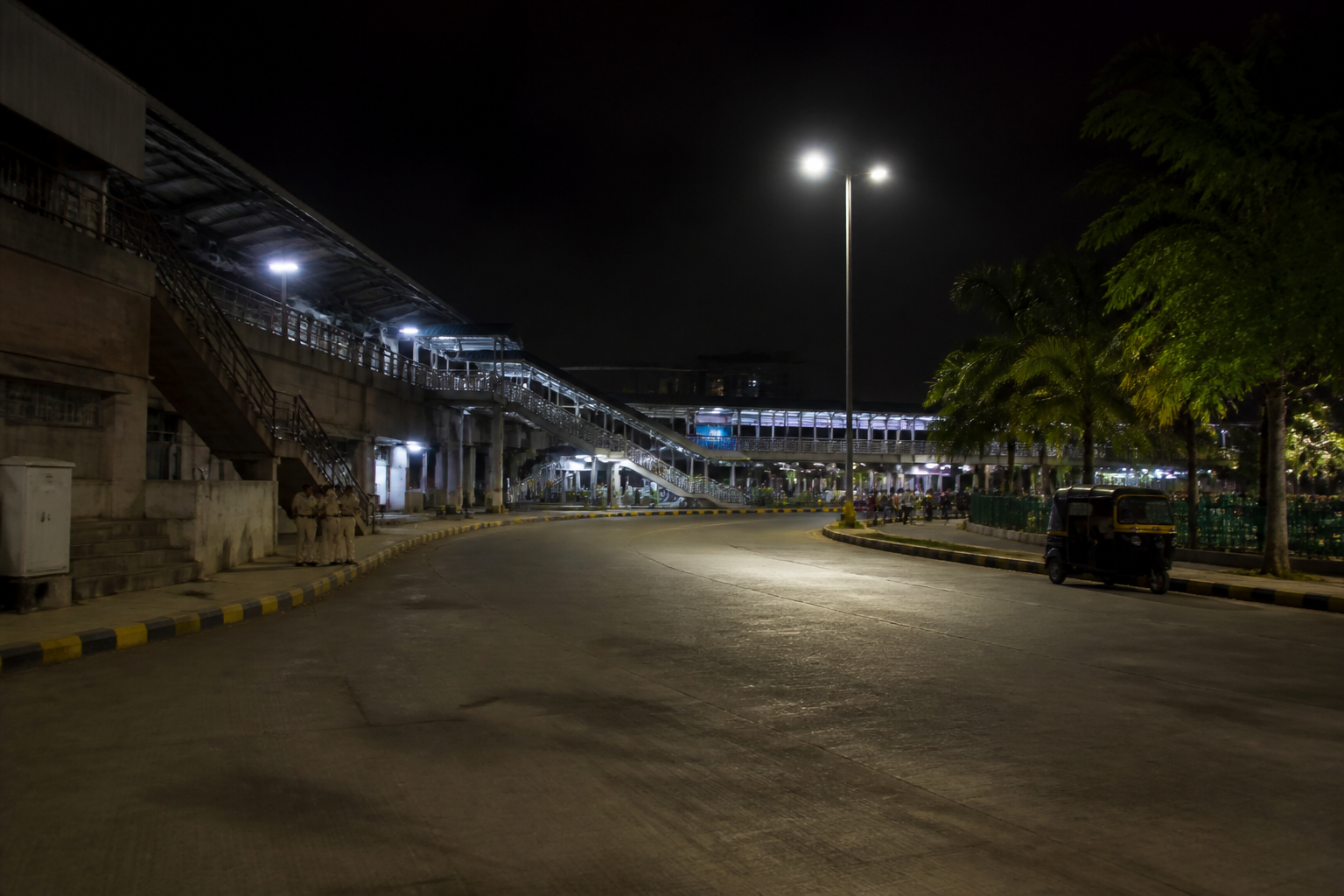
A joint midnight operation at Nerul railway station has brought renewed attention to a recurring urban problem in Navi Mumbai: how public authorities manage station surroundings that are used for passenger movement by day but become vulnerable to disorder, substance use and unsafe activity at night. The action removed homeless people and people described in the report as drug users from the station and inspected suspected locations on both the eastern and western sides of the station.
The operation was conducted between 11.30 p.m. on September 1 and 1.30 a.m. on September 2 by the Navi Mumbai Police, the Navi Mumbai Municipal Corporation and CIDCO. According to the report, the police initiated the action after complaints about alcohol-related nuisance, drug consumption and sale, gutkha sales and disputes involving passengers in and around Nerul station in Sector 20.
The immediate event was a coordinated enforcement drive. The larger urban question is whether such drives can produce sustained safety when station environments contain open spaces, underused corners and poorly monitored areas that can repeatedly attract activities authorities regard as illegal or disruptive. The available report records the operation and the police position, but does not establish how many people were removed, whether arrests or prosecutions followed, or whether any rehabilitation or support services were offered to those identified as homeless.
That distinction matters. A station precinct is not only a transport facility. It is also a public interface where passengers encounter roads, footpaths, bridges, open land, commercial activity, municipal services and security arrangements. Responsibility is therefore divided. In this case, the police led the operation, while NMMC and CIDCO participated. The need for a joint drive itself indicates that managing the space involves more than policing alone.
The complaints reported at Nerul were linked to several different categories of activity: public drinking, drug consumption and alleged sale, gutkha sales, arguments with passengers and general nuisance. These concerns may overlap in the experience of commuters, but they require different administrative responses. Criminal activity requires investigation and enforcement. Unauthorised vending requires municipal or regulatory action. Homelessness raises questions about shelter, outreach and social assistance. Poorly lit or inactive spaces require maintenance, surveillance or changes in how the area is designed and used.
Treating all of these issues as a single problem of removal can make an operation visible without making its outcomes measurable. The report says that homeless people and drug users found in the station area were removed and that eviction action was taken at relevant locations. It does not provide details on where those people went, whether the action was repeated elsewhere, or what mechanism would prevent their return. Those unanswered questions are central to judging whether the operation addressed the problem or displaced it.
The police say the Nerul action followed letters sent earlier to the relevant departments. Deputy Commissioner of Police Amit Kale said that similar action is carried out from time to time at railway stations and that further drives would continue. The report also cites an operation conducted two months earlier at Seawoods, Kille Gaothan and beneath the Belapur flyover, involving about 150 police personnel and action against 400 people.
That earlier figure provides a measure of enforcement activity, but not of long-term effectiveness. The number of people acted against can show the scale of a drive; it cannot by itself show whether passenger safety improved, whether reported offences declined or whether the affected locations remained clear. No such follow-up figures are provided in the supplied material. Without repeated measurements, enforcement numbers risk becoming an account of activity rather than an assessment of outcomes.
The timing of the Nerul operation is also significant. It took place over two hours in the middle of the night, when passenger movement is lower and the visibility of station surroundings may be reduced. The report identifies open spaces, areas beneath bridges and dark corners as locations that can be used for prohibited activity. These are not merely policing concerns. They point to the relationship between the physical form of a station precinct and the way it is occupied after regular commuter activity declines.
A space that is busy, visible and actively maintained is likely to be easier to monitor than one that is dark, vacant or separated from surrounding streets. However, the supplied report does not contain information about lighting levels, CCTV coverage, patrol frequency, access points, design features or maintenance conditions at Nerul station. It is therefore not possible to conclude which physical interventions would work there. What can be established is that authorities themselves have identified the management of such spaces as a continuing requirement.
Nerul also illustrates the institutional complexity of railway-adjacent urban areas. The police can conduct searches, maintain order and investigate offences. The municipal corporation can address sanitation, public-space management and civic enforcement. CIDCO, as the development authority involved in Navi Mumbai’s planned urban landscape, may control or manage land and infrastructure in parts of the area. The railway station and its immediate operational assets may involve additional authorities, although the supplied report does not specify their role in this operation.
This division of responsibility can create gaps even when agencies cooperate during a special drive. A police action may remove people from a location, but regular surveillance, lighting, cleaning, access control and social support depend on continuing coordination. The report’s call for regular monitoring by NMMC and CIDCO, along with sustained police patrols and inspections, reflects that operational reality. The central test is not whether agencies can assemble for a midnight action, but whether they can maintain a shared system after the operation ends.
The question of homelessness requires particular care. The report groups homeless people with people described as drug users in its account of those removed from the station precinct. These are not identical categories. A person without shelter may be using a station area for survival, while drug consumption or sale involves a separate public-safety and legal issue. The source does not state whether homeless people were connected to shelters, welfare services or outreach teams. That omission limits what can be said about the social consequences of the action.
The same caution applies to the phrase “action” against 400 people during the earlier operation. The report does not specify whether this meant detention, removal, prosecution, seizure of goods or another form of enforcement. Precision is important because different forms of action have different implications for accountability and future prevention. A removal drive and a criminal investigation should not be treated as equivalent outcomes.
What the available evidence does show is a pattern of recurring intervention. Nerul followed complaints previously reported by Loksatta, while the police referred to earlier actions at other Navi Mumbai locations and said that such drives would continue. This suggests that authorities see station precinct disorder as a repeated urban-management concern rather than an isolated incident. It does not, however, establish whether the problem is increasing across Navi Mumbai or whether the same individuals and locations are involved repeatedly.
There is also no evidence in the supplied report to quantify the effect on commuters. The complaints indicate that passengers experienced nuisance and conflict, and the operation was intended to reduce those problems. But no passenger-safety data, complaint figures, crime statistics or before-and-after assessment is provided. Future evaluation would require authorities to publish clearer information on the locations inspected, violations found, action taken, repeat incidents and the condition of the precinct after the drive.
For urban governance, the Nerul case therefore presents a narrow but important lesson. Enforcement can be necessary when public spaces are associated with drug sales, violence, nuisance or threats to commuters. Yet enforcement is only one layer of station-area management. The effectiveness of the response depends on whether the physical environment is monitored, whether agencies act within clearly defined responsibilities, whether vulnerable people are dealt with through appropriate support systems, and whether results are tracked beyond the night of the operation.
The immediate facts are clear: police, NMMC and CIDCO conducted a joint operation at Nerul railway station after complaints about disruptive and allegedly illegal activity; people identified as homeless or drug users were removed; and surrounding locations were inspected. What remains uncertain is the duration of the effect, the legal outcome of the action, the destination and support available to those removed, and the role of station authorities in maintaining the area.
The next phase will be measured by the authorities’ stated intention to continue patrols, inspections and inter-agency action. Regular surveillance of open spaces, areas beneath bridges and dark corners will determine whether the operation becomes part of a sustained public-space management system or remains a temporary response to recurring complaints.
