


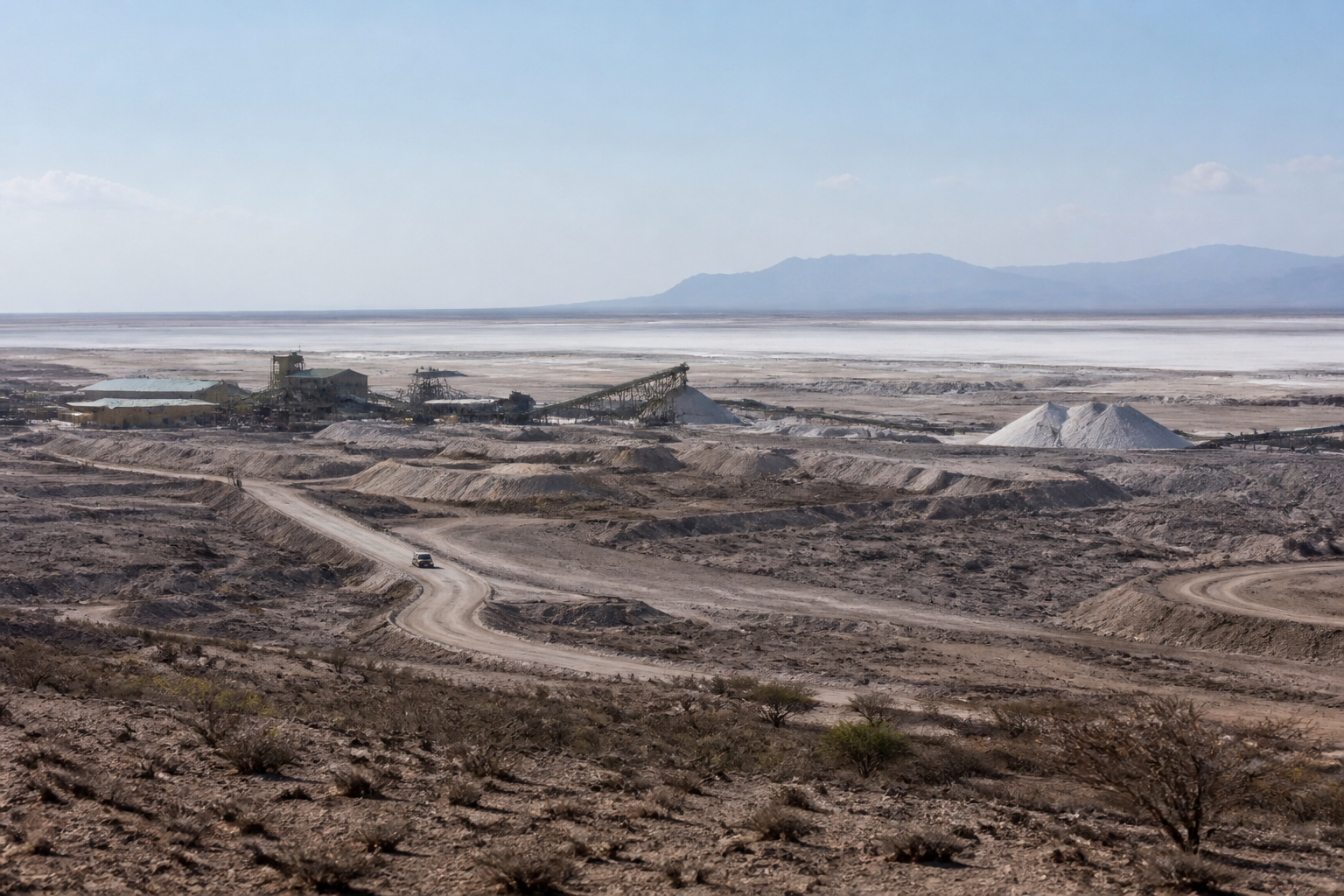
Kenya’s order for Tata Chemicals to stop operating at its Magadi soda ash business is more than a dispute over a mining licence or unpaid obligations. It is a test of what a resource-producing community can demand from a company that has extracted and exported minerals for decades.
During a visit to Kajiado County, President William Ruto said Tata Chemicals had held a 100-year contract but had not built a factory in the area. He said the company’s operations had failed to benefit Kenya sufficiently and questioned whether the country was “slaves to other people”. Ruto said the government would bring in two new companies: one to establish a large glass manufacturing business in Kajiado and another to produce chemicals locally.
The remarks escalated a dispute that began with the suspension of Tata Chemicals Magadi Limited’s mining operations on July 28. Kenya’s Mining Cabinet Secretary Hassan Joho had ordered the suspension after the government cited unresolved questions involving royalties, export reporting, mineral beneficiation, community development agreements, local employment, skills transfer, procurement and environmental compliance.
Tata Chemicals has disputed the suggestion that it has failed to meet its obligations. In its latest statement, the company said its Kenyan subsidiary had submitted all the information, reports and documents requested by the Ministry of Mining, Blue Economy and Maritime Affairs on August 11. It said the submissions addressed the ministry’s concerns about regulatory compliance and that the company was waiting for the government to review its response and issue further directions.
The company’s position is that the Magadi operation has contributed substantially to the Kenyan economy since Tata Chemicals acquired the plant in 2005. It said the business supports about 500 employees and their families, as well as contractors, suppliers, transporters and local businesses. Tata Chemicals also said approximately 30,000 people in the Magadi community benefit directly from support for water, healthcare, education, infrastructure and community development.
Those figures are company-provided claims, but they point to the central complexity of the dispute. A major industrial operation can support local livelihoods and public-facing services while still facing demands for greater local employment, procurement, manufacturing and community participation. The argument in Magadi is therefore not simply about whether the business creates economic activity. It is about who captures the value generated by a natural resource and where that value is realised.
Tata Chemicals Magadi produces soda ash, or sodium carbonate, from trona, a naturally occurring mineral found at Lake Magadi. Soda ash is used in glass, detergents, other chemicals and water treatment. The company describes the operation as one of Africa’s leading natural soda ash manufacturers and says it exports more than 350,000 tonnes annually to markets in Southeast Asia, India, the Middle East and Africa.
That export profile helps explain Kenya’s demand for local value addition. Soda ash is an industrial input rather than a finished consumer product. Kenya’s government now wants the resource to support manufacturing closer to the point of extraction, particularly glass production and chemical manufacturing in Kajiado. Such a shift would change the role of Magadi from an export-oriented mining and processing site into part of a broader industrial chain within the country.
The government’s list of concerns covers much more than manufacturing. It includes the reconciliation and payment of royalties, the accuracy of export reporting, compliance with mineral-beneficiation rules, community development agreements, Kenyan employment and skills transfer, local procurement and environmental requirements. Taken together, the list shows that the dispute concerns the full operating framework around the mine: public revenue, local economic participation, social obligations, environmental management and the legal basis for continued extraction.
Kenya’s mining ministry said it had been engaging with Tata Chemicals for years over the company’s statutory obligations. It required the company to submit documents showing full compliance and address outstanding liabilities before operations could resume. Tata Chemicals, meanwhile, said it was fully compliant with the relevant regulations and would work with the authorities to find an amicable and speedy solution.
The suspension has already affected soda ash exports from the facility. That gives the disagreement consequences beyond the mine boundary. The operation connects the Lake Magadi site to international industrial markets, while its local economic effects run through employees, contractors, transporters, suppliers and community services. A prolonged shutdown would therefore involve both a regulatory confrontation and a disruption to an established production and export network.
The operation’s history adds another layer. Soda ash production at Lake Magadi began in 1911, when the business operated as the Magadi Soda Company. Tata Chemicals acquired the business in 2005. The length of that operating history is central to the political argument now being made by the Kenyan government: an enterprise with more than a century of industrial presence is being asked to demonstrate not only continuity, but a deeper and more visible contribution to the host region.
The dispute has also entered the courts. Tata Chemicals challenged the July suspension and sought relief against the government’s decision, but Kenya’s High Court declined to lift it. The court said the decision had already taken effect when the company approached it. The government argued that Tata Chemicals had received earlier notices regarding its obligations and that the company did not have a current mining licence because its application was still being processed.
A Kenya Gazette notice recorded Tata Chemicals Magadi’s application for a mining licence covering approximately 63.5 square kilometres in Kajiado County for soda ash. The licensing question is separate from, but connected to, the broader compliance dispute. Even if the company’s position on particular obligations is eventually accepted, the status of its licence and the government’s regulatory process remain important to the future of the operation.
There is also a separate legal history involving land rates. Tata Chemicals disclosed in 2025 that Kenya’s Court of Appeal had ruled in its favour in a dispute over land rates raised by the Kajiado County government. The court held that the demand was arbitrary and illegal and that TCML was not required to pay the claimed land-revenue arrears without an open and accountable framework for determining the rates.
That ruling does not resolve the present confrontation. The current dispute, as described by the mining ministry, involves royalties, exports, beneficiation, community agreements, employment, procurement and environmental compliance. The two cases illustrate how resource projects can face overlapping relationships with national ministries, county governments, local communities and courts. Each institution may exercise a different form of authority over the same industrial site.
For Kajiado, the question is whether the presence of a long-running extraction business has translated into a sufficiently broad local economy. Ruto’s proposal to bring in companies for glass and chemical manufacturing suggests that the government sees the existing model as incomplete. Its stated objective is not merely to restart mining, but to connect mineral production with factories, jobs and investment in the area where the resource is found.
Residents have not presented a single position in the material supplied for this story. Some Magadi residents welcomed the July suspension and raised concerns about employment, community participation and local benefits. Tata Chemicals has emphasised the people and businesses that depend on its operations, as well as its support for community services. These positions reveal the gap between aggregate economic contribution and the distribution of benefits at community level.
The immediate uncertainty is institutional rather than geological. Tata Chemicals says it has submitted the requested information and is waiting for the ministry’s review. The president, however, has moved beyond a call for compliance and said the company should be replaced. The government’s next steps will determine whether the dispute remains a regulatory process, becomes a legal battle over the company’s operating future, or leads to a restructuring of the industrial model around Lake Magadi.
What the Magadi case already establishes is a wider policy conflict. Resource extraction can generate exports and sustain a network of workers and suppliers, but host governments may increasingly demand local manufacturing, stronger community agreements, domestic skills development and clearer environmental accountability. The unresolved question is whether those demands can be reconciled with the company’s compliance claims and the legal procedures governing the mining licence.
For now, Tata Chemicals says it remains committed to constructive engagement through legal and regulatory channels and to the well-being of its employees, the Magadi community and other stakeholders. Kenya’s review of the company’s submissions, the status of the mining licence and the government’s plans for potential replacement companies are the next developments that will clarify the future of the operation.
