


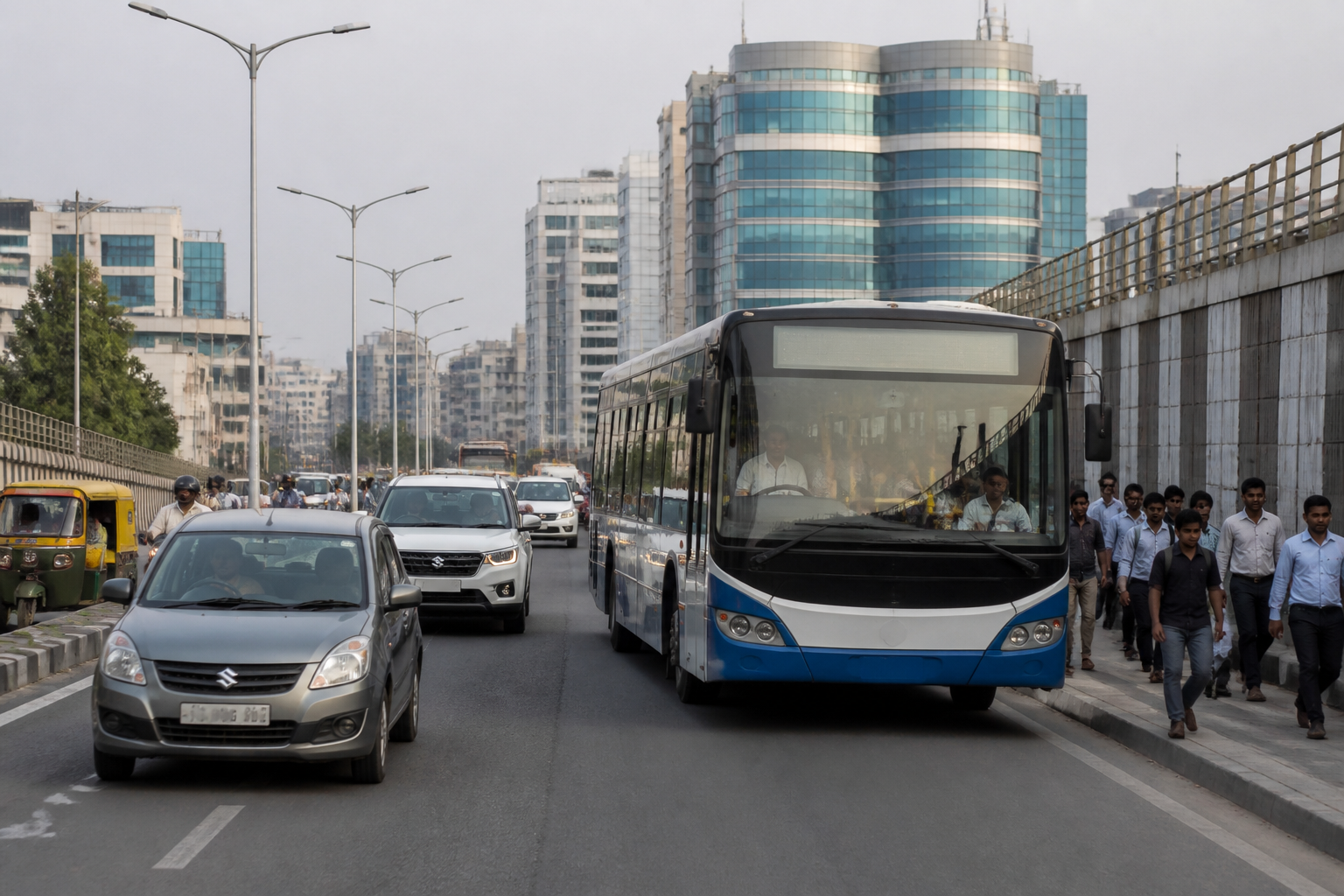
A new study by the Council on Energy, Environment and Water (CEEW) places everyday travel behaviour at the centre of the G20’s transport-emissions challenge. Its modelling suggests that more carpooling, sustained hybrid work and higher bus ridership could reduce annual passenger-transport emissions from G20 countries by 15-20 per cent by 2050.
The study, titled Mitigation Potential of Behavioural Change in Passenger Transport in G20 Countries, estimates that the three interventions could together save about 538 million tonnes of carbon dioxide (MtCO2) every year in 2050 under its higher-impact scenario. That would be roughly one-fifth of the G20’s passenger-transport emissions under a business-as-usual pathway.
The significance of the findings lies in what they measure. The analysis does not depend only on replacing petrol and diesel vehicles with cleaner technologies. It examines how often people travel, how many people occupy each car and which modes they choose. In doing so, it treats transport demand and urban mobility systems as part of the emissions problem, rather than focusing exclusively on vehicle technology.
The study estimates that these behavioural shifts could produce cumulative savings of 5.7-8 gigatonnes of CO2 between 2025 and 2050. CEEW says that is equivalent to around 5-6 per cent of the remaining carbon budget associated with limiting global warming to 1.5 degrees Celsius. The figures are modelled estimates, not measurements of emissions already avoided, but they indicate the scale that transport behaviour could have in national climate strategies.
Carpooling has the largest standalone potential among the three measures examined. If average car occupancy rises by 50 per cent from current baseline levels, the study estimates annual savings of about 237 MtCO2 in 2050. If countries converge towards the same average car occupancy, the potential rises to around 411 MtCO2.
That potential is concentrated in places where private cars dominate mobility. Developed countries and China account for around 90-92 per cent of the estimated carpooling savings, according to the study. Their higher levels of car ownership and lower average occupancy create more scope to reduce emissions by ensuring that existing vehicle trips carry more passengers.
The distribution of potential is important because it challenges the assumption that the same transport intervention has the same value everywhere. A carpooling strategy in a highly motorised economy addresses underused private-vehicle capacity. In a country where car ownership is still relatively low, the immediate opportunity may instead be to provide reliable public transport and prevent future dependence on private vehicles.
CEEW Senior Fellow Vaibhav Chaturvedi told NDTV that the findings provide global evidence for the idea behind India’s Mission LiFE, which seeks to connect climate action with responsible consumption. He described the results as a call for smarter cities, better workplaces, cleaner mobility and lower oil dependence.
Hybrid work represents the second major area of potential. The study estimates that reducing commuting intensity could cut G20 passenger-transport emissions by 322 MtCO2 in 2050, or about 12 per cent compared with the business-as-usual scenario. The model does not assume that all employees work remotely every day. Instead, it examines sustained reductions in commuting, including working from home for part of the week.
More than 65 per cent of the estimated hybrid-work savings would come from developed countries and China. China accounts for about 96 MtCO2 of the reduction, followed by the United States at around 45 MtCO2 and the EU-15 at roughly 32 MtCO2. These figures again reflect the relationship between existing travel patterns and potential reductions: the largest absolute gains are expected where commuting volumes and motorised travel are already high.
Hybrid work also exposes the connection between workplace organisation and urban infrastructure. Daily commuting is often treated as an individual routine, but at metropolitan scale it determines peak-hour demand, road congestion, fuel use and pressure on public transport. The CEEW modelling does not establish how employers or governments would maintain hybrid-work arrangements, but it quantifies the emissions effect of reducing the frequency of work-related travel.
The third intervention is a shift towards buses. Here, the study’s findings are more limited than for carpooling or hybrid work. In the high-bus scenario, increased preference for buses produces emissions reductions ranging from 0.4 per cent to 6.7 per cent, depending on the country. Across the G20, the study estimates up to 54 MtCO2 in annual savings.
The results suggest that buses can contribute to lower emissions, but that shifting passengers to buses alone will not deliver the same scale of reductions as changing car occupancy or reducing commute frequency in heavily car-dependent economies. The effect of bus use depends on the existing transport system, the number of passengers shifted and the emissions associated with the vehicles being replaced.
This is particularly relevant for India, where the study identifies a different starting point from that of richer economies. In 2024, developed countries and China represented 34 per cent of the world’s population but accounted for more than 60 per cent of global road-transport emissions, according to the study. India’s motor-vehicle ownership was estimated at around 33 vehicles per 1,000 people, compared with 860 in the United States, 704 in France and 223 in China.
Those figures limit India’s near-term potential for reducing emissions by changing already-established car-heavy lifestyles. They also point to a different urban policy question: whether Indian cities can expand mobility without reproducing the levels of private-vehicle dependence seen in more motorised economies.
The study estimates India’s hybrid-work potential at roughly 71 MtCO2 in 2050, largely because of the country’s population size. However, its per-capita savings potential remains much lower than that of richer, more car-dependent economies. CEEW Programme Associate Rohini Dikshit told NDTV that the geography of emissions savings matters because developed countries and China have greater absolute potential while India’s per-capita potential is lower.
Dikshit said India and other developing countries have an opportunity to avoid future lock-in to private-vehicle dependence, while richer economies need to treat behaviour change as a near-term climate-mitigation lever. The distinction separates two policy tasks that are often combined: reducing emissions from existing high-carbon mobility systems and designing growing cities so that those systems do not become permanently car dependent.
The combined scenarios reinforce that difference. The United States and EU-15 account for 61-63 per cent of the total estimated savings, while developed countries and China account for 80-88 per cent overall. These concentrations mean that the global emissions impact of behavioural change will be shaped substantially by decisions in high-emitting economies, even as developing countries build new transport infrastructure and urban districts.
For cities, the evidence links climate policy to decisions that are usually handled by separate institutions. Employers influence commuting patterns. Transport authorities determine the availability and reliability of buses. Urban planners influence the distance between homes, workplaces and services. Households decide whether shared mobility is practical. The study models the emissions potential of these changes, but does not claim that behaviour will shift automatically without supporting systems.
The policy landscape therefore extends beyond climate departments. Higher bus ridership requires public transport that can attract and retain passengers. Carpooling requires conditions under which sharing a trip is convenient and dependable. Hybrid work depends on workplace practices that reduce commuting without simply shifting travel to other purposes. The supplied study does not provide a detailed implementation framework, funding model or institutional roadmap for these interventions.
What it does establish is the scale and uneven geography of the opportunity. The largest absolute reductions are associated with economies that have high car ownership, low average vehicle occupancy or substantial commuting volumes. India’s larger strategic opportunity is to expand access to mobility while avoiding a future in which rising incomes translate directly into rising private-vehicle dependence.
The evidence also places limits on broad claims about public transport. Buses can reduce emissions, but the modelled reductions vary widely across countries and remain below the potential estimated for carpooling and hybrid work in the higher-impact scenarios. The results do not support treating a single intervention as sufficient. Passenger transport emissions respond to a combination of travel demand, occupancy, mode choice and the structure of cities and workplaces.
The CEEW study ultimately reframes transport decarbonisation as both a technology question and a demand question. Cleaner vehicles remain outside the specific interventions examined here, while the reported estimates focus on how people travel and how frequently they need to travel. For G20 cities, the central issue is not simply whether mobility becomes cleaner, but whether urban systems can deliver access with fewer vehicle kilometres and more efficient use of existing capacity.
The study confirms substantial modelled emissions-saving potential from carpooling, hybrid work and bus use, while the exact gains differ sharply across countries. What remains uncertain from the supplied material is how quickly these behaviours can be sustained and what institutional changes would be required. Future assessments will need to track whether cities can convert this potential into durable changes in commuting, vehicle occupancy and public-transport use.
